Sunday, October 06, 2013

Homage to Harian


Today Ojak Silaban posted pictures of Sihol and her children on Facebook. I look at the beautiful children. Sihol’s grandmother would have been proud of them. I remember weaving with her one afternoon when the sound of church bells came wafting over the rice field. Ompu ni Sihol sat up and took notice. Someone had died. It was a child. We walked over and visited the mourners and I saw the deep sadness in Ompu ni Sihol’s face. I do not know how many of her own children she had buried, but only one son had survived. How thrilled she would have been to have had these healthy, smart, great grandchildren!

The ‘Back to the Villages’ expedition with Rangsa ni Tonun had to include Ompu ni Sihol’s village in Harian Boho to pay homage to the woman who had provided ‘The Weaving Song, the theme song of the film. I had taped her in 1980 while she sang and reeled yarn to demonstrate the use of the iraniran, or Batak reel. Thirty years later, Suarasama made a musical arrangement for it and performed it for our film.

On 16 September, 2013, our boat sailed toward Harian Boho and we docked at  the empty marketplace.

See how barren the hills have become. They used to be covered in forest growth.
Se
MJA Nashir took these beautiful photographs of our approach to Harian Boho and our boat at the dock.
It wasn’t market day and the morning market was over, too. The last time Nashir and I had been there was 2010. We knew our way to the coffee-tent, but it was a very hot day and there was almost nobody there. That had been one venue that we had considered for showing the film. There was no need to say anything to each other. We knew it wouldn’t work.

We started to climb the path to Ompu ni Sihol’s village. It was a path that I used to love to walk in the cool, verdant forest. It took me through rice fields first and then along a stream. I had had to wind my way around megaliths and huge tree roots. How I wish I could have given my team that experience, but the modern path is flat and paved and straight. And so hot under the tropical sun! So many of the Batak villages have used heavy equipment to shift the rocks and have poured concrete mortar between them to make flattened stretches that are easily negotiated on foot and by motor vehicle. Modern, maybe, but no longer delicious.

We finally found Ompu ni Sihol’s village, deserted and empty. Her son’s house is still standing and he was there with his very young granddaughter. 
Ompu ni Sihol's son's house. It was once a traditional Batak house but had been cut down to make a modern bungalow. 

Ompu ni Sihol blind son was there with his granddaughter.

He was blind. This wasn’t a good place to show the film, either. I was suffering from the flu and I wasn't much use because I could only think of lying down. We sat together on the front veranda of the house and Nashir saved the day.
MJA Nashir evaluates the situation.

He began to play the soundtrack of Rangsa ni Tonun that starts out with Ompu ni Sihol’s quavering old voice. Her son recognized it immediately, noticeably. We all watched his face. Then Nashir found his digital copy of my tape recording of her from 1980 in his computer and he played it for the old man.
Ompu ni Sihol's son enjoyed listening to his mother's voice. (Photograph by Febrina Pakpahan)

The blind man sat back with a smile. He remembered his mother and the day. He enjoyed it. Playing that soundtrack was the best way to present Rangsa ni Tonun in Ompu ni Sihol’s village.

And then we took our leave. I made sure that I snapped photographs of her house this time. 
Ompu ni Sihol's house in 2013.

Who would believe me that she had lived in such a little, impoverished hut? The lean-to beside her hut is no longer there, but the stones on which she balanced her earthenware pots and dyed her yarn are. I tried to picture the village as it had once been. I found it hard to do. 
Ompu ni Sihol's house in 1980.

Bits and pieces of memory came back. We wandered over to her grave. I remembered the rice fields with the church on the other side. I had forgotten how lush the trees beside the village were. 

 I rejoiced in being able to catch a glimpse of how the Batak villages in Harian Boho must once have been. I could see that now although I cannot remember having seen that thirty years ago. There was still bamboo growing atop the rocks surrounding the village. The stages of decay have been slow and have left traces.

Then we left the desolate village and made our way back under the merciless tropical sun to the boat.


Saturday, October 05, 2013

Sihol


The day starts earlier in Indonesia than it does in Holland, so when I wake up in the morning, I like to check my email and Facebook messages first thing to get up to speed. This morning was very special because of a message from Ojak Tampe Silaban, one of the four young people on the Pulang Kampung III team. 

Ojak is full of the unexpected. (Photo by MJA Nashir on the DEL University campus.)
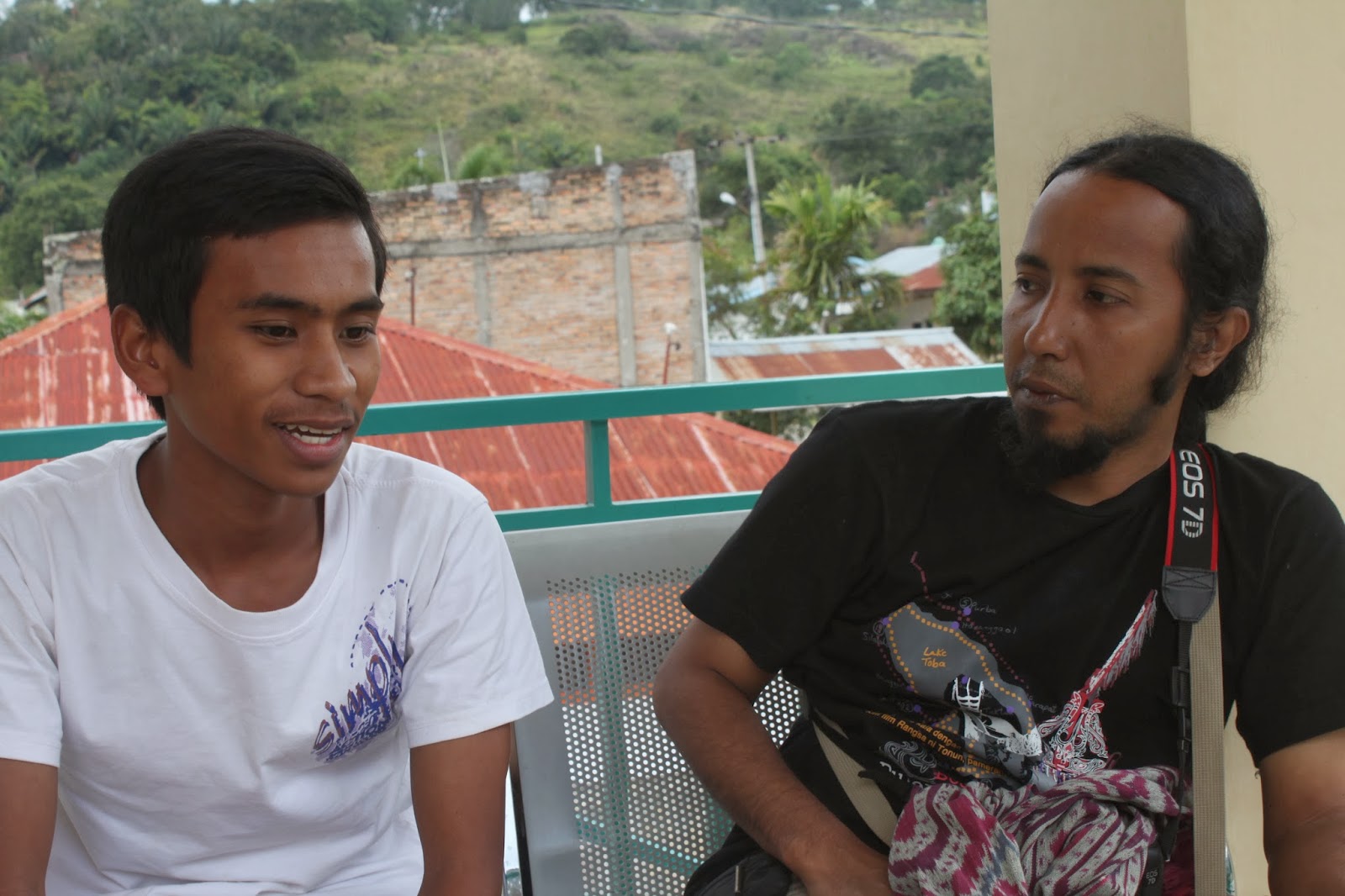
He said that he had given a copy of Rangsa ni Tonun to Sihol Malau, that he had told her in colourful detail about our adventures and that he had spent the night in her house. This message went straight to my heart.

Sihol Malau is the Ompu ni Sihol’s granddaughter, indeed, the one after whom Ompu ni Sihol is named. Several of Ompu ni Sihol’s grandchildren played in the village plain when I took my weaving lessons with her. They wound her weft, scared her pig, the dog and chickens away from her loom, fetched salaon (indigo plant) with me on the hillside, chewed the kemiri nut and spat it in the can when Ompu ni Sihol needed it for her starching solution (she had no teeth). I didn’t know them well. I was 24 at the time and was more focused on my weaving notes than on these children.

But now that granddaughter Sihol has Rangsa ni Tonun, my heart is very glad. I imagine her playing the film and hearing Ompu ni Sihol’s cracking old voice as the origin of the theme song of the film. I can see her open the book that I wrote about the film and find the picture of her grandmother. I can imagine her feelings. How I would love to find my own grandmother in a book!

Thank you, Ojak Tampe, for giving such a good start to my day. I look forward to seeing the photographs that you took.

The day of the launch of the Boat Budaya comes back to me. Saturday August 24. We were crazy busy setting up a stall where we could offer our books and posters for sale, dealing with some last-minute upsets and preparing for the afternoon event in which Ibu Stephanie’s textiles would be officially handed over to Museum Tekstil. Amidst all of that, I went over to the huge Batak house at the corner of the North Sumatran village of Taman Mini to review the exhibition and make sure there were enough copies of the Bhinneka Tabloid (about our activities) on hand for visitors. A young woman came up to me. She introduced herself as Harna. And then time stopped.

Stephanie Belfrage's textiles were displayed beautifully by the Museum Tekstil staff in the Batak house of Taman Mini. (Photo by MJA Nashir)
I looked at her. She looked at me. We were both speechless. Then we hugged each other for a long time. I know Harna through Facebook. She is another one of Ompu ni Sihol’s granddaughters. Legacy in cloth brought us together. After I had presented the book to her brother in 2010 (a gift from the book’s designer, Marie-Cécile Noordzij Pulles), it eventually made its way to her in Medan. She has now moved to Jakarta and made the effort to come to our launch. Meeting her was one of the most memorable moments of the launch.

The meeting took place surrounded by photographs of the Pulang Kampung I the journey when I gave a copy of  Legacy in cloth to Ompu ni Sihol's family.  (Photograph (and photo exhibition) by MJA Nashir.)


Thursday, October 03, 2013

Another Experiment in Muara


 The afternoon showing of the film in the Muara market was successful, but we still felt obliged to give more of the people who appear in the film access to the film (especially the indigo dyers in Huta na Godang). I remembered the beautiful evening arranged for us by Restuala Namora two years earlier when Threads of Life came to visit Muara. Behind Hotel Marsaulina there is a small conference room surrounded by four glass walls overlooking Lake Toba. It really is spectacular. Restuala had brought musicians and the tables and chairs could be rearranged to suit the discussions that took place. There is no better backdrop in all the world.

Mas MJA Nashir shows pictures of Rangsa ni Tonun to our youthful helper.  The picture gives a good sense of the room and the backdrop.

Br. Situmorang, who works for Marsaulina Hotel, was very interested in our work. Here we see the view off to the right. Beautiful Lake Toba.

There were other advantages as well. It turned out that the Boat Budaya could be moored there. This was important because all of our equipment was on board and we have to carry it to the film-showing venue and also guard the boat. The part that I liked was that I, the Westerner who couldn’t get used to sleeping on the floor of the boat, could have a comfortable bed in the hotel.  Nashir and I were both charmed by the venue – but would people come? They would have to make the effort to leave the villages at night, maybe hunt for a becak (there are a couple of becak’s in Muara!). Muara doesn’t have a nightlife, there are few streetlights and it would be a bit of a walk – a long walk for the ones who lived up the hillside..

Nashir still had the telephone number of Ishak Aprianto Aritonang, one of the youth that Restuala had selected to participate in the Forum Anak, a program to teach cultural knowledge to selected young people in Muara. He called him and we sat in front of the hotel and discussed the possibilities with him. 

He agreed to drive around on his motorcycle and drum up enthusiasm so that people would come to the showing. So we made the decision and rented the space from boru Situmorang who works in the hotel, and we phoned Captain Siregar so that he would shift the Boat Budaya from the market to the hotel. Then we got to work rigging up the screen and setting up the sound equipment. Lasma and Febrina were at Ompu Rido’s house and would come in time for the evening screening.

….

Ompu Rido warned us that few would come. She wanted us to show the film at the intersection of the two main streets in front of the bank. It sounded awkward and difficult to manage so we stuck to our plan in the back of the hotel. In the end she was right. She came that evening and her enthusiasm infected her neighbours who came as well, but nobody else from Huta na Godang came. (The next day Ompu Josua told us that she was too old to go out at night; they go to sleep at 9 p.m. and get up very, very early in the morning.) We learned an important lesson.

Nevertheless, the evening was a success, even a resounding success. A lot of young people came and especially other members of the Forum Anak. The leader of the youthful traditional Batak orchestra,  Hendra Siregar, brought his hasapi (guitar-like instrument) and after the film and discussion, he played and several of the young people sang. Brilliantly! They inspired us all and we were truly impressed.

Hendra Siregar with a budding fluit player and a 15-year-old female vocalist. (Photo by MJA Nashir) 
I sat beside former weavers, Ompu Rido's neighbours. (Photo by MJA Nashir) 


The discussion after the film was played was valuable. The theme was becoming familiar to us. “Of course we would like to continue to weave, but if the market is not strong enough, of course we have to stop.” Weavers look for other ways to earn money, mostly through farming-related activities. Of course there is regret – but they have to be able to feed their families!

Wednesday, October 02, 2013

A Ham selling Goldfish (or The Unexpected is to be Expected on a Batak Market)

I was called over by a goldfish seller in Muara because she wanted to show me something and I was to take photographs.


Aaaah, now she's got it!

Introducing a New Baby


Let go of the modern concept of ‘the marketplace’ for a moment and think of the power of the market in the pre-colonial Batak world. It was a world of internecine warface. Village warred with village, marga (lineage) with marga, region with region. Batak ‘wars’ were always cunning (conducted with the help of  magic, spells and potions),  occasionally involving face-to-face fighting (but more often guerilla-style attacks and counter attacks), and often of long duration. But life had to go on, food and ironware had to be obtained, produce had to be sold including to external markets, and so the ‘peace of the marketplace’ was set up. All of the great markets around the lake worked on a set schedule. On those market days pacts ensured safety from village to market and especially in the market. Warring was set aside temporarily for the sake of trade. Markets were large and busy and because of the transportation opportunity offered by the lake, they could be attended by huge crowds, all of whom made their way there in the solu bolon (large dug-out canoes) bearing their trade goods.

One can imagine, then, that the marketplace was a place of singular importance. The marketplace was the place to meet and exchange the news. Women introduced their newborn babies on the market, a kind of ‘social’ baptism. This was also the original crucible in which textile design was introduced, exchanged and innovations achieved consensus. Logically, disputes were settled on the market. The large waringin trees mark the spot where adat leaders would meet to hear cases and try their hand at settling the problem. There were also large ritual gatherings, called bius, but these were infrequent and involved the population of a region, and were choreographed for the occasion. Markets consisted of motley crews, people from near and far and the unexpected was expected to happen.

When I thought of the places where I would like to re-introduce Rangsa ni Tonun into the Batak community, the Batak market sprang to mind. The Batak village was my first choice, in the village square. During the journey, the weather did not work in our favour, alas. There was so much rain. In the end, we had no screenings in village squares at all, but always in Batak homes crowded full with everybody who could fit in. The ancient Batak markets took place on grassy plains under the open skies, but the current markets are covered over and dark. That would work to our advantage.

When we left the Festival Danau Toba on 12 September, our goal was the Nainggolan Market, but it was a barren, desolate (and smelly) place and turned out to not be the wrong spot for that day, so we chugged on in our Boat Budaya to Muara.

Muara! Immediately we were recognized! There was Febry, home from Bali, flaunting his news about his successful engagement to a Dutch girl for all to hear. Close to the entrance to the market we ran into Ompu Rido selling steamed rice cakes. She was wearing our Pulang Kampung III t-shirt and became so excited when she saw us she scarcely knew what she was doing and began to jitter! We left her with a huge bag of rice cakes in our hands. Then we saw Restuala’s Mom and Ompu Joshua’s daughter; it was like a homecoming with the true spirit and warmth of the marketplace.

Restuala's Mom and Ompu Rido on the street in front of the market.


Nashir stubbornly pressed on. The marketplace may have been my harebrained idea, but his stubbornness made it happen. We found a market stall willing to accommodate us. We chose a textile stall and explained our need for a place to set up a projector and Pak Jerry’s bulky sound system. That might sound easy, but we had to bring the generator from the boat, purchase fuel for it,
Fueling the generator on the street before entering the market. The young
man wearing our Pulang Kampung T-shirt is the 'boat-guy', the assistant to
Captain Siregar.

and make sure our extension cords could reach it. Just like other people with bales of wares, we pushed our equipment on two-wheeled trollies through the muddy aisles.

The generator in the market being managed by Ojak Silaban and the Captain's
assistant
Some textile proprietors grumbled that we were ruining their opportunity to make sales and we argued in turn that this would only take a moment and that we were attracting the public and stimulating them to love Batak textiles. We handed out copies of Bhinneka, the tabloid about our activities, and nestled in amongst the bales of red, gleaming textiles made on ATBM looms to watch the film.

The aisles filled up with people of every age.

Nashir stood beside the rigged up, white cotton screen and tried out the microphone. It worked. Paul Manahara Tambunan manned the projector atop a bale of textiles.
Paul Manahara Tambunan manned the projector


Ojak Silaban and said a few words to introduce the film and then Nashir clicked the right keys on his computer and started the show.

By that time, Ompu Rido had joined us and when Boru Hasagian appeared on the screen
Boru Hasagian on our makeshift screen. Nashir examines
his documentation of the screening. I over-exposed the shot so that
Nashir would be visible in the dark.

, she was beside herself once again, and didn’t know whether to try to hide amongst the textiles in her shyness or stand up and take a bow. She shrieked a few times and flopped back on her back. It was her crowning moment in her own village and when I said a few words at the end to thank the textile proprietor, I also thanked Ompu Rido for her participation in the film. I was sorry that not all of Huta Godang was there as so many of our film stars are from there.

The film attracted alot of attention.

Lasma and Febrina snuggled into the bales of machine-made
textiles for sale in the stall to watch the film

Ompu Rido joined us and sat transfixed next to Lasma

Isma, the reporter from Tempo Magazine, was with us for this
leg of the journey.
Photo by MJA Nashsir showing the constraints of the market stall.

In an attempt to get a bit of a discussion going, a few words were spoken by a clever woman who immediately realized the power of the film. She expressed the wish that Batak textiles would thrive. Lasma made a few resounding comments to thank the visitors for watching and to remind them that the survival of Batak weaving depends on them.

Then there was the requisite photo session. “Please Miss, a photo?” The stall proprietor’s son draped their best textiles over our shoulders and photograph after photograph was snapped.

Thus we introduced ‘our baby’, Rangsa ni Tonun, on the market of the place that feels the most like home for us in Tano Batak. It was an experiment and one that we liked alot. The screening wasn't perfect, however. There just wasn't enough room to accommodate all the people who wanted to see it and although we had a strong sound system, the sound got lost in amongst all the textiles. We weighed the pros and cons of every screening and no screening was ever perfect, but this one had magic. We will always think of it with a smile.