Thursday, October 10, 2013

Solu Bolon


With Dian Sidauruk (fourth from the right) at Museum Simanindo
in front of the solu bolon
recognizing the spirit of Pulang Kampung III

On 9 September we made our way from Silalahi to Tuktuk stopping in Simanindo on the way. Nashir and I have made the acquaintance of Dian Sidauruk through Facebook and we have been moved by his support. Visiting him to show him Rangsa ni Tonun was a priority on our agenda. 

Before we visited his home, he took us on a brief tour of Museum Simanindo and we saw the only solu bolon that I am aware of the existence of. It was the inspiration for the poster of our project.


This is what MJA Nashir had to say about our visit, about the poster, about the spirit of project Pulang Kampung III and the Boat Budaya

"I still remember when Sandra used to talk to me about the ‘solu bolon’ [large Batak dugout canoe]. I thought she was just dreaming. A ‘dream’ in the sense of a ‘fantasy’ as Jesral Tambun wrote in his ‘status on line’ a few days ago, “Life without imagination is a statue!” It reminded me of the words of my late father, “Life, yes, but like a corpse.” And life (read culture) is often constructed atop of dreams and fantasy, or to use a cool idiom, it is ‘a dream come true’. Until one day when we were working on our ‘Pulang Kampung III’ plans and I asked Sandra what kind of image she would like for Pulang Kampung III, Sandra chose the ‘solu bolon’. Even though I had already made a design with an image of a loom and textile. J Yes, I was surprised and confused at that time. I didn’t say anything when I received that email. In my heart I wondered what the connection was between ulos and the solu bolon. In the end I was aware that I myself had daydreamed in front of the solu bolon in Museum Huta Bolon Simanindo in 2010 when I was with Sandra for the first Pulang Kampung voyage and I saw people from the past wearing various kinds of ulos.

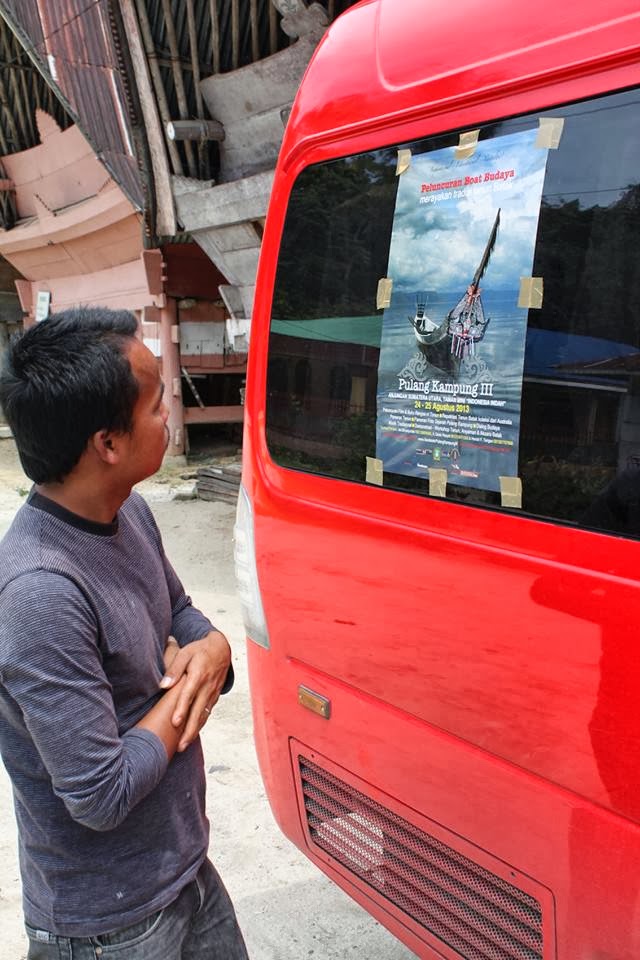
Poster of the Pulang Kampung III project
designed by MJA Nashir
Immediately I rummaged through my stack of photographs from 2010, the files of Pulang Kampung I, and found two photographs. One was the solu bolon from Museum Simanindo and one was a photograph of Lake Toba, wide, empty, calm and mystical. So I plopped that Solu Bolon onto the surface of the water. I realized this ‘dream’ and figment of the imagination. Immediately I sent it to Sandra via the email. She was thrilled. Since then we consider this the visualization of Pulang Kampung III with the subtitle ‘Boat Budaya’. I believe that Sandra was not just playing with the idea of the Solu Bolon. Besides I know exactly how earnest she can be about an issue. And indeed, she can explain this matter in glowing descriptive detail, about this image of the past, about the solu, Lake Toba, ulos, the market tradition in times past, until the Nommensen era, this ‘spirit’ of water transportation. And this ‘spirit’ of water transportation underlies Pulang Kampung III (Boat Budaya). We were indeed aware that to fully realize a ‘Solu Bolon’ as the medium of transportation for Pulang Kampung III during the relatively short time that we had to prepare for it was an impossible task. However, the symbol of the solu bolon became the spirit of Pulang Kampung III, a symbol of a means of transportation, a symbol of accessibility, and at the same time a symbol of awareness of the natural environment. To the extent that Sandra did her best  -- even though a solu bolon couldn’t be made and used – to use a prahu or boat which was environmentally friendly (not one with a noisy motor that contaminates the lake environment), for example a boat that is powered with solar energy. We hope that one day there will once again be solu bolon on the waters of Lake Toba. In any case, the solu bolon from the past is visible proof of ancestral knowledge protecting the natural environment." (free translation by myself)

Tuesday, October 08, 2013

Project Back to the Villages III meets Jesral Tambun

(Terjemahan dibawah)

Last night I received a series of excited posts on Facebook. Jesral Tambun had discovered salaon, a Batak indigo plant, in the area where he lives, close to Porsea. It was a plant growing wild in uncultivated land and his questioning of elderly people about indigo led him to his discovery. He was thankful to Lasma Sitanggang for having asked him whether indigo plants grew in the area. He is thinking of cultivating the plant beside the house that he is building.
Photo by Jesral Tambun

 The last stop of Proyek Pulang Kampung on the way home to Medan was in Ompu Okta’s village. Jesral Tambun had helped MJA Nashir during the last filming session for Rangsa ni Tonun, so Nashir contacted him and let him know we were coming.

Jesral helped Nashir on the last day of filming Rangsa ni Tonun in Ompu Okta's village. We see the pipisan or cotton depitter than we purchased in Bali because we couldn't find one in the Batak area. It is strikingly similar to the Batak variant.

Jesral meets Proyek Pulang Kampung

It was my first meeting with Jesral. I had heard about him from his uncle, Nestor Rico Tambunan. Jesral is very interested in Batak culture, he had said. Might there be a way to include him in our activities? I did not forget this question and I was excited about meeting Jesral.

We all ate lunch together in Ompu Okta’s home (just as we had done when shooting Rangsa ni Tonun) and shared stories. 

Later we went to visit the house that he is building for his future.

Jesral's house is under construction. In the background is a carved and painted plank that he is restoring.


We had hoped that Jesral would be able to join us on the Pulang Kampung III journey but circumstances had intervened and made it impossible. I quickly discovered what an asset he would have been. He is fully dedicated to making a life in the village and enriching it with explorations of his culture. He is particularly interested in wood and has apprenticed so that he can make gorga, Batak painted woodcarving.

Jesral Tambun (Photo borrowed from Jesral's Facebook site)
He is an orphan; both of his parents died when he was still young. He is not wealthy by any means, but he has an extraordinarily nice collection of textiles that he can wear to adat, all purchased with his savings – quite remarkable in this day when the Batak are selling off their textiles! His textiles are new, but the finest modern ones that money can buy. There is a picture of him on Facebook wearing his textiles when he performed the special role of requesting music from the Batak indigenous orchestra at the TB SilalahiCentre. He loves the indigenous textiles of his culture and hopes to find a wife who is a weaver. He senses that he will be happy to come home to a woman who  is weaving. What a remarkable statement by this passionate young man.

His interests are broad and he has a lot of energy. I am struck by how fervently he plunged into the exploration of indigo and his enthusiasm when sharing his discovery. I asked him if he could also explore the mangkudu/bangkudu plant that the Batak used to make red dye. The use of this dye was particularly strong in his region. I also asked if there were any weavers left who could make the extraordinary supplementary warp patterning (jugia) such as in his textiles. The weaver of his textiles is now deceased. Was she the last? It will be through our contacts in the Batak area, contacts like Jesral, that our knowledge will grow.

Jesral joined Proyek Pulang Kampung III on the last day and the last stop, but I sense that he will remain with the project always in his heart and in his activities. The past of Batak culture will never return, but in people like Jesral Tambun, the culture will survive and will perhaps become vibrant again. It will bubble with enthusiasm and grow, connecting with the outside world in a new way.


This post was translated by Jesral's aunt, Rita Tambunan, a few days after it appeared.

Proyek Pulang Kampung III: Bertemu Jesral Tambun

Semalam saya menerima sejumlah postingan menarik di Facebook: Jesral Tambun 

telah menemukan Salaon, sejenis tumbuhan tropis yg dipakai masyarakat Batak 

untuk memberi warna biru, di wilayah di  mana ia tinggal di Porsea. Salaon adalah 

tumbuhan liar dan keingintahuan Jesral akan tumbuhan ini membuatnya bertanya-

tanya pada orang-orang tua yg kemudian membantunya menemukan Salaon. 

Jesral berterima kasih pada Lasma Sitanggang yang merangsang rasa ingin tahunya 

tentang keberadaan Salaon di daerah ia tinggal. Sekarang Jesral berpikir untuk 

menanam Salaon di samping  rumah yg sedang dibangunnya.

Perhentian terakhir dari Proyek Pulang Kampung, sebelum kembali ke Medan, 

adalah kampung tempat  tinggal Ompu Okta. Jesral Tambun membantu MJA Nashir 

dalam sesi terakhir pembuatan film ‘Rangsa  ni Tonun’. Karena itu, Nashir 

menghubungi Jesral dan memberi tahu bahwa kami akan berkunjung.

Itu adalah kali pertama saya bertemu dengan Jesral. Saya telah mendengar tentang 

Jesral dari pamannya, Nestor Rico Tambunan. Jesral punya perhatian besar pada 

budaya Batak, kata Nestor.  Apakah mungkin untuk melibatkan ia pada aktivitas 

kami? Saya tak pernah lupa akan pertanyaan itu dan karenanya menjadi sangat 

senang akan segera bertemu Jesral.

Kami makan siang bersama di rumah Ompu Okta (seperti pernah kami lakukan 

waktu pengambilan film Rangsa ni Tonun) dan berbagi cerita. Setelah itu, kami 

berkunjung ke rumah yang sedang dibangun Jesral untuk masa depannya.

Sebenarnya, kami berharap Jesral dapat bergabung dengan kami pada perjalanan 

Pulang Kampung III, tetapi ada masalah yg membuat hal itu gagal terwujud. Saat 

bertemu dengannya, saya segera mengetahui bahwa Jesral sungguh asset luar 

biasa; ia demikian berusaha untuk hidup di desanya dengan berusaha 

mengeksplorasi budaya Batak. Jesral sungguh mengabdi untuk desanya dengan 

berusaha menggali budaya Batak. Jesral sangat tertarik pada kerajinan kayu dan ia 

dapat membuat Gorga, ukiran kayu khas Batak.

Jesral anak yatim-piatu; kedua orangtuanya meninggal saat ia masih sangat muda. 

Ia tidak kaya, tetapi Jesral punya sejumlah koleksi pakaian layak pakai yang khusus 

ia kenakan untuk acara adat. Pakaian itu ia beli dengan tabungannya. Pakaiannya 

baru. Ini adalah fotonya di akun Facebook dengan baju yg ia kenakan khusus saat 

melakukan pertunjukan musik Batak di TB Silalahi Centre. Jesral mencintai kain 

tradisional Batak dan berharap suatu hari nanti dapat beristrikan seorang 

perempuan penenun. Ia membayangkan betapa bahagianya pulang ke rumah 

bertemu dengan istri yg sedang menenun. 

Sebuah pernyataan yg luar biasa dari seorang anak muda!


Jesral punya perhatian terhadap banyak hal dan ia punya energi besar. Saya amat 

terkesan bagaimana ia demikian berusaha menemukan tumbuhan seperti Salaon itu 

dan antusiasme-nya untuk berbagi penemuan itu. Saya berkata padanya siapa tahu 

ia juga bisa menemukan Mangkudu/Bangkudu, tanaman yg digunakan orang Batak 

untuk mendapatkan warna merah. Mangkudu/Bangkudu ini biasa dipakai orang di 

daerah Porsea dan sekitarnya. Saya juga bertanya pada Jesral apakah kira-kira 

masih ada penenun yang dapat membuat Jugja, ornamen luar biasa, seperti yang 

ada pada koleksi kain yg dimiliki Jesral. Jesral bilang, penenun kain yg dimilikinya 

sudah meninggal. Apakah ia orang terakhir yg bisa membuat Jugja? Saya kira kita 

akan mendapat jawabannya dari orang-orang seperti Jesral.Jesral bergabung 

dengan Proyek Pulang Kampung III pada hari dan perhentian terakhir kami. Tetapi 

saya merasa ia akan tetap melanjutkan terus proyek ini di dalam hati dan 

aktivitasnya. Budaya Batak tak akan pernah lagi seperti dulu, tetapi dalam orang-

orang seperti Jesral Tambun, budaya luhur ini akan tetap lestari dan, mungkin, 

akan berjaya lagi. Antusiasme dan perkembangan dan upaya penyebarannya ke 

dunia mungkin mewujudkan harapan itu.


Monday, October 07, 2013

"Why do you love Batak Textiles?"


I was interviewed many times during the Pulang Kampung III journey in which my team brought our film, Rangsa ni Tonun to the Batak area. The first question when I was interviewed was always, “Why do you love Batak textiles?”  I found this question difficult to respond to in a sound bite while standing on a windy field, hence this note.

I once impatiently answered in return, “What does it matter? The Pulang Kampung expeditions are not about me and my likes and dislikes, they are about the repatriation of material and intellectual culture. What I love is not the point.”

Was I wrong?

Many interviewers seemed poised to have a truth unveiled, the microphone pointed expectantly at my mouth. In the not too distant past, white-skinned newcomers entered the region and said that the textiles and most of the rest of Batak culture were of the devil. The White Man’s views achieved dominance through the hegemony of the new church and state. Sometimes I sense that only a white-skinned newcomer can release the culture-bearer from the burdensome yoke that my ancestors placed on them and, like a kiss from the prince, awaken them to the beauty of their own culture. These textiles have value, I say; do not underestimate them! What makes you love them? they press in return. Tell us what it is! They have been taught that modernity has value, not indigenous culture. Why does this white woman spend so much time, money, energy, so much of her life, on this textile tradition? What on earth does she see in these cloths?

Beautiful supplementary warp. Are there any weavers left
who know how to do this?
I could have waxed lyrical about the complex, beautifully executed, supplementary warp patterning (jugia) that is sometimes found in old textiles. I love the innovative combinations of supplementary weft (jukkit) and ikat. I love the way the same patterns are sometimes executed in all of the textile techniques in a single cloth: ikat, supplementary weft and warp and twining. I love the clever ways that weavers have adapted external influences and ‘Batakized’ them on their backstrap looms. I love the micro-regional traditions that used to be so vibrant, yielding ever so slight differences in weaving equipment and the resultant textiles. I love the deep, ancient colours that were obtained by methodical hard work, knowledge of nature and infinite patience. I love the way weavers once had the latitude and the opportunity to express their creativity at their looms. I love that I had the opportunity to work with Ompu ni Sihol and to catch a glimpse of how a textile was made in pre-colonial culture. But how could I share all of that when the people who were interviewing me probably didn't know the fine details of the old textiles and the names for the techniques that constructed them? The tradition is dying.

Beautiful ikat. Nobody makes this anymore.
How quickly and radically things have changed! I confess that I don’t like the brightly coloured, modern Batak textiles with gold yarn that are made on ATBM looms. I find them gaudy. They make me sad. I see in them the careless, simplified, purely market-driven dead end of a rich and dignified heritage. This is not the part of the tradition that I love. But it may be all that the reporters are familiar with. Hence their question, perhaps? Hence my difficulty in responding.

But even my admiration for Batak weaving techniques and patterning could not have sustained me for all of these years were it not that they opened a window onto something much larger that never ceases to fill me with awe: the entire complex and tradition of Indonesian weaving. There are a few places on the world’s surface where weaving has attained a dazzling height of complexity and achievement. The Indonesian archipelago is one of those places.The weaving of the Batak people of Sumatra is a small, though very special, variant in that giant corpus of Indonesian weaving.

A stunning bintang maratur ikat. This textile is no longer made.
This makes Batak weaving all the more precious. Its distinct and special value emerges when it is juxtaposed with all of the other traditions in the archipelago. The value of the Indonesian textile tradition as a single, great complex is greater than the sum of the weaving traditions that comprise it. Each individual tradition is a building block or a link in the mesh. Each gains additional meaning from that larger whole and contributes to the fabric of that larger complex. Only as an assemblage is it complete. When people ask me why I love Batak textiles, one of my stock answers is that my focus on Batak textiles is a fluke of fate. I could have chosen any of the textile traditions in the Indonesian archipelago. All are rich. All are deserving of deep scrutiny within a comparative context.

Frankly, I am dismayed that UNESCO chooses to select bits and pieces (batik, Sumbanese weaving) to promote as intangible world heritage. This well-intentioned attempt to preserve the finest cultural contributions in fact demonstrates how little UNESCO knows about what is special about the weaving culture of Indonesia. Its recognition of pieces of the whole undermines momentum to recognize that larger whole. By focusing on the individual pieces of the puzzle, UNESCO fails to see the larger image. There is a need to recognize and protect the entire complex.
Only a simple twined edge, but so well made and the colours blend beautifully.

Through my own work I do what I can to raise awareness of the value of the Batak tradition. My means are limited. I have no institutional backing and no source of funding. (I am very lucky to have the loyal support of MJA Nashir who understands and shares my vision and goals and hugely augments my ability to pursue them.) The Batak tradition is more than rich enough in all of its facets to fill my anthropological career. Research of the Indonesian textile tradition is a multi-person project.

An ikat pattern that is no longer made. It combines three different ikat patterns.
Combination of supplementary weft and ikat. Soft and beautiful.
Sometimes I want to answer the question of why I love Batak textiles by invoking an even larger context. I want to point out that it is not Batak textiles per se that I love. Rather, I am committed to doing what I can to make room in this world for indigenous culture. The world is in deep crisis. Indigenous cultures are endangered. Languages and cultures are disappearing at an ever-increasing rate. Contrary to what some Batak people think and thank me for, my intent is not to “promote Batak culture outside Indonesia”. Instead, I confront people, and especially Batak people, with the fact that Batak culture is a victim of so-called progress. The spectacular cultural accomplishments of the Batak people are diminishing daily. Do I feel love for this? No, I love the possibility of cultural diversity. I feel horror, sadness, disgust at cultural loss. Will the Batak people choose to nurture, protect and promote their own cultural contributions or will they continue to turn their backs so that they can march to the drum of modern materialism? To my mind, a well-made Batak textile has greater and more lasting value than a Mercedes Benz fresh off the assembly line, but my views are not supported by the global economy. Will the Batak safeguard their cultural identity? How will they do it if they choose to do it? It is a huge challenge and it faces all of the indigenous peoples of the world.

An unusual sibolang ikat. This is the only one I know.
An individual weaver's creative impulse?
Thankfully she had the time to experiment.
During my first ‘Back to the Villages’ project, I gave a copy of my book, Legacy in cloth, Batak textiles of Indonesia (2009) to a weaver and I watched her reaction. She ran an emotional gauntlet. The book confronted her with the fineness of the textile achievement of her culture and simultaneously with its loss. Memories surfaced. The book made her silent. Another weaver said she felt happiness on the one hand and pain on the other when she witnessed the achievements of her culture. My original intent was just to say thank you to the weavers by giving them my book. I am an anthropologist. It is my obligation to give my research results to the people about whom I conduct research. I had not reckoned on the impact that the return of cultural heritage would have. This is not about objects, not just about cloth. This is about identity, hearts, minds, memories, the sense of the past and the future.