Showing posts with label Museum Volkenkunde. Show all posts

Tuesday, June 22, 2010

The Muara weavers in the opening photo


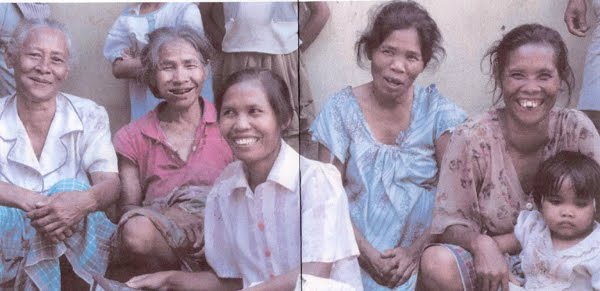
One of the opening photographs of Legacy is a two-page spread depicting a smiling group of weavers in the bay of Muara in the southwest corner of Lake Toba. One of my main goals on the 22nd of June was to find those women.

The spirits of Toba guided our search. Our chauffeur, Pak Jerry, decided spontaneously (after my search had been fruitless) to ask a young man walking down the road if he recognized any of the women in the photograph. The young man was inscrutable at first, pointing out that two of the women were deceased. It took him awhile to divulge that one of them was his mother and that she was working in the ladang (on the land). Later the young man repeatedly noted how lucky our meeting had been as he was generally working in the garden himself at the time that we met him.

The garden was far away and he agreed to climb into our vehicle to guide us to his mother. Her peels of laughter when we found her reminded me of that merry day, 24 years ago with my friend Erna Lohuis, when the photograph was taken.

We crouched on the side of the road and I explained the book and the Back to the Villages Project and presented her with a copy. Ompu Josua received it proudly. When the school next door requested a book for their library, we insisted that Ompu Josua be present for the group photograph to acknowledge the ancient weaving heritage that her skills represent. As Mas Nashir put it, she is a cultural hero. For me, this was an important and symbolic moment as I notice repeatedly how much culture is being lost in the struggle to make ends meet and to march to the drum of external cultural influences. The struggle – there is no better word for it – to survive and get ahead in the current social and economic climate entails the excruciating irony of disregarding and coring out that which is ancient, valuable and beautiful in the people’s own culture. We do not live in a time when school children are proud to say that their mother is a weaver and weaving is not a goal to which a school child aspires. It even felt somewhat subversive to make a Batak weaver a centerpiece in a photograph of a school, but it was time! I had given the book in the name of Wendela ter Horst, a dear
socially progressive friend in Oosterbeek who makes no bones about battling “the system” when she feels that injustices need to be corrected.

The young man who guided us to his mother, then took us to his neighbour, another of the women depicted: Mutiara, br. Pandiangan. She was covered in mud and working in the fields. She and her husband climbed into our vehicle and we joined them in their house for a cup of coffee. She showed us some of her old textiles and the harungguan that she was making. 


Pamela's weaver, Mutiara br. Paniangan, Ny. Siregar, making a harungguan

Near the end of our visit, the weaver’s husband asked if I couldn’t assist in some way to revive the Batak weaving arts. I told him that this was one of my long-term goals and that I would do my best to contact them again in the future. The weaver is a very talented and bright woman. She knows how to make indigo dye from the local salaon plant and longs for the opportunity to weave textiles of integrity rather than just to earn a pitiful few cents on the market.

I was pleased to have made this presentation of
Legacy courtesy of Pamela Cross. Pamela has been so terribly supportive of both Legacy and this project that she deserved a recipient in that wonderful opening photograph in the book. Furthermore, Muara has ancient ties with the Silindung Valley with which Pamela also has strong ties. And finally, the hint of a future for Batak weaving, through this talented weaver promises to give her gift longevity. I hope that she may one day meet the recipient of her generous gift.

Another of the women in the photograph lived close by, but was unavailable just then, so we gave her the book through her daughter-in-law, courtesy the Soroptimists of Arhem. 


Before leaving Muara, I wanted to give one more book to a group of active weavers. I found them by calling Torang Sitorus (see blog: Didn’t Pay? It was costing money!) who had expressed the hope that indigo-dyeing could be revived in that part of Toba. It also turned out to be a village that I had contacted in the past: Huta Simatalo II. Two women were weaving the very long surisuri textile and the whole village came out for the presentation – courtesy Museum Volkenkunde in Leiden.


I could not have hoped or imagined that more interest could have been expressed in the book.  Such a moment, sitting on a mat with the entire village, talking about the results of my 30 years of work…I must not dwell on this as it is too overwhelming.


See Back to the Villages - the map!


Sunday, June 20, 2010

Sulphur

On Samosir, the spirits are etched in the landscape. It is one of the most spectacular places in the world, a place of magic, myth, poetry and power. Waringin trees. Monoliths (the Batak have stories about them flying through the air to their destinations). Stone walls that defy physics. A spring with seven different flavours. Waterfalls. Scarred hills that tell of ancient cultivation. A lake so deep that it can only be described as bottomless, the highest and largest in all of Asia. 75,000 years ago, one of the biggest explosions in the history of the world occurred here. Lake Toba is the crater. The violence of the eruption has softened with time. Great, bald hills encircle the lake like gentle protective arms. The highest peak is Navel Mountain, the umbilical of Batak origins. The apical ancestress was a weaver who lowered herself from the realm of the gods on her handspun yarn. Weaving has traditionally occurred all around the shores of the lake.


I write, now, from the gash in Navel Mountain where hot water gushes and the air smells like sulphur. I feel that the spirits, today, have guided my journey. The meetings have all been precious. They have collapsed all time, from the first weaver, Si Boru Deak Parujar, to my first visit 30 years ago, to the realization of this Back to the Villages project.

Today I gave away five books. Each is a complete story in itself. Each was photographed extensively by MJA Nashir who, I could tell, feels in every fibre of his being exactly what this project is about. How wonderful to have him along and to have no concerns about this amazing journey being recorded.

The five books:

1. Simanindo Museum at the northern tip of Samosir Island. I gave this book in the name of the Volkenkunde Museum in Leiden to the daughter-in-law of the now long-deceased Sidauruk couple who so kindly helped me with my research. They allowed me to stay in their home and introduced me to Amang Adir, the village guru knowledgeable in esoteric Batak matters. I commissioned the spinning wheel (sorha), yarn pitter (pipisan) and bow (bosur) in my collection from him. The daughter-in-law, now widowed, looks after the vision created by her father-in-law whom she never met. She was pleased to receive the book and wanted to share it with the other family members (in Jakarta and Medan).


2. As we were leaving the village, we spoke to Lemar Sidauruk, a villager. He wanted to know what our business had been. When I described it, he said he badly needed a book because it would assist the village when it puts on dances and ritual re-enactments for tourists. Sensing that his interest was sincere, and realizing that if I gave him a book many more people would have the opportunity to see it (that, after all, being the goal of Back to the Villages project), I gave him one in the name of Andrew and Lily Wang whose message specifically thanks the recipient for perpetuating tradition. As we left, he had already been joined by a few men and they were thumbing their way through the tome.


3. Further along the road, approaching Pangururan, we stopped at the same village where I had been a few weeks earlier and had promised to return. One of the weavers was present. Her mother and neighbour were also weavers. 


We sat together on a mat in the mother’s house while she demonstrated how she winds yarn using a spinning wheel. 


I gave them the second donation from Andrew and Lily Wang. They were very enthusiastic about the book but decried current market circumstances. Weaving has become an almost worthless activity, they said. How could they keep the tradition alive?

4. After lunch at Navel Mountain, we continued over a very rough road to Harian Boho. My weaving teacher, Ompu Sihol, had lived there. She died many years ago but I hoped to find her descendants. It was as though her son was waiting for us. He was sitting in a make-shift coffee hut. He had gone blind. Fifteen years ago, he said.  My heart sank as this book was being given in the name of the book’s designer, Marie-Cécile Pulles. It was such a bitter moment because Cécile’s task had been to care for the appearance of the book. This bitter moment had a silver lining, however, because the blindness of the son meant that the grandson had to be sent for.  

He was 6 years old when I had taken my weaving lessons from Ompu Si Sihol and he still remembered me. Cécile had seen the children lurking in the background of my photos with Ompu Si Sihol and she had specifically asked for the book to be given to them, the future of the Batak tradition. From a bitter moment, it became a very emotional moment combining my memories of Ompu Sihol with the bond forged with Cécile as we made the book together. The recipient, Juni (from Juninto) Malau immediately recognized his grandmother in the photographs in the book and also her dye pots. He was a nice young man and his little daughter was with him. I asked him if she would learn to weave. He led me and his blind father to Ompu Sihol’s village which I had visited every day, walking along a babbling stream and through the rice fields.  


I visited the spot where she had cached her indigo pots.  It was close to where her grave is now. Much had changed and much had remained the same. I recalled my last meal in her son’s house. They had served me chicken wings to help me weave “in my country” (this was said with much flapping of arms and merriment). This time, I departed with a strong sense of a history that the future would bring.

 5. I left one book behind in SiHotang (valley and bay south of Harian Boho) with a family member of Ompu Borsak depicted on page 73 of Legacy. He was a farmer threshing his rice while we drove by. We stopped the car to ask him if he recognized the women in the picture and he responded without hesitation. They were family members. He said that the older one was still alive, but lived some 20 km. further down the tortuous road that we had managed only with the great skill, patience and willingness of our driver. The clouds were closing in over our heads and we knew the road would be impassable if the rains were heavy and it might be difficult to get back. I decided on the spot to request his help in giving the book to Ompu Borsak and her daughter.  We sat down in his lean-to shed amidst the threshed grains of rice and I explained the project. He listened attentively, periodically asking a question. When I was done, he said that he didn’t feel that he should receive the book, but that I should give it to Ompu Borsak’s son in Pangururan. Now, I liked this farmer a lot. His eyes were as bright as his occasional brilliant smile. He was clearly dependable, honest and sincere and was certainly in some awe of the gift. I told him that I would take a copy to Ompu Borsak’s son, but that I also wanted to, through him, give one to the valley of Si Hotang if he would be so good as to show the book to as many people as possible. He was pleased to assume this responsibility and the transfer was able to proceed.  I gave the book in the name of Jan Hofstede, a person who lives close to the earth, is a farmer at heart, and would have felt great affinity with this rice farmer.


As we left this remarkable valley, we caught a glimpse of the great stone walls depicted on page 106 of Legacy. I could not resist, despite the risks involved in further delay, clambering over the boulders marking the boundaries of the rice fields, and down to the gap in the fortress wall. I stepped once again, just as I had 30 years before, inside the great village of Simarmata. The magic was almost palpable.


fig. SR 1.1 Samosir village surrounded by a stone wall topped with thorny bamboo.  1986. Batak built walls around their villages to protect themselves from internecine warfare.

See Back to the Villages - the map!

Saturday, June 05, 2010

Bees knees

An idea has something in common with the pollen sacks on a bee's knees. As she goes from flower to flower a bee picks up pollen until the sacks are full and then she carries it all back to the hive. An idea is born through a process of meetings, discussions and ponderings. The idea to write Legacy in cloth, for example, fed partly off the flower of the Ethnographic Museum in Leiden. It was my access to that collection, many years ago, that inspired the plan to write a comprehensive catalogue of Batak textiles.
 
Yesterday in Jakarta, to my great surprise, I received a telephone call at my new Indonesian number from the S.E. Asia curator of that very museum, Francine Brinkgreve. She informed me that the director of research at the museum had supported her request to participate in the Back to the Villages project. The museum is very strongly in favour of returning the products of research to the indigenous peoples where the research was conducted, and has actively worked on several collaborative projects with Indonesian museums. They feel that my Back to the Villages project dovetails well with their own values and priorities. They wish to donate 5 books!
 
I am fully convinced that partnerships between museums and indigenous peoples, originating in collections of their material culture, constitute a foundation for the future of both. My Back to the Villages project is precisely that kind of partnership because my book is filled with depictions of museum textiles, many of which are no longer woven or remembered in the Batak area. As examples of the Batak weaving heritage, they can inspire the weavings of the future. Needless to say, I am thrilled with this contribution from Museum Volkenkunde in Leiden. I feel proud of this museum that played such a strong role in my development as an anthropologist and so honoured to have them on my list of donors to the project.
 
Only minutes after being given with this news from the Dutch museum, I received a visit from the Batak designer, Merdi Sihombing. He had brought sumptuous armloads of his own textile inventions with him for me to explore and enjoy. I saw ancient designs in new colours and materials. I saw cross-fertilization between other Sumatran traditions and the ancient Batak tradition. The Batak textile heritage is Merdi's clay that he is molding into new forms. He is making his Batak weaving tradition vibrant. In his hands it is vitally alive. He brought the copy of my book that had been donated to him by the Indonesian Heritage Society and explained that it was going to be a valuable source of inspiration for him. I was gratified to hear this as I could not have received a higher compliment! Of course this is how I hope the book will be received by Batak weavers as well. This is the reason for the Back to the Villages project!
 
As I write this blog, I have received my wake-up call. Alas, it is unnecessary. I am definitely awake. It is getting to sleep amidst all of this excitement that is my problem. Today we are off to Medan where the Back to the Villages project will unfold further.


See Back to the Villages - the map!