Friday, August 16, 2013

A Hundred Blessings: Investiture by T-Shirt


MJA Nashir and I were astounded when a young Batak fellow came to our Pulang Kampung I exhibition in Erasmus Huis in Jakarta in 2011 bearing a heavy, awkward, trussed-up bale. When we opened it, we discovered 100 T-shirts printed with our poster image.


It was a gift from someone who believed in our cause: Christian Gultom (he had read about it on Facebook). Christian is a quiet man who has a textile business to support himself while he devotes his heart and soul to those who are less fortunate. He is a rare person with a heart made of pure gold.

For Pulang Kampung IV, he promised us another bale. Nashir made the T-shirt design and not too long ago the heavy freight was delivered. Now I see from the pictures that Nashir has recently posted on  Facebook that he and the organizing team at Taman Mini are all wearing the T-shirts. Like an emblem of solidarity with the Pulang Kampung effort.


Nashir composed a photograph of himself wearing the T-shirt. He adopted the familiar Ompu Nerda pose, pointing his finger at the viewer, demanding reflection:

If not I, who?
If not now, when?


We will use the T-shirt as part of the fund-raising effort. The remainders of the bale will be snapped up. Knowing that, Nashir has ordered some more (at our cost).

Christian Gultom’s gift is giving over and over again. In 2011 we distributed the first bale in North Sumatra among those who had played a role in the first Pulang Kampung project. Now the shirts have increased symbolic power. The wearers are members of the team and supporters of the the third Pulang Kampung journey. There is every indication that there are growing numbers of these.

Wednesday, August 14, 2013

Oosterbeek paints the Boat Budaya green

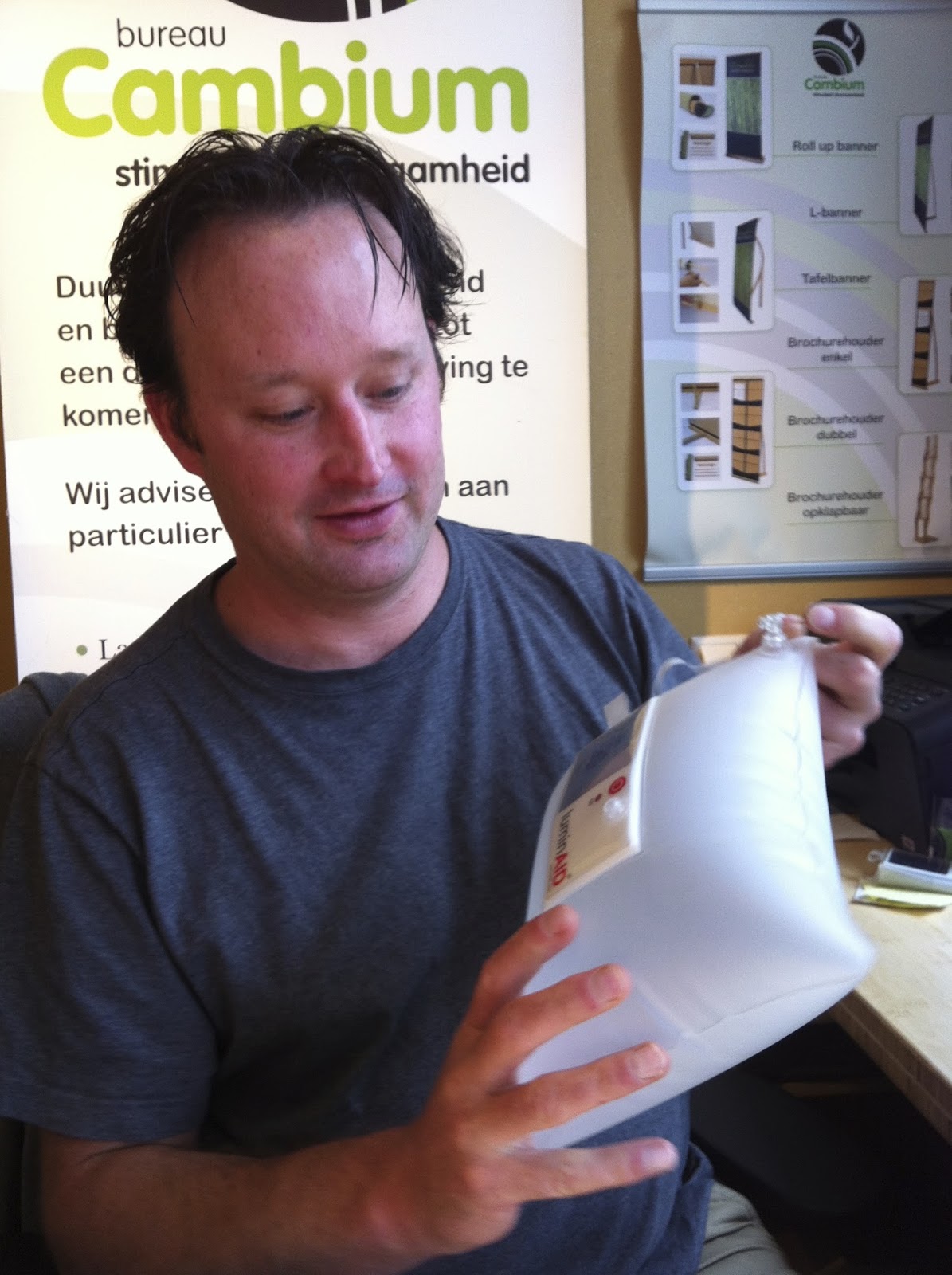
Things are suddenly coming together. An unexpected, generous donation for solar support for the Pulang Kampung journey meant that I could go to Bureau Cambium in Oosterbeek and discuss the options.

Wibo Teerlink showed me the Luminaid. He blew up the little cushion and then turned on the solar lamp. We tossed around how the little cushions would look in the evening - when the musicians are on stage or when Rangsa ni Tonun is being shown in the villages. I have just stuffed ten of these aids in my suitcase.


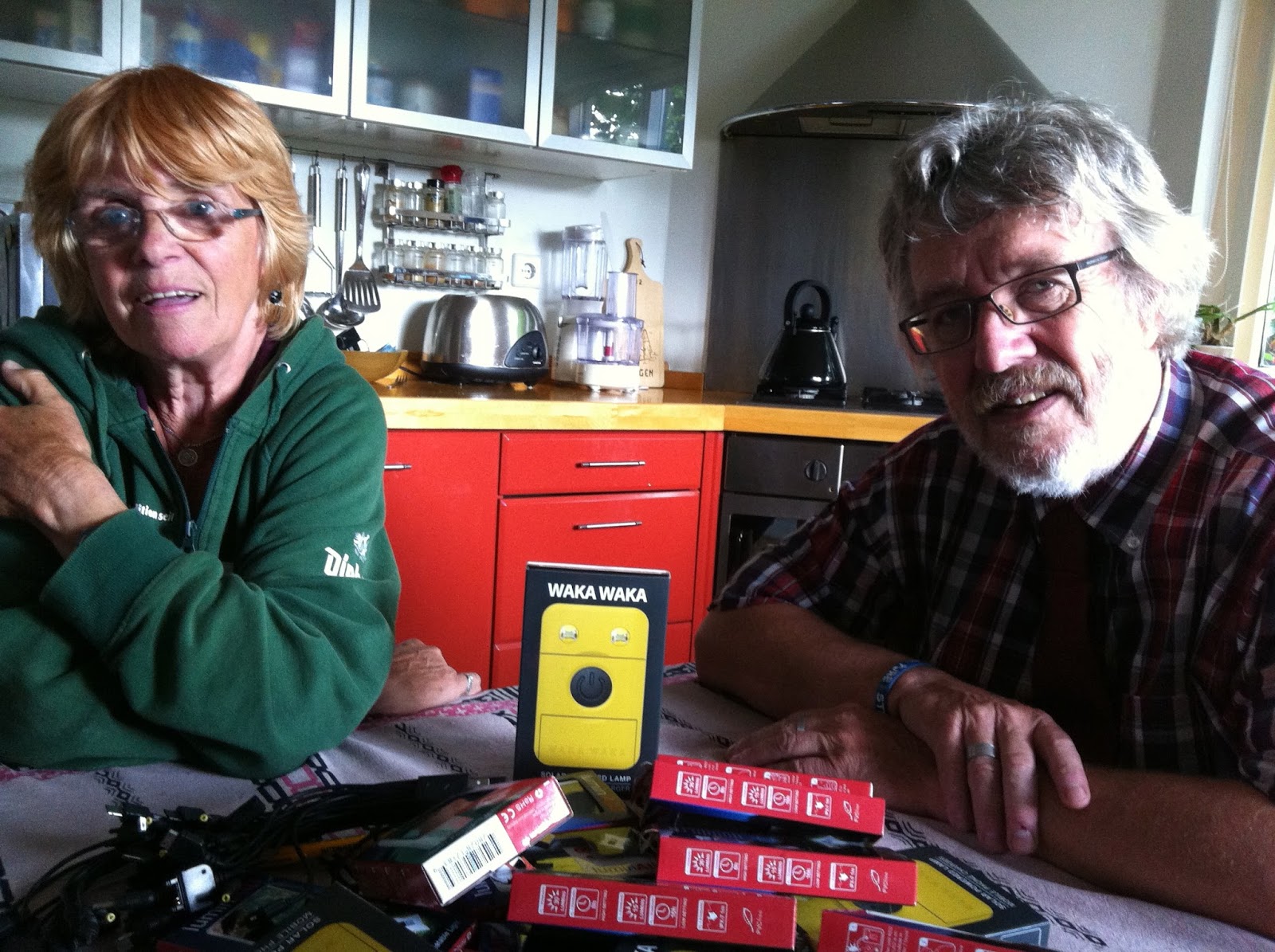
And then there were the Wakawaka power to power the cell phones and other small gadgets (we will try them out on the second-hand cameras that I bought).


Wibo's neighbours, Dirk and Sineke van Uitert, were the generous donors of the solar aids for the journey. (They had also donated generously to the first Pulang Kamung journey.) I couldn't refrain from knocking on their door after leaving Bureau Cambium to show these supporters what they had provided for the young people on the Pulang Kampung journey. I stacked up the goodies on their kitchen table and then took this photograph.


It will be fun to show the four young people who are joining the journey how solar power works. I will invite them to blog about it. We'll see what comes out. I hope that my kind donors will be pleased. I think that my boundless appreciation for their kindness will be contagious.

Wednesday, July 31, 2013

Tuesday, June 11, 2013

16. Pulang Kampung: the process is the project


I have been thinking about the process of realizing the Pulang Kampung project.  This project is not just about executing a plan.

The first Pulang Kampung journey had a singular goal: to say thank you to the people, particularly weavers, who had helped me gather the data for my book, Legacy in cloth. Pulang Kampung III is different. Since the appearance of my book, many people have looked to me for leadership in the huge question of how to ensure the survival of the Batak textile tradition. The goals of Pulang Kampung III are complex and compound. Ensuring the survival of a textile tradition is a momentous challenge, much bigger than it may seem. In the long run, it is about ensuring the survival of a cultural tradition.

The PKIII project design is a translation of the signals that I pick up from my Batak friends, in combination with my knowledge of Batak culture and history. I notice how moving it is for many Batak people when a Westerner devotes energy to promoting their culture. My admiration for Batak culture seems to give them energy, confer validity. I think of it as a tiny antidote to the hefty cultural criticism that the Batak reaped from the West after the onset of colonialism.

I don’t think that I am deluding myself when I conceive of finding support for the Pulang Kampung voyage as a tiny facet of the larger issue of finding space in the current global world for indigenous culture.  Ultimately, that space must be found by the people themselves -- in their hearts and their thoughts, their lifestyles, goals, activities and values. Only they can demand that space.

To date, I have been unsuccessful in finding the pot of money that will allow us to happily rent the boat and mini-van for the project and purchase our food and lodgings. Without these resources, the project cannot proceed. However, I discern an important message in this failure. The message is that we must continue to look for the path that will take us in the direction of the survival of Batak culture. A cultural grant from some institution might be easier to obtain, but the process will not involve the Batak people. I believe that our project will be of much greater value if the Batak people are involved in a fundamental way throughout. The greatest value of PKIII could well be the process of making it happen.

The Pulang Kampung project is about hearts and longings. “Going home” inspires a huge range of feelings. Touchstones from our past tell us about ourselves and the directions we are taking. Going home refreshes, renews, gives birth to, and changes resolves. If there is no Batak will for our Pulang Kampung journey, then its value will be minimal. However, the responses to Pulang Kampung I, my book, MJA Nashir’s book, FB friends, audiences, and so on, have convinced me that there is a strong will.  Just a few weeks ago, I was deeply touched by my Batak audience (Bona Pasogit) in London where I had been asked to speak about Pulang Kampung. I was struck by the depth of concern for what is happening back in Tano Batak and the quandary about what to do to ameliorate it all. Sometimes I sense that the tinder is dry and that I am a spark. If that is useful, I am happy to play that role.

While I was in London, mas MJA Nashir was in Jakarta at the North Sumatra pavilion of the magnificent open air museum and recreation centre, Taman Mini, exploring options for the grand premiere of our film, Rangsa ni Tonun and the launch of Pulang Kampung III. He met committed and concerned Batak people who understood and endorsed our project.

Momentum is building. Now I hope that there will not be a large pot of money forthcoming from corporate or government sources. The process of finding Batak support is far too valuable for it to be broken off at this point. May the project continue to be shaped, as much as possible, by the Batak people. May it help to create the path that will lead to important resolutions and solutions for the future of Batak culture.  May our path to realizing Proyek Pulang Kampung III be slow enough to create a solid foundation and fast enough to inspire, entice and encourage. 

Wednesday, May 29, 2013

15. Another step towards the boat

Yesterday my friend, Tim Babcock, sent me an email. He was prepared to foot the entire bill for the translation of my book about Rangsa ni Tonun (the book is about both the Rangsa ni Tonun text and our film). This is what he wrote:

This is a small contribution that I am really happy to be able to make --- to a field, textiles, that I love; to causes --- cultural preservation/revitalization, ethical research, community development --- that I strongly believe in, and to various degrees have worked in;
and to the work of someone, i.e. you, whose energy and creative thinking, among many other wonderful traits, really enthuses me!


After I had caught my breath (WOW!), I sat down and looked at the accounts. With a little bit here and a little bit there and a sprinkling of luck, we just might have enough to cover the cost of laying out the book as well. MJA Nashir is looking into the techniques and challenges of copying our film. We want to produce cassettes of book and film. Above is an image showing the way MJA Nashir has visualized it.

The generosity of my friend and believer in our project is a milestone on the long path to launching the Boat Budaya on Lake Toba and finally being able to accomplish the Pulang Kampung III journey.

The clock is ticking and we still have alot to do even just to make the book materialize, but for me this milestone is also a signpost, or a signal tower. It tells us to keep wandering down this path because it will bring us to the Boat Budaya. We will celebrate with the Batak villagers and plenty of happy music.

Thank you, dear Tim Babcock!

Saturday, May 11, 2013

14. Gonna Take a Sustainable Journey


Today I wandered down to the Weverstraat in my town where Wibo Teerlink has his shop, called Cambium. Wibo is an idealist with great understanding and knowledge of modern products that contribute to a more sustainable lifestyle. I purchased the new WAKAWAKA gadget from him. It is a solar-powered lamp that can also charge the mobile telephone and tablet.

We talked about strategies for making solar energy available to all participants on the Pulang Kampung III journey. Wibo showed me the American-made LUCI lamps that produce as much light as kerosene lamps to light up cozy gatherings in the night. These would be ideal in the Batak villages at night when we show our film.

And of course, there is the indispensable WAKAWAKA power to charge the mobile telephones. I would like everybody on the voyage to have one of these chargers. These will allow everyone to keep their telephones charged during the journey, even when we are traveling in boat and bus. The youth will be able to keep theirs and afterwards show everyone in the villages how they charge their telephone using the light from the sun. 

The total bill for this solar requirement for the Pulang Kampung III journey will come to 1000 euro, a reasonable price due to Wibo’s goodwill and desire to make this project work. I told him that we would be documenting the journey in film and that useful images will come out of the project that he and the manufacturers of the solar products will be able to use for promotional purposes.

Wibo and I are going to pool our efforts to realize this “solar goal” of Pulang Kampung III. He was very pleased with MJA Nashir’s design of the Pulang Kampung III proposal and will use it when we look for support for the project. When he shook my hand at the end of our meeting, he said confidently, “It is going to work.”

In the meantime, I have my mobile telephone charging at the rate of 1%/minute as my solar charger transforms sunlight into electricity on this cloudy day.


Wednesday, April 17, 2013

12. A Pang of Conscience


Oland Benz Sitorus is one of my many Facebook friends. I have never met him and we have been “friends” for only two days. Today, in a brief message, he posted his feelings. They were a pang of conscience, a pang that I am familiar with because his words echo the feelings that many Batak people have shared with me over the years. I was terribly moved by his words, as though I was hearing this sentiment for the first time, and so I asked for (and received) his permission to share them (in translation) in my blog.

“When I heard a little bit about Sandra Niessen’s travels in Tanah Batak, I got goose bumps. Something between pride and sadness melted into one.

Pride because a Dutch person was willing to come to Indonesia from so far away to study Batak culture and ulos, ever since she was a young woman.

Sadness because I, someone of Batak blood, no less, and born in Java, had never given any thought to perpetuating the culture of my ancestors.

My brief acquaintance with my sister, Sandra Niessen, inspires in me the awareness that I must perpetuate the culture of my own ancestors, wherever I may be. I might migrate somewhere far away, but I must not forget that at some point I will have to go back home, back to Tanah Batak.”


Ketika aku mendengar sedikit kisah jejak ito Sandra Niessen di Tanah Batak aku jadi merinding. Antara bangga dan sedih melebur menjadi satu.

Bangga, karena ada seorang Belanda yang mau jauh-jauh datang ke Indonesia mempelajari Budaya Batak dengan ulos-nya sejak beliau masih gadis.

Sedih, karena aku yang notabene berdarah Batak dan kelahiran Tanah Jawa tidak pernah berpikir untuk melestarikan budaya nenek moyang ku.

Perkenalan singkat ku dengan ito Sandra Niessen memberikan ku sebuah inspirasi tersendiri, bahwasanya aku harus melestarikan budaya nenek moyang ku sendiri, dimana pun aku berada. Aku boleh merantau jauh, akan tetapi aku tidak boleh lupa, bahwa suatu saat aku harus Pulang Kampung, kembali ke Tanah Batak.