Thursday, March 16, 2023

Ompu ni si Markel’s Story


It started out quite simply. I went to her house and she offered me a chair and sat in the one next to me. 

SN and OM. This is the selfie we took upon our first meeting.


S.N. Your story yesterday was so amazing (tidak terduga). How is it possible that you and I should meet and that I should have known about part of your story from another perspective?


Our meeting the day before had not been by chance. She had seen me next door and had obeyed an urge to greet me. She told me that she had been to the TongTong Fair in The Hague in The Netherlands in 1978 and that her loom had been collected for/by a museum. She invited me to visit her sometime. I had been touched by something very sweet in her character, and I wanted to connect with her, perhaps learn more about her experience in the Netherlands just a year before I went to Indonesia the first time myself. She and I are almost the same age. Now I, too, was answering an urge to meet her. In the privacy of her own home this time, just the two of us, it was her pain that led the conversation.


SN: I would like to learn more about your visit to The Netherlands. What did it mean for you? Was it worth it? It was such a huge and expensive undertaking for that time!


OM: They asked me for my loom for the museum and said that I would be compensated for it later, but I never received anything for the loom.


I had to let this sink in. Then I explored it with her.


S.N. That’s so unfair! Was it the museum that didn’t pay you?


Ompu ni si Markel shrugged.


OM: I don’t know. I can’t place any blame. I have let it go. I had no recourse. I don’t know how it happened.


SN: Who is responsible for this? Who ‘donated’ or ‘gave’ these items to the museum? Was it your group leader? Did they receive the money from the museum?


OM: I know that none of us were compensated for our equipment that we left behind. I stayed in touch with some of the others and I know they didn’t receive anything either.


She looked at me without emotion, simply stating a fact, but I started to get hot under the collar.


SN: This is wrong! The museum should have a record about who donated the equipment! Surely we will learn the facts in this way!


OM: Please know that I am making no demands.


SN: You are a much more gentle soul than I. I feel very upset and angry! I want to know who deserves the blame! 


OM: Please don't be upset! I do not want you to be sad!


SN: I have great difficulties with this story. You came from a country that was colonized by the Dutch. And then you received the wonderful opportunity to go to The Netherlands and display your work. And then you were robbed while you were there. This is injury upon injury. You thought you were on an exciting journey, and then this happened. What a bitter end to this experience! This must be so painful!


Ompu ni si Markel looked down for a moment when I connected the misfortune to the colonial era. Then she looked up at me again and nodded slightly. Her eyes became a bit red. Even though it happened 45 years ago.


O.M.: There was someone who went to my mother after I left and expressed amazement that she let me go. “You will never see your daughter again,” that person said. "They will keep her there."  In those days there were no mobile phones. My mother and I couldn’t reach each other after I left. My mother cried and cried for days. She thought she had lost me forever.


I had to let this sink in as well. The courage the mother had shown to let her daughter go! In those days! A young girl of only 22 years of age. I felt so sad thinking about this. And the young girl herself! At the age when she needs to spread her wings! The biggest event of her life happening when she was only 22! I paused for a moment.


There she is, the sweet girl in the white blouse, just after she got home again.


SN: ... Was the equipment your mother’s or was it your own loom? Was it a family loom?


I knew I had touched another nerve then, because her eyes became wet.


OM: It was my mother’s loom. A mother always sacrifices herself for her daughter, to help her daughter get ahead. The loom was from our ancestors. My mother got it from her mother. I don’t know how far back the loom went beyond my grandmother. My mother had to purchase a new loom and she had to pay for it herself.


SN: How terribly sad. You must have felt so bad! 


OM: Yes. I was chosen from 3 candidates. We were interviewed and tested, and they selected me.


There was pride and regret mixed. She grabbed a tissue and dabbed her eyes.


SN: I can see why they would have chosen you. You have such a wonderful presentation of self, so clear, so gentle and honest.


OM: And also my fluency in Indonesian. In the end, I had to go to Medan three times in preparation for the journey, to arrange for my passport and so on. All of this occurred through the Kantor Bupati, the office of the Regent.


I myself went to Indonesia for the first time in 1979, a year after her journey to The Netherlands. I remember the road to Medan. It was still under construction then. It was an arduous journey all the way from Tarutung and took an entire day of 10 – 12 hours, longer if you got stuck in the muck.


S.N.: Was there anything good about the trip? Did you enjoy it at all? Were people good to you?


OM: I stayed in a guesthouse at Nassaulaan 7 in The Hague. We met the Ambassador and his wife. She was a Hutagalung, br. Tampubolon. They gave me a jacket because my clothes were not warm enough. It was so cold. And they fed us nasi goreng. But we didn’t get much rice at our accommodations and that was something to get used to, but we had enough to eat. It is called ‘experience’. (That is what traveling is all about.)

When I left, Mrs. Ambassador gave me some money for her father. He lived close by us in Tarutung. So that he would have proof that I had returned from The Netherlands, from visiting her.


I let this sink in as well. She had not been given compensation for her weaving equipment, but she dutifully brought money to the father of the Ambassador’s wife. In the back of my mind was the question of who had arranged for their looms to be given to the museum? 


SN: Was it a lot of money?


OM: No, not very much. And when I got back home, I gave a gift to the head of the Department of Industry. They were the ones who arranged the journey. I presented him with the material for a new suit.


SN: That was a very significant gift….Was it Perindustrian (Department of Industry) that arranged for the donation of your equipment?


OM: I don’t know. I am making no demands. I don’t know how it all worked. So how can I blame anyone? There was Perindustrian Medan and the local Perindustrian. I don’t know who was responsible.


I let this sink in, too. I think of a young girl with few opportunities in life. She prepares to go on a huge journey that is actually unthinkable for someone in her circumstances, a journey to another country, where another language is spoken. She does so with trust. She has no fall-back. She is alone in a foreign place.


SN: You were very young. In fact, you were in a position in which you could hardly say, “no” if someone asked for your loom. After all, they had organized your trip! And you couldn’t phone your Mom and ask for permission. Did  your mother get angry at you?


OM: Why would she? I was not at fault. And we could make no demands because we didn’t know who was responsible.


She showed me this worn photo of her demonstrating her
skills in The Hague. "I always have this photo with me."


SN: So you were told that you would receive compensation after you got home. I suppose in the beginning you believed that. And then slowly, slowly…..it would have become clear that the compensation would not be forthcoming.  And slowly, slowly, you would have felt sad and then increasingly bad as the awareness sank in that you had been tricked.


Ompu ni si Markel looked down. I think she was remembering how the slow realization settled deeper and deeper into her being.  She dabbed her eyes.


OM: But they did give us compensation while we were there. We received money for doing the demonstration and it compensated us for the days that we were not earning while we were away from home. And our food and our accommodations were given to us. My father advised me to just accept what happened. So I am not making any demands. How can I blame anyone?


SN: Of course your food and accommodations were provided! You were working in the interests of another! Did you get to do any sightseeing while you were there?


OM: Yes, I was on a train that went underground. One of the men in our group took us to the seaside. They were good men; they behaved honourably. And the flight was an experience. One girl from Eastern Indonesia sat beside me. When the plane took off it started to shudder. I put my arm around her and told her not to be afraid, that this was normal, and nothing to fear.


We chatted a little bit about trains that went underground, planes that shuddered, and the Dutch land relative to sea level.


But the tears by then could not be staunched. She kept needing to dab her eyes. 


OM: I haven’t told anyone this story. You are the first one I have told in such detail. I haven’t told my husband or my children or my neighbour. How could I tell them? They have never traveled. But you are from the Netherlands and you understand. And you speak Indonesian, so I can share my story without a language barrier. 


SN: Your story is pretty amazing. I think that the person who arranged for the collection by the museum may have been Rita Bolland, former curator of textiles at the Tropenmuseum, and one of my dissertation advisors. She wrote a publication about one of the looms, and I have used that writing in my work. I even saw the looms when she showed me the museum Batak collection. I remember her telling me about the weavers who came to The Netherlands from Indonesia. She used to live in my town and I used to visit her. And I know the TongTong Fair and the Nassaulaan and the Indonesian Embassy in The Hague. I can imagine it all. It does bind us.


She laid her hand on my arm.


SN: I don’t think your story is over yet. I would like to share your story. Would you mind if I share your story?


OM: I have nothing to be ashamed of. I didn’t do anything wrong. I am not blaming anyone. I am only telling the truth. I am not lying. I am only saying what happened.


SN: I believe you. If I share your story on social media, would you be OK with that? 


I pulled out my mobile phone and showed her LinkedIn and how stories are shared for the general public, for the whole world.


SN: Would you be OK with that? There are people concerned with restitution these days. May I share it with them?


OM: I have nothing to be ashamed of.


I wrote to a former colleague in the Tropenmuseum while I sat there with her but did not receive a response while we were together. 


SN: We will meet again. What a bitter edge to a story. And it is not over yet.  Have you lived here all your life?


OM: Yes, since I married.


And then she looked down once again. Out come an afterword about her recent, severe illness, a long and critical hospital stay which could only have cost a lot of money, that her husband received no pension, that she still had young children at home for whom she had to fend, and how her work at the loom was her only source of income aside from a small rice paddy. 


I felt so utterly, utterly sad. I saw her courage, her pride, her pain, her resolve, her humility, and especially her dignity. The fact that she had come to me to tell this story after all these years meant that it still bothered her. I grabbed her two hands in my own and felt like I wanted to pray with her, to infuse her somehow, with something. Amelioration. She said that our meeting was a blessing. And so I share her story. I still hope/plan that it turns into a blessing for her.


3 July 2023 - update


Before I left Indonesia in May I visited Ompu ni SiMarkel one last time. She looked much better, clearly still recovering from her long illness. Her neighbour quickly joined so that she wouldn't miss out on the excitement, so I didn't feel that I could talk. I did sadly relay to Ompu ni SiMarkel that several of my contacts in the Netherlands had failed to find any record of her loom. I began to wonder if it might have been acquired by a curator visiting from another European country.


A curator at the Tropenmuseum and key people at the former Nusantara Museum,  the TongTong Fair and the Indonesian Embassy in the Hague had all responded to my blog but their efforts didn't yield anything. Apparently there were no holdings in the Tropen and no financial records going back that far; no acquisition record of the loom in Nusantara; no records at TongTong, although they did their best to put me in touch with the museum curators.I decided to hold off with my search until I was back in The Netherlands. So I left Ompu ni Si Markel with a promise and a little bundle of rupiah notes to make her feel that she had received at least a token for compensation.


Back in the Netherlands I was initially swamped with catch-up, but I eventually got in touch with my old friend, Koos van Brakel, former head of collections at the Tropen. He was first on my list because he had known Rita well and I thought he might remember the looms of the TongTong Fair. He did! He confirmed my own memory of Rita Bolland's excitement about those looms and suggested I contact the current head of collections in the museum. Another old friend, from the days when I documented the Batak textiles in the museum, Richard van Alphen!


Richard was incredibly empathetic and helpful and immediately found a loom from the TongTong Fair of 1978! I thought that we had hit the jackpot, but no. This loom was from an Angkola Batak weaver who was making an Ulos Godang (Rita had written about that textile), while I was looking for a Toba loom with a half-woven Pusuk Robung textile. According to the acquisition record, the Angkola loom had been acquired by the Twents-Gelders Museum in Enschede. Five  years later it was transferred to the Tropenmuseum. Apparently I had worked on the on-line description for the loom myself when I worked there, but I have no recollection of that.


The Twents Textile Museum hasn't yet put its collection on-line, so I couldn't search their collection from my armchair. I sent them an email to see if they had anymore looms from the TongTong Fair of 1978. An answer is pending...


Then I coupled back to Richard van Alphen who dug deeper into the museum acquisition records and found vague and confusing mention of a Batak loom, one apparently a heddle rod and shed stick loom (backstrap) that had gone to the Education Museum in The Hague. It was not what I was looking for (the museum record had a photograph) but I also immediately wrote to the National Education Museum and was put in touch with the collections manager. This museum's holdings are also not yet on-line. So far, they haven't found the loom, but will search further. 


That is where the matter now stands. As I wrote to Richard, it just doesn't seem likely that a loom would be misplaced or de-acquisitioned, so we retain some hope that we may uncover it as yet. Stay tuned!


7 July

It turns out that there are two education museums. The one I contacted was in Dordrecht and not The Hague, but when they found nothing matching my description in their holdings, they suggested I contact the one in The Hague, which I did, and am awaiting further information.

Stay tuned!


13 July, 2023.

The loom has been located! Yesterday, to my great joy and surprise, I received an email from a staff member of MUSEON-Omniversum  (The Hague) with a scan of an acquisition card and the news that she thought she had found it. It matches the description that I received from the weaver, including the Pusuk Robung textile half woven.


I wanted to phone the weaver immediately, but it was too late in the day. I did call Gisele, the MUSEON staff member, who was most helpful. One puzzle solved, but it yielded many more puzzles. The loom was acquired in 1980; where had it been in the meantime? Was it used in the exhibition on gold yarn textiles before then? What did the message from the Tilburg person have to do with the story? How was the Ambassador involved, besides as the donor? We are going to try to find out.


This morning early I tried, without success, to call the weaver. Her telephone was not receiving calls. Was she out of call credit? Was her phone broken or lost? Was she not well? I called my trusted and kindly becak driver and asked him to look in on her next time he drove by. He promised, saying he would do so tomorrow. I will call him again the day after tomorrow. 


If I can somehow contact the weaver by telephone, I can ask her about her wishes. Does she want her loom back? Would she prefer compensation in the form of money or something else? Clearly, it is a 'stolen object' because, for whatever reason, the owner did not get paid for it. And that matter needs to be cleared up by hook or by crook.


Stay tuned....


18 July

The becak driver said that the weaver was out working in the fields. This is harvest season. The neighbour would let her know that I was trying to contact her.


Today the weaver picked up her phone when I called. She received the news politely. I told her we were still trying to find out where the loom was located between 1978 and 1980.


She said she did not need the loom back, but she would gratefully receive money for it. I passed this news on to MUSEON and await their answer as to how to proceed.


I let my becak driver know that his mission had been accomplished.


Stay tuned...


July 20

The last word is that the museum is pleased that Ompu ni si Markel knows that her loom has been located and is being cared for well. I let them know that Ompu ni si Markel's preference would be to be paid for her loom. They are discussing the matter internally and also continuing to try to find out what happened to the loom between 1978 and 1980 when it was finally acquisitioned by the museum. I understand that this is not a pleasant position for the museum to be in and they will want to know who was responsible for the promise to the weaver and where things might have gone wrong. By accepting the loom they have, through no fault of their own, been placed in a position of responsibility. I hope their research turns up the information that we are all looking for. We did not agree on a deadline. I should probably go after that because things like this can drag on for a long time, and the weaver is not getting any younger.


September 1

MUSEON has written to me with the news that an article appeared in the Trouw newspaper on 4 July 1978 to announce the acquisition of the looms by Dutch museums:


 “De Indonesische culturele attaché drs. Koesnadi Hardjasoemantri heeft zondag de Ikat-weeftoestellen, waarmee weefsters uit Sumatra, Borneo en Timor demonstraties hebben gegeven, geschonken aan het Tropenmuseum in Amsterdam, het Museum voor Land- en Volkenkunde in Rotterdam, het Volkenkundig Museum Nusantara te Delft, het Twents-Gelders Textielmuseum in Enschede en het Museum voor het Onderwijs in Den Haag.” 


 [translation:" The ikat looms that the weavers from Sumatra, Borneo and Timor used for their demonstrations were donated by The Indonesian cultural attaché drs. Koesnadi Hardjasoemantri  to the Tropenmuseum in Amsterdam, Museum voor Land- en Volkenkunde in Rotterdam, Volkenkundig Museum Nusantara in Delft, the Twents-Gelders Textile Museum in Enschede and the Museum voor het Onderwijs in the Hague."]


This is important information. It means that the fault does not lie with the Dutch museums; they simply acquired a donation through the Indonesian Embassy. 


But there are outstanding questions. 

Who promised the weavers compensation for their looms but subsequently did not pay up and why not?  

And why was the Batak loom not registered as part of the MUSEON collection until 1980? 

These questions will probably never be answered. Only one thing is really clear: those least able to afford it were the ones who paid for 'the gift'. 


How that came about looks, on the face of it, to be a tale of power, hierarchy, coloniality, status and possibly mischief or error, certainly neglect. 


Funny how things come to light after 45 years.


September 6

One question has been resolved. MUSEON has explained to me that the official registration of the loom in the museum collection may have occurred a bit behind schedule. It may have been acquired in 1978 but only been officially acquisitioned in 1978. It seems that the loom was inspected in the meantime.


October 17

The past month has seen some exciting developments in regard to the Ompu ni si Markel's loom. The very kind and clear-sighted curator of MUSEON-Omniversum, Hub Kockelkorn, took the matter to heart. It is no museum's pride to hold stolen objects and if the past can be rectified, all the better. That a museum is unable to 'purchase' a museum object some 40 years after it was officially acquisitioned, makes good sense. Mr. Kockelkorn proposed that Ompu ni SiMarkel supply a newly-woven ulos for the museum under terms and conditions of sale that will represent a win-win for both parties. I shared his proposal with Ompu si Market through a WhatsApp call, and we made a plan for the three of us to meet through another WhatsApp.


It was a successful meeting. Ompu ni SiMarkel and Hub Kockelkorn were both able to state their positions and felt mutually understood. Ompu ni SiMarkel was willing to weave an ulos for the museum. The down payment has been sent. 


As soon as she receives it, Ompu SiMarkel will be able to buy the yarn for her ulos. She was no longer able to make the 'pusuk robung' type that she wove in 1978 (the supplementary weft patterning is hard on her eyes), but she offered to make a 'mangiring', the traditional cloth that is a specialty of her village. Hub preferred a red one to a black one (it comes in two varieties) and Ompu ni SiMarkel will do her best. I do hope for a happy ending for this story. May it end with pride for both sides.


November 11

Last Saturday, market day in Tarutung, Ompu ni SiMarkel purchased yarn for her museum ulos. Yesterday, when I contacted her daughter, she told me that the ulos was finished (this is customary in Tarutung; weavers spend a week on their ulos to prepare it for market a week later) and had sent to the twiner to make the patterned edging. She wants to have it ready to send to The Hague next week. I can hardly wait to see it.


December 13

A week ago I contacted the museum to find out if the cloth had arrived in the mail. It hadn't. I had another look at the proof of shipping and found nothing hopeful there: no insurance, no track and trace, no request to have the package returned to sender if it could not be delivered. I became upset again. Could the fates really be conspiring to have Ompu ni Si Markel fall victim to bureaucracy again? I started to devise strategies and Plans B. (These took me an entire night of thinking....) but the next day when I called Ompu ni Si Markel's daughter, Esther, she showed me a second proof of shipping that had track and trace. It turns out that the package is hung up in Dutch customs. So we have to sit tight, be patient, and pray. I have lost textiles in the Dutch postal service before....


December 16

According to the track and trace, the package was ready to deliver to the museum but had not been accepted by the museum. I immediately contacted the curator who tracked down what had happened. Apparently a letter had been sent to the museum requesting payment of the customs invoice. It was not paid on time, so the package is now being returned to Indonesia. Needless to say, we are all very disappointed. We have to try again and do it better. But the most immediate priority is to make sure the cloth does not get lost on the way back to the weaver. I suggested that the weaver's daughter go to the post office immediately on Monday to let them know that they are waiting for the return of the package. Argh.


December 20

The past few days have been a scramble to try to figure out what happened and to try to ensure that the package does not get lost on its way back to Indonesia -- also to figure out how to send it better the next time (if there is a next time).

The curator obtained interesting information from the 'complaints' line. It turns out that the Post Office had used an email address that it had 'on hand' but was not the email address of the museum and was not even a valid address! This was why the museum did not receive the request from Postnl to pay the import duties. It is odd that the Post Office did not use my phone number, which was listed on the package. All very frustrating and evidence of a refusal to accept responsibility. There is something rotten in our postal system. Clearly.

I have also been in touch a lot with Ompu ni Si Markel's daughter to coach her through thisl, making sure she visit the Post Office in Tarutung, that they have her number, that they will call her if/when the package comes back. She was concerned that she had done something wrong at her end when she sent the package, so I had to reassure her that the problem lay with The Netherlands. Sad for them, as they had looked forward to the final payment before Christmas.


4 January

It was feeling critical. The package should have arrived back in Indonesia by now. I wrote to Ompu ni Si Markel's daughter, Esther, and asked whether she had been able to visit the Post Office again to ask whether the package had arrived. She wrote back immediately.  Yes, she had been to the Tarutung Post Office and they had told her to rest easy, that they would contact her and tell her to pick it up when the package arrived. 

Then it seemed to me that the time had come to pose the next, rather challenging questions: How long should we wait?  And what will we do when we have given up hope?

This question also received an almost direct response, and it was very different from what I expected. It was a photograph of the package.


"I have just picked it up," she wrote.


Halleluja!  The  New Year had just been rung in!  I wrote to the curator immediately and he joined the chorus. "Now for the second attempt," he wrote.


I know that this responsibility will again fall to me. How to do it better the second time? I am still pondering my strategy. Uppermost in my mind is making a complaint to the Dutch post office, but I have to set my ire aside and tackle this properly.


16 January

The curator has requested that the shipping fee be transferred to Indonesia. When the weaver receives it, she will re-send the package. This time we will follow the track-and-trace and make sure that we get the package as expeditiously as possible. For now, we wait for the museum admin and the banks. In the interim we researched other means of shipping, but there are no others in little Tarutung.


16 February

Well, the weaver re-sent the package by post and the Indonesian track and trace said that it arrived in The Netherlands on the 4th of February. By today, it had not been picked up by the Dutch track-and-trace system. I called customer service and they said that they had no information on the package. Obviously, I found my shirt once again in a knot. How was it possible that all initiatives for this weaver could end up being stuck under such dark clouds?


Only minutes later, the curator wrote to say that he had received the billing from customs, and he had paid it immediately. Now we have to sit tight and wait for it to be delivered. Fingers crossed.


22 February,

Is it possible?? Should I pinch myself? The curator writes to say that the cloth has arrived! Hallelujah! This story nears its end. The weaver will now receive her last installment. And the past will have been straightened out. We can shift gears towards the future. Hallelujah! 


18 May 2026

Ompu ni SiMarkel is no more. She passed away yesterday, quietly, in a Tarutung hospital. She had been ailing for quite some time. It was difficult for her daughter. She had no more time to weave, and thus no more income. She spent all her savings on her parents. Her father was not well, either. The hospital stay meant no reprieve for her as she had to shuttle back and forth from home to bring food and other necessities for her mother; they are not provided by the hospital. 

Tomorrow Ompu ni SiMarkel will be buried in the company of her family. Several hand woven textiles will accompany her into her afterlife, perhaps one woven by herself. She leaves behind a grieving husband and daughter. Other children from afar will be present. 

I am glad that we were able to sort out the issue of her loom while she was still alive. I know that it gave her peace.

Friday, February 10, 2023

A Batak Photograph I took in Silalahi in 1986


This Batak photograph graces the hompage of the renewed website of Fashion Act Now. It is from my book, Legacy in cloth, Batak textiles of Indonesia (p. 138). 

It was taken in North Sumatra, Indonesia in 1986, and specifically in a village on the North shore of Lake Toba called Silalahi. I snapped it quickly because I was so excited to see the regional version of the textile called ‘bintang maratur’ (ordered stars) typical of that region. I had seen the ikat patterning and textile layout in century-old museum collections but nobody was making it anymore. The textile tradition of the Batak people is in sharp decline.

Like most varieties of Batak textiles, this textile has become extinct. The Batak people living around the edge of Lake Toba have (perhaps I should write ‘had’) an ancient weaving tradition. Based on weaving vocabulary and the technical repertory, it is believed to be one of the oldest in the Indonesian archipelago. At one time a tremendous number of ikat patterns, expressed in manifold variations in the different villages around the huge crater lake, characterized their tradition, but since colonial times that variety has shrunk as has the quality of the textile work. 


This is not the fault of the weavers. Despite often being on the receiving end of blame for the decline in their tradition, in fact they are the heroes of their story. It is by dint of their ingenuity, technical prowess and allegiance to their craft that they have continually been able to adapt the fruits of their looms to the vicissitudes of the market and changing social circumstances. They have learned to deal with altered materials including yarns, dyes and loom parts, and have also altered their patterns to be able to weave faster. This has inevitably meant larger and less complex patterns and letting go of some of the exacting rules taught by their ancestors to ensure high quality. They have developed divisions of labour and the speed of their work is spectacular, but after a while even their amazing creativity and perseverance has not been able to win against the forces of the market. I have witnessed weavers in tears because the cost of yarn had become higher than their earnings from weaving it. They had no choice but to put down their looms. This is traumatic for them because they lose their expertise and social position and are no longer able to supplement the family income. It is not their choice to stop weaving; they are forced. Many of them burn their looms in hopelessness and discourage their daughters from taking up the craft. Poverty is a major reason why their tradition is dying. The failure on the part of government to protect them from competition from (semi-)mechanical looms that take over their designs and then sell their ersatz products at a lower price is partly to blame for their destitution. None of this is the fault of the weavers. They are being sacrificed by the system.  Their skill and aesthetic system is being obliterated by modernization: industrialization, colonialism, capitalism, and the incessant exhortation to wear Western garments and fit into urban culture. 


There are amazing stories of weaver resistance here and there around the world. This article about Guatemalan weavers explicitly points the finger at the fashion industry to explain their resistance. An Indonesian story reveals how Mama Aleta in West Timor used her Molo loom and her weaving community to protect her natural environment from planned mining operations. Her story fits the familiar theme of indigenous people standing up for clean water, ancestral lands  and access to the forests for natural dye and other materials. These are people unwilling to be erased and to live in sacrifice zones. So far no leaders in Batak weaving communities have stood up to organize resistance. And their tradition continues to decline.


Many initiatives are afoot to further commercialize, professionalize, speed up, commodify and fashionalize the Batak weaving tradition. The computer has been brought into the mix to ‘invent new Batak motifs’ and extensive efforts are trying to fashionalize the indigenous aesthetic. This has led to the introduction of yet more (semi-)mechanical looms in the region. Designers (many of them male) and university students have blithely assumed the weaver community’s prerogative to design their own tradition. Collectors have scouted for the last remaining heritage pieces of cloth and sold most of them to buyers from outside the country and in urban settings. Ironically, these collectors  are often celebrated as ‘aficionados of indigenous craft’. The youth have lost touch with the wealth that their tradition used to embody.  Modern versions of their heritage tradition have become, like fashion, items to parade, wear, use decoratively and then discard where they have permanence as waste because they are made with synthetic fibres.


It is, in short, a tale of enclosures, to use a word from the commons. The first wave of industrial and economic enclosures took place a century and a half ago with the introduction of synthetic dyes and commercial yarns and knowledge of natural dyes and fibres went into sharp decline. The second powerful wave of enclosures  occurred with the introduction of (semi-) mechanical looms against which the weavers were unable to compete. We are now in the third wave of enclosures in which computers and professional designers are assuming the weavers' role as designers. It is as though amnesia has struck and all have forgotten that it was the weavers themselves who invented and grew their brilliant tradition. Now they have been relegated to labour positions and become alienated from their own tradition. They have been squeezed out of the social position from which they constructed that tradition. This textile history is also about the loss of women's space. Yet they are the authors of weaving techniques and designs that are unique in the world. The textile tradition that is taking over from them in the name of ‘preserving their tradition,’ especially for tourism, is anything but unique. It represents decline and impoverishment and the kind of transformation that is taking place everywhere. Ho hum.


 This why I wanted to capture the image in Silalahi of a woman wearing a beloved textile from times gone by. I am sorry that I was not able to obtain the name of the wearer and she is probably no longer with us today. If anybody can identify her, please let me know. I would like to publish her name for posterity to accompany this photograph.


Follow-up:


C.F. Sidjabat contacted the writer of this blog in April 2023 because he knew the woman depicted in the photograph: Nai Jainus, Nyonya Sidebang, boru Simanjorang.


Tuesday, January 31, 2023

Pekalongan 2023: Where Batik Lives

Yesterday Pekalongan’s magic emerged for me again. This time it was in the meeting room of the Batik Museum.  When the batik maker Lim Po Him spoke I realized I was once again in the heart of passion. Afterwards Pak Sapuan explained that Lim Po Him frequently cries when she talks about her batik enterprise, a kind of trademark! He asked her whether she was crying from happiness or sadness or pain. It was unclear; it was all jumbled together. It seemed to be pure passion: gratitude, an expression of her great struggle, her success, the meaning of her entire life.  

“I have been able to live because I sell batik.” She explained that her father began the enterprise out of desperation and he started from ‘0’; he had to learn batik from scratch. (Tears of empathy). He died when she was just a teenager (tTears of sadness and shock) and she took over. She bore the responsibility for keeping it going (Tears to mark the struggle and the fear). Everything she knew was from him; he was her teacher (Tears of nostalgia and acknowledgement). Now she had white hair and she was grateful that she was still able to make batik. (Tears of gratitude.) Endlessly grateful. Even though it was difficult to survive. (More tears to mark her struggle.) Despite corona. She had managed to get through the pandemic with her workshop intact. (Tears of gratitude and pain.) Batik was her entire life: her upbringing, her relationship with her father, her avenue to learn about life, her repository of passion, aesthetic and skill, her pride, her success, her love. Oh yes, and her income. It was not a ‘business’ in any cut and dried ‘rational’ sense. It was her entire life.


This is the magic of batik in Pekalongan. I am not writing about the Pekalongan where batik is the centre of trade. I write about the Pekalongan where batik is inscribed on the hearts of the ones who wield and guide the wax pen (canting).


Pak Sapuan spoke with a kind of meta-voice. He revealed that that only five batik workshops where the wax pen is deployed (rather than the print production) had survived corona. It was a quiet fact. He did not complain, but this fact told me enough about the pain. Even here in the batik centre of the world! My heart dropped down to my sandals. It had been a ‘lockdown’ of craft. Lim Po Him’s words had revealed how profoundly hearts had been broken, how unwillingly the traditions severed, the immensity of the loss.


The first time I met Pak Sapuan was in the home of Ibu Fathiyah, about 12 years ago. That was when I encountered the vibrancy with which a textile tradition can live in a community. Ibu Fath had invited batik makers and they brought their favourite ancient batiks with them. Everybody discussed them avidly and shared stories of their families as batik makers. I referenced that meeting during my talk: “I grew up in Canada. There clothing and textiles are what one buys, wears and throws away. They are dead. Here in Pekalongan, they are alive. They are treasured and discussed. They bring their owners in touch with their forefathers and their histories. Here people live through their cloth.” That was the first time I experienced Pekalongan’s magic. Pak Sapuan referenced my words. They had struck a chord. Some people recorded Lim Po Him while she was speaking. She was voicing the essence of batik in Pekalongan. It was an historic moment.


Afterwards a young man came to me and said that there was also an exhibition of promising new batik talent in the museum. He took me to see two of his pieces on display. Such extraordinary talent! Falahy Mohamad is an architect, a textile design student devoted to his batik tradition, an artist learning about natural dyes. His batik deployed intricate geometry combined with the ‘buketan’ or flower bouquets that, since colonial times, have come to characterize the batik of the Pekalongan area. Most important, he is an aspiring batik maker and he faces an economic system that is hostile to art, particularly of the craft nature. He asked me for advice and I felt the enormity of his question. Two young colleagues were with him facing the same challenge and hoping for a golden bullet.


I suggested that they band together, make a community, survive through collective strength and action. Going it alone is not an answer. Later when I was interviewed for the batik television channel I was clear that a tradition that was ancient and vibrant should not be allowed by a government to suffer and die because of an economic blip. The young man’s appeal rests heavily on my heart. I know that an art form cannot survive on alms and donations and an occasional sale; it has to be part of the fabric of society. Is his only avenue for survival the high-end art market for rich collectors? Both of his batik pieces on display took two years to make and they reveal spectacular talent. Artists such as this deserve a prize and a path, not looming destitution. These are the treasures of humankind. More of Lim Po Him’s tears should be of joy.


Thank you to Arief Dirhamsyah of Pekalongan Heritage and the Pekalongan Batik Museum for putting on the informal discussion about batik on Sunday 29 January, and for including me in it. One of Stephanie Belfrage's batiks was in the Museum show about the Chinese tradition of batik in Pekalongan. I had returned this batik to the public collection, at her behest, some 7 years earlier. For a more complete account of this history, see MJA Nashir's writing


Sunday, February 06, 2022

My Grandmother's Sarung

 Uli shared a story about her grandmother’s sarung that will be of interest to consumers in the West who are trying to curtail their clothing consumption. Aside from the complicating theme of coloniality, the story is parallel to ones you would hear in the West, and that should come as no surprise. In Uli’s small North Sumatran village the people are also having to contend with planned obsolescence and an expanding garbage heap. However, the colonial theme makes the Asian tale more poignant.
 
“Everything I wear has a history and has undergone a long journey,” Uli wrote in her Facebook posting of 25 January 2022, and she went on to discuss how her grandmother's activities as a weaver inspired her:
 
“35 or 37 years ago, before I started school, I watched my grandmother weave this sarung. I watched her starch the yarn for this sarung. Watched her wind the warp and design it herself. I watched her count the yarns during weaving and calculate the gold yarn she would use, which some 30 years ago was difficult to acquire and expensive too.I accompanied her when she purchased ready-made fabric to append to the top of this sarung. I watched her baste this sarung with the sewing machine. I watched her iron this sarung with a charcoal iron on a rice box in the village named ‘Parhombanan I’.
 
At that time, a sarung woven by hand was not considered to be 'acceptable clothing'. And I don’t remember seeing my grandmother wear this sarung. It is just that she once said to me [in the Batak language], ‘When you are grown up, you will inherit all of my weavings.’ 


I liked to watch my grandmother tidy the house, make the bed and fold cloth. I remember the knob on my grandmother’s linen cupboard was like a jade-green flat button. I liked the way she ironed cloth with both hands before she put it away in the cupboard. 


I didn’t envision that I would one day become a weaver. I got a good education and a good career outside the village. Returning to the village was impossible to my thinking and [foreign] to anything I felt. It was impossible.  But who knows life?
 
The fact is I became a weaver at a time when most of my grandmother’s weaving equipment had been looted by her husband’s in-law. She ordered me to take the equipment back again. She also told me to fetch several ulos which had been taken from the closet in secret. But I didn’t do it, because, you may believe it or not, all things will return to me in a way which is not expected.  It was my inheritance which was promised to me when I was little. I was to own it when I became an adult.
 
And I certainly own it because all this time, there is not a single cloth or piece of weaving equipment from my grandmother, which ‘fits’ anyone other than myself.
 
*****
 
Then I got enlightened. 
 
I and my grandmother were already clothing visionaries. Long before anyone had thought of using weavings as daily wear, she had already thought of this, although she wasn’t confident wearing it. At a time when people were drowning in the flow of consumer fashion, I thought of making my own clothes and making clothes to fit my body, rather than making me fit the clothes.
 
 … 

One thing that I am aware of is that clothing made from the best fibres lasts longer than cheap clothing. Take my blouse for example. I wore this blouse when I graduated 20 years ago. The material was expensive and the cloth was lovely. This year I purchased cloth that was cheaper than the selling price 20 years ago, and I hadn’t even worn it three times, only twice, and the cloth was already pilling and tearing, and had to be tossed because indeed the cloth was meant to be worn only a few times and couldn’t be let out or taken in; the idea was that the blouse was only to be worn once. 
 
This is the way textile factories increase production and people keep changing their clothing to conform to the demands of fashions and trends.“
_____________


After reading her story, I asked Uli what she meant by ‘acceptable clothing' and she explained: In the past, and still today, people didn’t consider that (hand)woven cloth would be worn on a daily basis, let alone to church. Because handwoven cloth was perceived as old-fashioned. Or they didn’t feel confident wearing it.”
 
I found this rather interesting, given that Batak traditional dress was their own handwoven textiles and these were worn everywhere and all the time prior to the colonial era.  O
f course Uli was aware of this. She pinpointed the change in thinking, not surprisingly, to colonialism and conversion to Christianity. Since then, “people look at what is worn in the West as what must also be worn in the Batak area. Most elderly Batak are even of the opinion that the name ‘Batak’ is old-fashioned and the name ‘West’ is advanced.”

_______________


It seems that the 'advanced West' has undermined culture. 


Monday, January 24, 2022

Uli / Beauty

 Uli, whose name means ‘beautiful’, is a lovely Indonesian woman of the Batak ethnic group who is thoughtfully sorting through her relationship to clothes. She is a skilled weaver who tries to earn a living by making the traditional clothing of her ethnic group. As she whiles away hours every day throwing weft between warp yarns, she ponders her challenges and then posts her thoughts on Facebook in the evening when her mother and daughter are asleep. 

It is fascinating to read her take on fashion. Here in the Northern nations we are pummeled by a barrage of fashion advertising that incessantly invites us to enhance our beauty and achieve our individual dreams through the purchase of new designs and styles. Uli is not exempt from this bombardment, even in North Sumatara, but on top of that she is situated in a cultural and temporal crossroads that influences her thoughts and choices. 

 She begins her clothing memories in her post on 17 January 2022 with what she learned at junior highschool – no doubt an element of the Dutch curriculum brought to the region during the colonial era: tall, slender people can wear bright colours and large patterns while heavyset people are better off wearing dark colours and small patterns.  She perceived of herself as being on the heavy side, not overly so, but enough that her mother bought clothing for her with small patterns and dark colours. When she reflects on her teen years, it is as though she had been “made to wear hotel curtains or bedspreads from the 19th century”. She grew up in a small Batak village far from a big city. 


When she eventually left the village to find work and earn her own living, she developed a new relationship to clothes. She got caught up in the world of fashion. Not only did she have access to a variety of styles but she had the means to purchase them! That was when “all clothes fit my body”. “…hot pants, ¾ length trousers, long straight pipes, bellbottoms, standard, everything looked good.” Uli used the word ‘tangkup’ to describe her appearance, a Batak word used to denote the “fitting” appearance of clothing being worn. “Whether a midi, mini or long dress, it was ‘tangkup’.” She regarded herself as blessed because she had the quality of 'tangkup'.


Now that Uli is older and has returned to her village, she has become critical of fashion, which she sees as “making us all dependent.” Consequently “we no longer see our bodies as beautiful in accordance with the intent of the Almighty,” but “we see our bodies as full of problems... Because of fashion and also imported beliefs, we see ourselves as having bodies full of problems and so we leave everything to the opinions of clothing designers.” She knows this from personal experience. She used to see her calves and thighs as “too big” even though she knows they are beautiful. She felt the need to hide them and they became “white from sunlight deprivation.” She also has “full breasts and in accordance with the dictates of fashion and fanatical Christianity, I covered myself up like a nun.” 


Uli’s frustrations with the world of clothing run deep. She is wedged in among a variety of forces. One is mechanization. She learned how to weave as a child, in the tradition of her ethnic group, and today she makes the traditional clothing of her ethnic group. These are oblong pieces of cloth that are hung over the shoulder or wrapped around the waist. However, in the neighbouring town there are mechanical looms, brought in during the colonial era, which produce variants of her laborious and time-consuming hand loomed work much faster and at one fifth the price. Competing with a mechanical loom is no recipe for well being for a hand weaver. It drags the price of textiles down. Uli’s work is vastly underpaid and she barely scrapes by.


But that isn’t all. The fashion system, she observes, has been “colonizing them” for a long time. “We live accordance with fashion trends. Fashion becomes ‘expired clothing’ because of the style [which becomes outdated].  [The fashion purveyors] are the ones who determine which [styles] are viable and which should be thrown out”  even though “Every 30 years, old clothing styles become trendy again…”. One senses how difficult it is for Uli to eke a living in the midst of the external  fashion forces over which she has no control. For her as a weaver of clothing, this is devastating. Fashion “makes many people, especially Batak people like me, reluctant to wear [our traditional clothing].” It whittles away her market.


Even in the world of traditional textiles, there are competing trends. Hip wrappers can be worn in the styles of the neighbouring ethnic groups, Minangkabau, Javanese, Malay, all of them considered more fashionable than the Batak style. Uli recounts how she once spent an entire day learning from her mother how to wrap her hipcloth in the Batak way. “We say that wearing our [traditional clothing] is complicated. Yes, in the beginning it is very complicated. But in the end wearing a sarung isn’t as complicated as wearing a dress with buttons, which is often very tight. If you buy a dress in the style and size worn by the masses, it often feels like you are wearing someone else’s clothes.” At some point Uli was struck by the absurdity of it all. “Why would we sell our own weavings, which are more beautiful and better made, for a low price to buy factory clothing which is expensive?”  She compared this kind of irrational behaviour to selling her Indonesian chickens to purchase Australian eggs, and only because the Australian eggs were imports and therefore had the allure of being somehow better. 


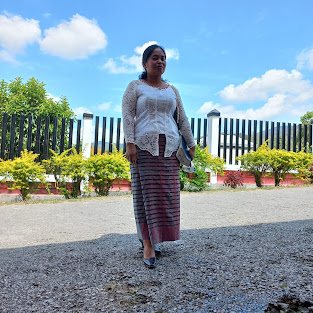
Uli has chosen to wear the fruits
of her own loom to Church
Now Uli has chosen to wear the fruits of her own hand loom to Church on Sundays instead of a purchased dress. She noted the progression in her thinking: “… after I started to weave, and read many perspectives about weaving, about heritage textiles of Nusantara, I discovered that the right way to dress was the way our ancestors dressed. They spin, weave textiles for all occasions, and suitable for all circumstances; it is the strength of the patterns, fibres, that they are able to handle nature’s elements and are so durable that they can be passed on to the next generation. Therefore, these are the clothes that are appropriate for these tough economic times. Moreover, clothing that is not cut and sewn highlights the ‘tangkup’ side of every person.” 


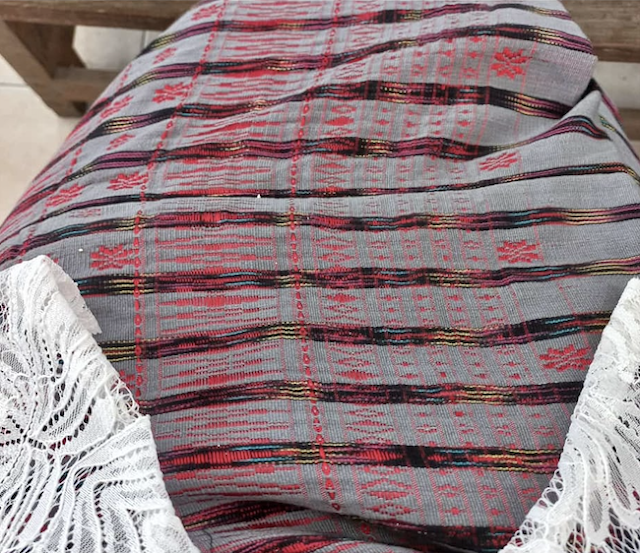
Uli took a photograph of her lap showing a close-up of her 
fine weaving. She explained that she is using kain and
kebaya, her traditional dress, to express her opposition to the
industrialisation of her weaving tradition and the
garment industry.


Uli gave her writing the title, ‘tangkup’ and explained that it denotes ‘fitting clothing’. She had been blessed with the quality of ‘tangkup clothing’, she noted – although there was nothing exceptional about her birth that had augured this good fortune. ‘Tangkup’ means that “I and the clothing I wear are mutually enhancing”. ‘Tangkup’ is not about the quality of the clothing per se, because “if anybody else wears my clothes they may suddenly no longer be nice to look at.”


I find this word 'tangkup' interesting and sense that it offers a glimpse into the traditional world of Batak dress. It seems to denote the combination of wearer and clothing. The emphasis is not on the material item. Uli’s perspective reminded me of the words of a Javanese photographer (MJA Nashir) who explained to me years ago that when some people wear clothes, regardless of the quality of the clothes, they look nice, while others don’t look nice regardless of the beauty of their clothing. This was a new perspective on clothing for me at the time and I wondered if there was a spiritual dimension to this talent. When I asked Uli she said she was not aware of a spiritual quality but she thought that charisma and grace figured in the nature of ‘tangkup’. 


It strikes me that as we, in the North, search for ways to make our clothing systems relevant once more, and less harmful to people and the physical and animal environment, we might gain from Uli’s insights, quandaries and challenges. The word ‘tangkup’ in the Batak language also denotes the ‘capture of objects and concepts’. May we ‘tangkup’ the Batak perspective on grace and charisma in dress. As an aspiration it holds a promise of beauty. And may the Batak clothing system survive to demonstrate the concept of ‘tangkup’ – even wile this may entail an overhaul of the fashion industry. 


....


 Postscript


I show Uli my blog, what I have made of her Facebook post, to request her permission to publish it on line. She is concerned that her criticism of the West (the Netherlands in the colonial era) is harsh and she asks me to receive her words in the spirit of friendship. She knows how hard it is for her when people criticize her country.


I reassure Uli that her words are not too radical and that we at Fashion Act Now are all about reforming the Fashion industry. Moreover, the fashion industry is multinational and not perceived as being owned by a single country. Currently it operates as a cancer throughout the world. 


I point out how important it is that we, in the West, become more aware of the ills of the fashion industry in other regions of the world and that this explains why we are so happy with her posts. The industry is already much, much, much too large and is not concerned with other dress systems, except perhaps to exploit them.


Uli immediately understands my perspective.  “The problem is that up until now, in the Batak area, the West has been the model of what clothing should be. Even if the clothing is produced in China or Korea. And then there are also the problems of waste, consumerism, and addiction to shopping,” she points out.  


“Yes, we are all victims,” I say in response. “What is distinctive regionally in Western countries is also erased by this huge industry. These are some of the sacrifice zones of fashion. We write about this on our FAN website (fashionactnow.org).”


The penny drops. “This means that we are all ruined by the industry,” Uli responds.


 “Yes, in this age, we are all victims of all kinds of large industries, oil and gas, palm oil, fishing, fashion, electronics, everything. And we must oppose this. Already 75% of wild animals have disappeared. The number of bees is declining drastically, and so on.”


“In Indonesia there is the view that if we don’t embrace development, we will be ‘without clothes’ forever,” in other words "that Indonesians will continue to wear their traditional clothing." This perspective saddens her. 


I concur. “This is colonial thinking,” I say. 

“It is the kind of thinking that justifies all exploitation, including of nature,“ says Uli. 


I confide that it is my crusade to try to raise awareness that every culture has its own clothing tradition and that all are valid. The Western variant is destructive to all others Why? For monetary gain. The industry prioritizes its own dominance and that entails continued growth. 


“We sacrifice land, rice paddies, forests, farmland and water for the sake of development,” Uli confirms. “Development for Batak people shows up in clothing and cars. This is obvious on ritual occasions such as weddings when people wear every kind of blouse (kebaya) and so on. They feel ashamed if they don’t wear flashy new clothes. My clothes have a minimum of glitter and I only wear the old style of kebaya (blouse). I do this intentionally. I am a model for the campaign. I also wear my grandmother’s sarung. I purchase second hand clothing for myself, and new clothing only for my daughter.”


Once again, she is on the same page with Fashion Act Now. We, too, purchase a minimum of clothing and try to salvage and utilize what is still wearable. 


Wednesday, December 08, 2021

How the spirit of weaving returned to its body

Agus really wanted to go to a national university and she thought that would please her parents. They had often gone on about how amazing it would be if one of their children were to obtain a degree from a national university and they were willing to make huge sacrifices, such as selling their only water buffalo, to make that happen. But in the meantime, they no longer had a water buffalo. The hard times they were in were hard indeed. Agus took the entrance exams and managed to win a full tuition scholarship. She was over the moon and knew her parents would be as well. She had really done her best, gone to a neighbouring city for the first time on her own, and focused intensely on the exam. She knew it was her one and only chance and she succeeded! Back in the village she told her mother about her achievement and her mother burst into tears. Agus assumed that the tears reflected how deeply moved her mother was by Agus’s achievement, but she was wrong. Her mother lashed out in anger. “Why would you do this when we are not able to pay for your needs in the city?” she asked Agus. “I am so ashamed.” 

 I pondered what Agus told me. Her mother must have been suffering very deep regret at not being able to facilitate her daughter's education.
 
Agus managed to overcome the situation by finding a sponsor who saw her through to the end of her degree. Recently she has been in a celebratory mood because she has graduated. She now holds a Bachelor of Arts from a national university and has letters beside her name. She has every reason to feel very, very proud. It was her indomitable courage that saw her through. She received her degree with self-confidence, pride and resolve. But I had a niggling concern. How would her mother be feeling given that someone else had supported her daughter? “Does your mother feel a little ambivalent toward the sponsor?” I asked. 


There is no doubt that Ompu Elza also felt proud. Agus dressed her in the graduation toga and took a photograph of her standing solemnly in front of the University, holding Agus’s graduation diploma. But was there also a tinge of sadness, regret, perhaps even a touch of resentment that she had not been the one to enable her daughter’s achievement? I knew Agus well enough that I could ask that question; I wanted to confide my concern about her Mom. I knew what my feelings would have been in her place.


“I will tell you what my mother said,” Agus answered in a decided way. “She said, ‘The spirit of weaving has come back.’”  I had not expected this answer. What did weaving have to do with Agus’s accomplishment? Agus explained. “Mother’s life was weaving. She started when she was very young and she did it every day. Her spirit and the spirit of weaving were one and the same. But then the spirit of weaving left her.” Agus knew precisely when. It was about twenty years ago, when economic circumstances forced her Mom to stop weaving, leaving her heartbroken. Try as she might, she was no longer able to meet her family’s needs by selling the products of her loom. That was how the spirit of weaving left her and how she withdrew from it. 


“A lost spirit will return when a body misses it and new sprouts will grow,” Agus explained to me.
 
I had to digest this. It appeared that Agus’s mother attributed Agus’s success (and thus her own good fortune) to the spirit of weaving. “Is it because she has started to weave again that she credits the spirit of weaving for your achievement?” I asked Agus. But Agus didn't know how to deal with my question. I think that the way I had framed it just didn’t make any sense across our cultural difference. She answered with a parable. 
 
“We plant a root crop (ubi) and the roots sprout new shoots. We can’t tell what the harvest will be because the roots are covered with earth. They can be covered up for a long time. Inang [the sponsor] came and tidied up the earth around the plants, cared for them.  And then there appeared to be new shoots. They represent hope.”


Ompu Elza at her loom. She returned
to it in 2015 - before the spirit returned.

But what made the spirit of weaving return?” I persisted.  “We don’t know whether the spirit of weaving attracted the sponsor, or whether the sponsor attracted the spirit,” Agus answered simply. The very question seemed irrelevant. “The point is, it returned, and it hadn’t been there for some twenty years. When the sponsor came to clean up around the plants, apparently there were still some shoots; they were still alive. Hope was still growing in the ground.” 


This story has kept me in its grip. It reveals so much. In the first place, about gratitude. Agus does what she does, to the best of her ability; so does her whole family, including her mother. I, as 'the sponsor', did what I did. We are only human and we proceed as we proceed. For Agus's mother, it is the spirit that prevails and bestows us with success, if it is to be ours. For us there is but one option: to feel gratitude when it bestows. That's when we experience good fortune. ‘Rejeki’ comes from a higher hand. The spirit prevails. Gratitude is built into such a stance. It is central to life,; it is not just a feeling.
 
Agus’s story told me, too, that Agus’s mother has felt very engaged indeed in her daughter's
university career and in that pinnacle: her graduation.  Agus’s success had awakened her Mother's weaving spirit. It had been buried there, under the surface all that time, capable of sprouting new shoots. This told me how deep Ompu Elza’s pain had been when she was forced to put down her loom, and just how profound the antidote of her daughter’s graduation had been. It restored pride, well-being, a sense of being fortunate. 

Agus with her father not long before
he passed away

All of this confirmed that the spirit of weaving is sweet and good.  It is a source of blessings, ability, pride, self-respect. It truly is a core of Ompu Elza’s being; how deeply lived, the act of weaving can be: positivity and hope, like the shoots of new life, the essence of life.
 
And I learned about how my Simalungun family lives reciprocally with spirit. I learned about their two-way engagement with the spirit world. Like tending plants. We tend them and they tend us in return. Like the line in a Batak prayer about nurturing rice so that it can nurture us (Eme na hupagodang; Eme na pagodang ahu). When Ompu Elza wove, she was nurturing her weaving spirit. And when she was forced to stop weaving, she lost the spirit that was nurturing her existence. 

Postscript

Sometimes reality seems to take a strange twist. Then it becomes a challenge to locate the truth. This time, however, I think it is pretty clear where it lies. And that egg? Is it on my face? I choose to be lenient; this is just the way learning in a different culture proceeds: lots of twists, lots of egg, triangulation and hopefully learning. Let me explain:


Yesterday I shared with Agus’s elder sister, Lasma, how proud her mother had been at Agus’s graduation and I mentioned that Ompu Elza had used the expression ‘roh tenun’. I wanted to get Lasma’s take on her mother’s ‘weaving spirit’. I also wanted to know what the Simalungun word would be for that spirit that had returned to the body. 


Lasma told me that ‘roh tonun’ is said when someone completes a difficult task that has taken a lot of time, something like ‘congratulations’ but then with more weight. I didn’t get it. Why the word ‘tonun’ (Simalungun for weaving) and why ‘roh’ (spirit)? 


It turns out that some confusion hinged on the word ‘roh’, meaning spirit in Indonesian but meaning ‘come’ in Simalungun. I didn’t know that, and had thought that the Toba word for come, ‘ro’ was used in Simalungun. Lasma explained that the expression ‘roh tonun’ means ‘weaving comes’. I confirmed that with my Simalungun dictionary – and will have to get back to Agus to see how she responds to this discovery. She had spoken to me of ‘roh tenun’, in Indonesian, ‘the spirit of weaving’. Could be that she was  mixed up between the Indonesian and the Simalungun? 


But I still didn’t understand why ‘roh tonun’ would be used to express congratulations for a really considerable accomplishment. Lasma had an insight into that as well. “This is an expression that is used by weavers,” she said. When a weaver finishes a textile, the other weavers in the group will say, “Roh tonun” to compliment her. She had learned this from her grandmother, Ompu Elza’s mother. The accomplishment is considerable because it is a long and complicated process to weave a cloth. The process of weaving is apparently used as a kind of measurement for a considerable accomplishment, hence it was used by Ompu Elza. 


Once again, however, this interpretation confirms the positive light in which weaving is held.  Whew. But I am still horrified by the extent to which Agus and I had been spinning a tale rather than accurately interpreting a Simalungun expression.


Postscript 2

I shared with Agus what Lasma had told me, and Agus said that it did not alter her story. She had been talking about 'jiwa tenun', the spirit of weaving, and she had obtained her information from her mother. She knew her story to be true. 


I guess I have to go back and share this news with Lasma. Or ask Agus to talk about it with Lasma.... Reality is not always clear. There can be different perspectives, different experiences, different interpretations. Interpretations can be dynamic and malleable. Culture is never cut and dried or singular or clear, and the process of digging to understand an interpretation can shed much light.

Saturday, December 04, 2021

Stuck/Mentok vs. Memeyu Hayuning Bawana/Making the Beautiful World More Beautiful


Batik work by Mbak Nia and Mas Ismoyo

I had the honour of being asked to offer my opinion (to be a ‘penganggap’) at the Art and Dialog event put on by BSG (Babaran Segorogunung) in Yogyakarta, Indonesia, on November 27, 2021. I was excited by the goals of the event and I have long admired the people involved. As I perceived it, the Art and Dialog event was gently exploring a healing response to the current turmoil in which our world finds itself -- specifically to the heartache caused by the COVID-19 pandemic, which has been very hard on Indonesian artists They have received little support, have no security, and don’t know what the future will hold. But I felt that the BSG strategy had much larger significance. Earlier in the same month COP26 concluded in Glasgow. I perceived it as a failure at a critical time – despite some positive groundwork having been laid. Both COVID and increasing global heating place Indonesia in a very difficult position. Indonesia is being thrown upon itself; economic dependence on the 
outside world is precarious. The tourism industry, uncertain anyway, was now no longer sustaining the artists at all. To where and what could they turn?


The important groundwork at COP 26 was precisely the ‘coming closer together’ of the parties which, during the course of the past century and longer, have been drastically separated by economic and political history. To solve global problems the globe has to come together. I perceived Art and Dialog as an opportunity to come together but not to just exchange sentences and opinions across formal and informal tables. It was about a more holistic coming together, and spectacularly, not about earnings, economic growth and social profile. It was about collaborative caring and authentic growth rooted in culture, history and being-in-the-world. You may be scratching your head and wondering why I am comparing a COP to Art and Dialog, but that is precisely the point. COP failed, and civil society has been thrown upon itself to forge solutions. A solution will not come from more of the same that got us into this existential pickle in the first place. It must come from the ground up. In fact, structurally, we are all in the position of the Indonesian artists. We have all lost our future security and we must all learn how to build it back wisely and sustainably. I read into the Art and Dialog event a profound response to the world’s problems


I was struck that mas Ismoyo’s intentions revolved around the dialogue between humans and nature as a wellspring for both art and life. I was also struck that mas Nashir, one of the designers of the exhibition, juxtaposed the artworks in such a way as to maximize wordless   ‘dialogues’ among the pieces, and between them and the surrounding nature; that he included the ‘art’ of a neighbouring farmer in the assembly. Key here is mas Ismoyo’s word: ‘sensibility’. The dialogues going on were multi-layered and multi-intersecting, explicitly involving all of the senses. Art and Dialog was not just about the art pieces and the discussion that we ‘opinion givers’ were to offer. It was about our relationship to the past, to culture, to our world, to what it means to be alive, to each other, and to our future. The event embodied and enacted openness to values and people and regions and ideas, to enhance our sensibilities to each other and to our surroundings. I experienced it as an antidote-in-action to the world’s problems, the product rooted importantly in the process.


I find the word ‘stuck’ evocative. It is so everyday, so earthy (wheels in mud); it so easily elicits memories, nothing highbrow. Yet it is being used to characterize our place in history. Authors David Graeber and David Wengrow make ‘stuckness’ a leitmotif of their already heralded new book, The Dawn of Everything: A New History of Humanity (2021). We in the North have slammed into the limits of our ability to imagine other ways of organizing our society. How could this have happened when history and all the cultures of the world constitute a parade of experiments in social organization? And why did we get stuck in one that is killing the earth? We are caught in a vortex that reduces every diverse kind of value to monetary wealth. Where money is generated as a result of debt -- which is how our economic system works -- destruction can only be the result. The great monetary wealth in our world is paralleled only by the great collapse of its living systems.


Stuckness is like being in a theatre when you want to escape a film and you can’t find the door; like being unable to awaken from a nightmare; like needing to slam on the breaks only to discover that they are failing. These are confrontations with tipping points, crucial moments of change that should be avoided. You end up in a landslide where you have lost the capacity to steer. We, in the North, are stuck. There have been about 30 COPs and still the CO2 emissions are going up. COVID-19 is mutating and still we have not got it together to sufficiently share the vaccine with the rest of the world.


I decided to centre my remarks at the Art and Dialog event on a graphic that depicts our nightmarish proximity to a critical tipping point. I badly wanted to share my perception of the profound importance of the Art and Dialog event from this perspective. After I spoke, mas Harjuno, among those assembled, expressed his confidence in the track record of humankind to find new paths and new ways. His comment was key. That is precisely what is needed, and  precisely what we, in the North, cannot find. Graeber and Wengrow also turned to the parade of other cultures to highlight pathways out of stuckness. This was the stock that I was placing in the Art and Dialog explorations. The event would not find a solution to world problems, but it was a forum to explore avenues to get unstuck. I put my faith in the intention of the event: the focus on relationships, on full-rounded, respectful dialogue, on including nature in everything. 


This is the nightmarish graphic showing the trajectory in which we are stuck:


This is a screenshot of a webinar slide shown by Dr. William Rees last May at a Canadian Club of Rome meeting, entitled “Too Clever by Half, but Not Smart Enough”. The slide shows the impact of fossil fuels on human population and economic growth. It is both a demonstration and an explanation of the global addiction to the stuff. The fuels have enabled a century of growth unlike any other in the history of the world. Common sense alone tells us that this trajectory cannot continue. In Rees’s terms (ecological footprint analysis), we already need 5 earths to support current levels of production/consumption. However, some 30 COPs have not been able to avert our course, even when there is no doubt that the future of life as we know it is hanging in the balance. Many now believe that collapse is inevitable. Others continue to fight for a swift and controlled reduction in the mining and use of fossil fuels, and of production and consumption. Will the future overtake us or will we determine our own fate? In either scenario, the upward line will turn down. William Rees depicted the familiar rapid decline that has been documented when other species run out of enabling factors for continued expansion.  


Our ‘stuckness’ in the North is spelling doom for the whole planet. That is unfair, as it is the ‘fault’ of the North. ‘We’ developed the dependency on fossil fuels and, for the sake of continuing growth, imposed it on every corner of the globe. Many suspect that COVID-19 is symptomatic of human encroachment on wilderness.


How does Art and Dialog relate to this? Specifically it does not, but in spirit it might very well be central. Mas Ismoyo and mbak Nia, the initiators of the event, have been profoundly influenced by the ancient, spiritual core of the art of batik, Memeyu Hayuning Bawana, making  the beautiful earth more beautiful. [I have blogged about this before.] 


In the midst of rapid technological developments, there is still a spirit to re-examine the fragments of life or the philosophy of the creative process in traditional societies to complete the balance of life in today's era with the aim to achieve a holistic creative expression that builds intimacy that is one with nature. With the goal that artists can achieve harmony, balance, serenity in a process of creating with aesthetics rooted in ethics. There seems to be a tendency that the deeper our intimacy with progress, the more fertile the desire for belonging, maintaining gratitude and devotion to a natural lifestyle that could hold an integral connection between the human mind and natural ecology and the source of creativity. 


I perceived that by sharing this scientific perception of the current state of the world and history, it might be possible to facilitate more communication between North and South. I wanted to convey my conviction to these artists, whose underpinnings have been knocked out from under them by the impacts of COVID, that their work is at the core of what the world needs today. I perceived it not so much as a search for solutions, but rather being the solution through their search, dedication to making the beautiful world more beautiful (Memeyu Hayuning Bawana) being central. I was touched when time was taken at the opening of the event to pray for its smooth execution. This was conducted in traditional ceremonial form (Pengawikan) with chanting, incense and holy water to bless all. It situated us a sacred space together. It was moving and it kindled hope.


I am a specialist in the textiles of the Batak peoples of North Sumatra and a Defashion activist. Western fashion is ‘stuck’. Industrial clothing is being produced ever faster; is worn ever less; is tossed away in all its toxicity to pollute the earth and clog waterways. And the industry remains hell bent on greater expansion. It is unable to self-regulate and the parameters of nature never figure in its calculations. It is engaged in a frenzy of production and does all that is within its power to expand consumption and thereby enable its continuing madness.


Against this backdrop the original handwoven garments of the Batak have become increasingly precious to me. Fieldwork in North Sumatra has made me privy to the life and thought of many weavers; they and their woven cloths have introduced me to the complexity of the art. I am awestruck. And that awe translates into a dull awareness of the superficiality of commercially produced clothing. It is naked speed, exploitation, competition and clock-punching combined with mythical delusions about dressing to enable becoming ‘whoever we want to be’ – all facilitated by the fossil fuel industry that provides synthetic fibres, synthetic dyes, extensive supply chains, industrial agriculture and so on. We are stuck in that, and with every item of clothing that we buy, we support it. Since the globalization of fashion, the whole world is stuck in that. Modernday Batak have also been sucked into the vortex. 


I cannot imagine that the human spirit will allow itself to remain in these shackles. Surely we will demand a way out. I choose, however impractical and irrational it may seem in the eyes of others and even, at times, myself, to treat the remaining precious, thoughtful, heritage-conscious weavers in the Batak region as a possible bridge to a better future. I have long cherished the conviction that the depth of thought that I have discovered in indigenous wisdom is the precious, precious antidote to our stuckness in the heedless suicide of over-production and over-consumption.  The traditional Batak weaving arts and clothing system are a kind of lifeline; a testimony; a source of inspiration; a proof of possibilities. Like the Borobudur ruins rising majestically out of the plain offering mysterious direction and hope. A Batak weaver, and weavers from every other indigenous culture, belonged fully in our midst at Art and Dialog. I felt I was among friends there; we shared the same spirit. I may have been there as a ‘penganggap’, someone to share my opinion, but I was also a member of the same world, the same dialogue.  


Mas Ismoyo and mbak Nia did not use the word ‘stuck/mentok’ in their Art and Dialog proposal, but I realized that the Art and Dialog event emerged out of a recognition of stuckness combined with a longing to celebrate the precious expressions of human possibility, and the will to pass them on to the youth. The Art and Dialog event was like the flower whose beauty and freshness we were thankful for in mas Miko’s art piece. His piece, as I understand it, was a cry of hope in the midst of the pandemic, but the symbol he constructed is universal.


Kerapuhan yang Membangkitkan  (Fragility that Generates)
Miko Jatmiko, Borobudur 18 Novembr 2021


The meeting gave me hope because it referenced that solid, diverse, magnificent backgound that Indonesia has to fall back on: its rich history, and culture from times past, what mas Ismoyo calls the ‘cosmocentric time period’. Has COVID engendered an opportunity to pick up an ancient thread, to recover precious gems from a buried past, and allow newness to emerge? The possibility of greater self-determination? Is this the silver lining of the pandemic?


Rusa Bersayap (Winged Deer)
MJA Nashir, 2021

MJA Nashir’s statue, the Winged Deer (Rusa Bersayap), resonated strongly with me. He resurrected it from forgotten, rotting wood buried in the ground behind his house, a symbol of revival that can both demonstrate and express the capacities of the human spirit. When he made it, he felt that he was freeing something alive and spiritual and for him it was the spirit of nature expressed in ancient cultural idiom. It was the hope that emerges from possibilities and a signpost. I particularly like the mythical and the mystical aspect of the winged deer. It is not just a likeness of a deer anymore than Ismoyo’s batik is just a dye technique applied to cloth. It references cultural wisdom, knowledge that has been passed down from one generation to the next, from one culture to the next. 


MJA Nashir stumbled across this buried wood while cultivating his garden. By chance. It has become the spirit of his garden. Automatically I think of Voltaire’s advice to cultivate one's  garden. For Voltaire it represented withdrawing from the corruption of society to find and preserve the authentic self. For my Indonesian friends, cultivating the garden is about authentically reconnecting, entering dialogue.