Showing posts with label I.L. Nommensen. Show all posts

Wednesday, April 02, 2014

Rangsa ni Tonun has now been to Bandung

We decorated a corner of the huge aula of the Sabuga building on the ITB campus by displaying Batak textiles on panels, thus creating a cozy space. Within that space, we projected Rangsa ni Tonun. We were able to offer copies of the film and book about the film for sale in a neighbouring booth.

I would like to thank the executive team of The Story of Buku Ende for their generous and kind support of the Pulang Kampung III expedition. Our textiles and film were invited to be part of the performance of The Story of Buku Ende; we were allowed to set up our exhibition and project the film in the aula of the Tiara Hotel in Medan in September 2013, and now once again in Bandung. Both have been wonderful opportunities to share our film with the public.

MJA Nashir's poster designed for
The Story of Buku Ende

‘The Story of Buku Ende’ is a musical, a choral drama that highlights the relationship that Batak Christians have (had) with their hymn book (buku ende). Audiences love it. The songs go straight to their hearts and many just can’t refrain from singing along with it—and the Batak are renowned for their musical abilities. They know the tunes because they sing them every Sunday and during rites of passage. They remember their youth and their parents’ and grandparents’ stories. The musical is a compilation of vignettes from daily life.

There is a synchrony between Rangsa ni Tonun and The Story of Buku Ende. Both are artworks that take Batak history as their starting point. Both translate Batak culture using contemporary media and interpret it for the modern world. People often assume that I want to “bring back” the Batak world of the past. This is far from the truth. What I sincerely hope is that the Batak people will be able to build their future on their past so that it remains meaningful to them and there is a measure of coherence in their lives. Both Rangsa ni Tonun and The Story of Buku Ende are examples of artworks that have brought the past meaningfully into the present day.

There was another connection between Rangsa ni Tonun and The Story of Buku Ende. Both have the great Prophet of the Bataks, I.L. Nommensen, as their point of origination. Nommensen was instrumental in having the Rangsa ni Tonun text committed to paper and in bringing German hymns to the Bataklands. In the first instance, he was the reason why a Batak text ended up in a German archive and in the second instance why German musical culture became grafted onto the Batak musical tradition.

The contemporary connections are also vivid. Irwansyah Harahap and Rithaony Hutajulu, the artistic directors of The Story of Buku Ende, arranged, performed and recorded the music for Rangsa ni Tonun. They recruited the filmer of Rangsa ni Tonun to direct the stage visuals of The Story of Buku Ende for the Bandung performance. Under MJA Nashir’s expert and creative guidance, the stage became satisfyingly colourful and complex.

It was an honour to be able to show Rangsa ni Tonun to the audience of The Story of Buku Ende. We hope that Rangsa ni Tonun’s following might also have augmented the audience of The Story of Buku Ende. It was fun to meet the huge and dedicated crew of The Story of Buku Ende. All of them loved to be part of The Story and hope that they will succeed in having the musical staged again next year in Jakarta.

I hope so, too. All Bataks love the musical. And if there is an opportunity to show Batak textiles again as a sideshow, I will leap at the chance. I would like to explore the integral role of Batak textiles in The Story of Buku Ende and thus in Batak culture.


Thank you to our dear friend, Christian Gultom, for his assistance in setting up our exhibition, and also to your friend Edianto Karokaro who helped out. His role was crucial and highly valued.

Thursday, September 19, 2013

Back to Guru Sinangga's Village


Suddenly there was no electricity in Hutabarat yesterday. We were there, in the Silindung Valley, to show our film in my older sister’s home (ibu Bonaria Hutabarat). I asked if we couldn’t perhaps go to Sait ni Huta in the meantime and at least see the church and place of origin of Guru Sinangga Matondang. A few moments later, we stood in Sait ni Huta where the huge, golden statue of Nommensen is erected. A large church there has the dates 1864 1933 painted above the door.  

Gereja Dane built in 1933. (Photo by Ojak Tampe Silaban)


Apparently that church was built in 1933, long after Nommensen had moved to Sigumpar. (He died in 1918.) The candidate minister who greeted us there in the village centre ushered us into the church, said that the original church built by Nommensen was no longer standing. A small monument had been erected to mark its place in the neighbouring cluster of homes.

The second church built, in 1864, was across the street from this big new church. 
The church built in 1864. Nommensen moved to Sait ni Huta in 1863, so this would have been the church that he built and used. (Photograph by Ojak Tampe Silaban)

It was now used as a Sunday School. Because the big church was so light, I asked if we could see the interior of the church built in 1864 and we were given this opportunity. Entering this building, the sense of history was much greater. The structure was older and darker. It was clear that this was the better building for a film showing. Ibu Hutabarat and I mused about what kind of seating there must have been in Nommensen’s day.

While Mas Nashir and some of the team were setting up, our big red bus went back to Hutabarat to pick up people who might like to come to see the film and Ibu Hutabarat, Lasma and Febrina and I went off to see the monument to the first church. As luck would have it a cluster of small children was twisting textile fringes and I filmed them as Lasma and Febrina talked with them. 

We brought a group of these children back with us for show time. Most of our audience was children.

And then there was the magical moment. There we were in Sait ni Huta, telling the inhabitants about the great Guru Sinangga Matondang, letting them know that through Nommensen’s intervention an oral text had been written down and was now stored in Europe and that we were ‘bringing it home’. While every screening has been an act of ‘pulang kampung’, this one in particular, was the real Pulang Kampung: back to the place of origins. Our first stop on our long trip was to Sianjur Mula2, the place of origin of the Bataks and now one of last stops is the place of origin of the text.

The woman sitting beside me during the screening mumbled some of her reactions. I could see that the language of the text was familiar to her. Not all of the weaving techniques were familiar, however, and I was reminded that our film really is a hodge-podge of reconstruction with a text from one place and weaving techniques from several other places in Toba. I explained to the audience the challenges that we had faced during the filming and how we had had to pluck skills from here and from there and that we had been lucky to find all that we had found.

I felt humbled by this Pulang Kampung act. It was so special to do it with the assistance of my ‘older sister’, Ibu Bonaria Hutabarat, deakonesse. It moved me to give her a copy of our film when we were done. She has known me since I was a scared 24-year-old coming to Tano Batak for the first time. And now she is elderly and I have established my own ‘style’ as an anthropologist. We faced each other yesterday as two women who have shared 35 years of our lives, grown and changed together.
Ibu Bonaria Hutabarat told some school girls about Nommensen after our
film had been shown.


We also gave a copy to the candidate Minister who told us that he wanted to erect a museum to Nommensen. It is likely that our film will enter the museum. Did Guru Sinangga become a Christian? Did he commit his knowledge to paper as ‘a heathen’? What was the nature of his relationship to Nommensen? Did he ever enter the church where we showed the filmed version of his text? The candidate minister was moved by our film and our devotion to Batak culture and said that he would like to see it many more times. There have been indications during Pulang Kampung III that many Batak believe that the church has been too strict and narrow in its acceptance of Batak culture. Will the presence of our film in the Nommensen museum in Sait ni Huta signify a re-unification of culture and religion? The fact is that the Rangsa ni Tonun text was among Nommensen’s papers. What did that mean in Nommensen’s day? Just language study? Admiration of the guru? We don’t know the answers to those questions, but the reception of the film in Sait ni Huta yesterday was a hopeful sign for the future.

Friday, March 01, 2013

2. Boat Budaya / Culture Craft


Back to the Villages III will take up the ancient tradition of water transportation to ferry the film, Rangsa ni Tonun, from place to place.

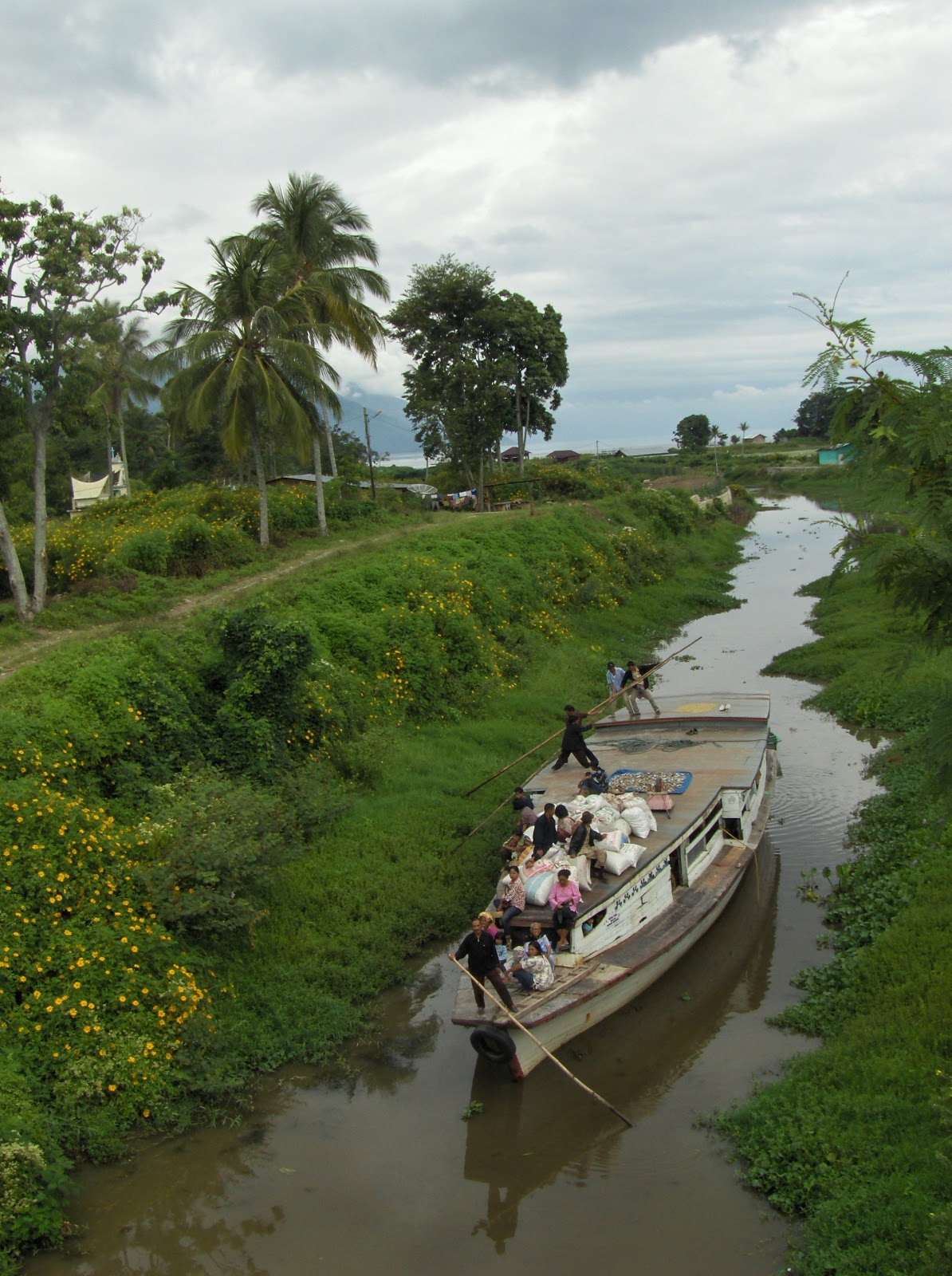
Historically, Batak weavers have been concentrated around Lake Toba. The largest Batak markets were also situated in natural bays along the shoreline. Before the mechanical age, the Batak used large dugout canoes to transport people, animals and goods from one market to the next and from one village to the next. The flat, smooth surface of the water (when the winds are calm) are inviting, especially when compared to the difficult mountainous terrain surrounding the lake.

Flat mirror-like surface of Lake Toba -- on a calm day!
Road traffic may have eclipsed water traffic in efficiency and speed, but it certainly doesn’t beat gliding over the surface of the water when it comes to pleasure. Of course we will be using a ‘kapal’, a large market or tourist boat. Nevertheless, our poster nostalgically depicts the romantic dugout (solu bolon) from a bygone age to emphasize the cultural mission of our journey. Alas, such dugouts are no longer being made or used. (Can they be revived?) No doubt, the market and tourist boats that currently glide across the water are more suited to our needs. They are large enough to accommodate dozens of people and huge freights and the decks are covered and protected from wind and weather.

This market boat, with fish drying on its roof,
is squeezing with difficulty through the narrow
channel separating Samosir Island from the
mainland.
Even the great Missionary L. I. Nommensen used a boat to spread the gospel around Lake Toba in the 19th century. Archives reveal that he imported a special boat from Germany to use in North Sumatra. (Where, oh where, is that boat, or its remains, today?) Given that the narrative text of the Rangsa ni Tonun film was written down at Nommensen’s behest, it seems fitting to spread this remarkable specimen of indigenous culture by boat.

We settled on the epithet ‘boat budaya’ for our project for a variety of reasons. 'Budaya' is the Indonesian word for culture. The ‘boat budaya’ is a ‘culture craft’, a boat dedicated to cultural heritage. Boat is an English word but it may as well be Indonesian as it is used so often colloquially. And doesn’t it just pop out nicely?

Might there have been Indonesian alternatives? We tried several on for size.

'Biduk Budaya' mouths nicely, but we rejected ‘biduk’ because it is too arcane. We need accessibility and immediate recognition!

'Perahu' is a fairly neutral word for boat, but a ‘Perahu Budaya’ has no charisma. ‘Kapal Budaya’ is just as flat, however accurate it may be. We need magic!

'Bahtera Budaya' has a nice ring to it. 'Bahtera' is at home in both Christian and Islamic environments. A good translation is ‘ark’. A formidable candidate, it just doesn’t enunciate as nicely as Boat Budaya. And we need a festival feeling of freedom!

The blend of cultures in Boat Budaya is a plus and not a negative in my books. The mixture designates a project that is being set up by a multicultural duo (the Javanese-Indonesian Nashir and the Canadian-Dutch Niessen) and well represents some of the bounty that can be harvested from successful cooperation between North and South.

We need the Boat Budaya!

A variety of small boats in Silalahi on the shore of a mysterious Lake Toba.
(Photo by MJA Nashir)