Friday, March 01, 2013

2. Boat Budaya / Culture Craft


Back to the Villages III will take up the ancient tradition of water transportation to ferry the film, Rangsa ni Tonun, from place to place.

Historically, Batak weavers have been concentrated around Lake Toba. The largest Batak markets were also situated in natural bays along the shoreline. Before the mechanical age, the Batak used large dugout canoes to transport people, animals and goods from one market to the next and from one village to the next. The flat, smooth surface of the water (when the winds are calm) are inviting, especially when compared to the difficult mountainous terrain surrounding the lake.

Flat mirror-like surface of Lake Toba -- on a calm day!
Road traffic may have eclipsed water traffic in efficiency and speed, but it certainly doesn’t beat gliding over the surface of the water when it comes to pleasure. Of course we will be using a ‘kapal’, a large market or tourist boat. Nevertheless, our poster nostalgically depicts the romantic dugout (solu bolon) from a bygone age to emphasize the cultural mission of our journey. Alas, such dugouts are no longer being made or used. (Can they be revived?) No doubt, the market and tourist boats that currently glide across the water are more suited to our needs. They are large enough to accommodate dozens of people and huge freights and the decks are covered and protected from wind and weather.
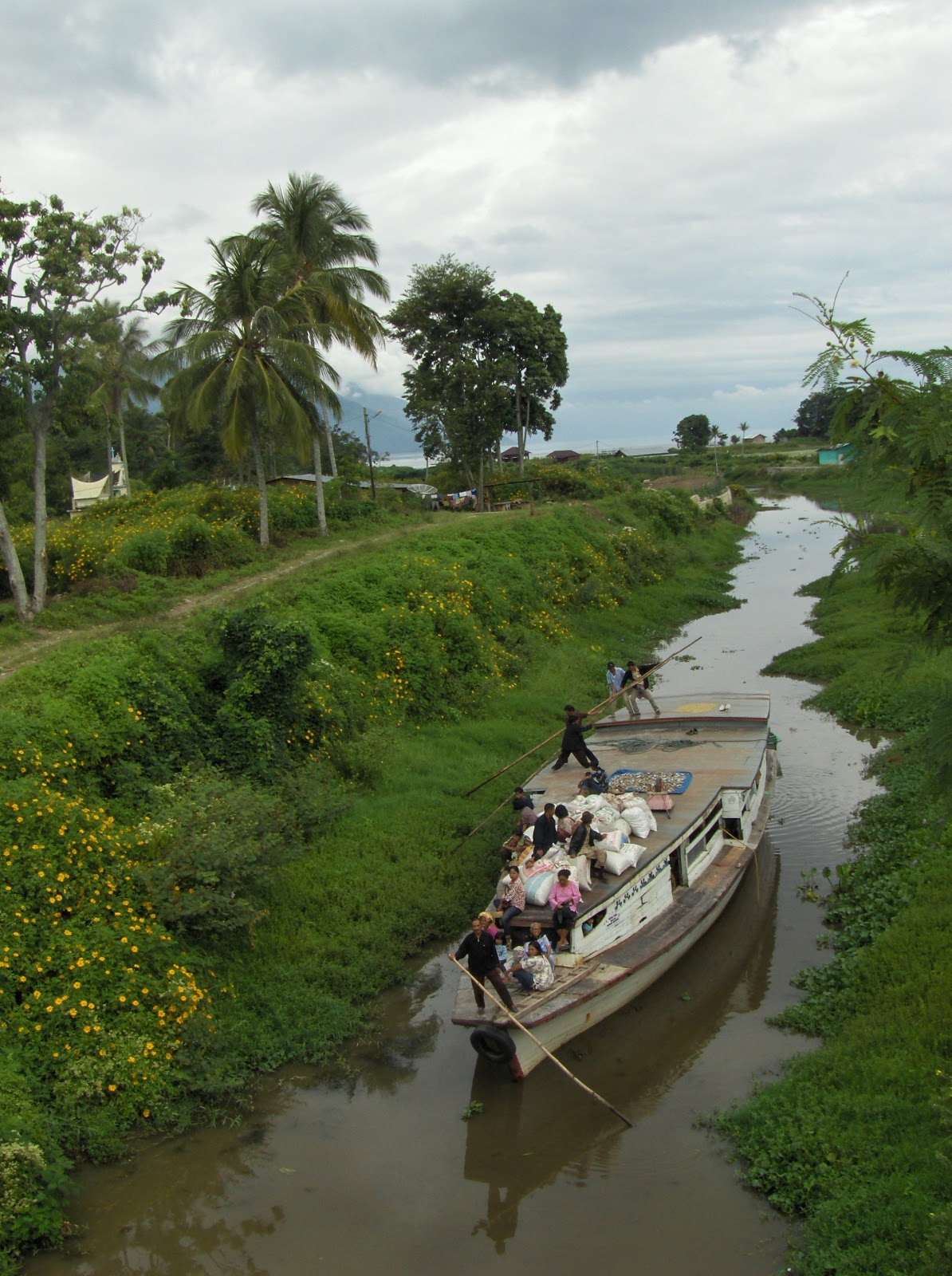
This market boat, with fish drying on its roof,
is squeezing with difficulty through the narrow
channel separating Samosir Island from the
mainland.
Even the great Missionary L. I. Nommensen used a boat to spread the gospel around Lake Toba in the 19th century. Archives reveal that he imported a special boat from Germany to use in North Sumatra. (Where, oh where, is that boat, or its remains, today?) Given that the narrative text of the Rangsa ni Tonun film was written down at Nommensen’s behest, it seems fitting to spread this remarkable specimen of indigenous culture by boat.

We settled on the epithet ‘boat budaya’ for our project for a variety of reasons. 'Budaya' is the Indonesian word for culture. The ‘boat budaya’ is a ‘culture craft’, a boat dedicated to cultural heritage. Boat is an English word but it may as well be Indonesian as it is used so often colloquially. And doesn’t it just pop out nicely?

Might there have been Indonesian alternatives? We tried several on for size.

'Biduk Budaya' mouths nicely, but we rejected ‘biduk’ because it is too arcane. We need accessibility and immediate recognition!

'Perahu' is a fairly neutral word for boat, but a ‘Perahu Budaya’ has no charisma. ‘Kapal Budaya’ is just as flat, however accurate it may be. We need magic!

'Bahtera Budaya' has a nice ring to it. 'Bahtera' is at home in both Christian and Islamic environments. A good translation is ‘ark’. A formidable candidate, it just doesn’t enunciate as nicely as Boat Budaya. And we need a festival feeling of freedom!

The blend of cultures in Boat Budaya is a plus and not a negative in my books. The mixture designates a project that is being set up by a multicultural duo (the Javanese-Indonesian Nashir and the Canadian-Dutch Niessen) and well represents some of the bounty that can be harvested from successful cooperation between North and South.

We need the Boat Budaya!

A variety of small boats in Silalahi on the shore of a mysterious Lake Toba.
(Photo by MJA Nashir)


1. Announcing Back to the Villages / Pulang Kampung III


MJA Nashir's poster for Back to the Villages III

In 2010 I brought my book Legacy in cloth, Batak textiles of Indonesia to the weavers in North Sumatra, so that they would have a record of their weaving heritage.  This was the first Back to the Villages Project.

The results of the journey were so spectacular that I swore to do it again, whenever I had published anew about Batak culture. I made good on my promise. In 2011 I brought copies of my exhibition catalogue, written for our exhibition in Jakarta’s Erasmus Huis to North Sumatra. It was intended especially for the people who figured in the exhibition. The catalogue was entitled Pulang Kampung / Back to the Villages, and it was about the original repatriation project in 2010. MJA Nashir accompanied me on this journey and we distributed copies of his book, Berkelana dengan Sandra, Menyusuri Ulos Batak at the same time. MJA Nashir was the photographer on the original journey and the book was his wonderfully detailed account of the journey. This second Back to the Villages project was relatively small and low key.

In the same year that we conducted Back to the Villages 2, MJA Nashir and I set to work on a film about Batak weaving techniques entitled Rangsa ni Tonun. That film is finally finished and now the time is ripe to conduct our third Back to the Villages project. During this journey, we want to travel as much as possible by boat to the villages around Lake Toba showing our film in a different village every day as soon as the sun goes down.

MJA Nashir has just finished designing the poster for this repatriation project. If we manage to find sufficient funding, the voyage will take place at the end of August and the beginning of September. This time our plans are bigger than ever and we are tailoring the project to focus on the most important facet of the two previous journeys, viz. inspiring pride in the villagers through the sympathetic presentation of their own cultural heritage.

We will use this website and a page that we are building on Facebook as our mouthpieces for the project.  Stay tuned! 

Tuesday, December 04, 2012

Who is Ibu Stephanie?

Stephanie Belfrage, the Australian woman who gave her beautiful batik textiles back to Indonesia, is "one of the warmest and most generous spirits you could wish to meet" according to a friend of hers. This warmth has shone through all of the correspondence that I have had with her.
Stephanie Belfrage with her husband and one of her hand-made quilts.

In addition to this, I know her through a short blurb that she wrote  for the big repatriation event in Pekalongan. Here it is:

In 1971, I left Australia, newly married, for Paris.  Seven years later, we packed up our young family and set out for Jakarta.  There was a marked contrast in lifestyle but the whole family fell in love with the people, the landscape and the vibrant Indonesian culture, and embraced it all with open arms. 
We wasted no time in learning Bahasa Indonesia, and quickly made friends among both Indonesian colleagues and fellow expats.  I became involved in a number of projects, all related in some way to textiles.  I joined a quilting group and through it learned about the different batik textiles.  I was on a committee that set up a shop, ‘The Red Feather’, to provide skills and income for the paraplegic residents of the Wisma Cheshire Home in Cilandak, Jakarta.  We taught the residents basic English and Accounting.  The girls learned to cut and sew patchwork items.  The boys made superb dolls’ houses.  The shop was very successful and enabled the residents to achieve a degree of independence, which would not otherwise have been possible for them.  (I am not sure whether or not the shop is still functioning). 
Batak textiles from North Sumatra were first introduced to me through the  Ganesha Society (now called the Heritage Society??) where I also met Batak people living in Jakarta.  I then began to collect their textiles,  learning about the significance of  ulos within Batak culture.  This study became part of a lecture programme of  the Ganesha Society
Double ikat weaving, unique to the village of Tenganan, was introduced to me in regular sojourns at Ibu Oka’s Ashram in Candi Dasa, East Bali. A visit to the Batak homeland of Samosir in North Sumatra expanded my knowledge of their textiles (ulos). Attendance at a traditional funeral ceremony in Sulawesi resulted in the acquisition of one of the most valued textiles in my collection, which has recently been most welcomed by the Jakarta Textile Museum and is now, as I understand it,  part of the current exhibition of Torajan textiles.  Travel to Cirebon and Linggar Jati in 1985 to visit the home of the beautiful Pekalongan batiks and to watch them being created in the traditional workshops, led to my exposure to yet another variety of Indonesian textile.
Everywhere we went, we collected textiles.  The everyday ones, were cut and used in patchwork quilts as shown in the photo attached.  When we left Indonesia in 1986, the textiles and patchwork quilts came with us.  They have been much admired and much loved since then.
However, life goes on.  This year we have moved to a smaller space and foremost on my mind was what to do with the textiles.  Of the options available, returning them to their original home seemed by far the most satisfying.  Indonesia had been so welcoming to us, introducing us to wider cultural  perspectives, which in turn invited us to reflect on our own. Thanks to modern technology, I ‘met’ Dr. Sandra Niessin, who told me about her Pulang Kampung project, which I immediately identified with.  With Sandra’s guidance and the help of Mrs. Mara Soekarno, Dr. Anne Conduit, Mr. Greg Roberts and Mr. Ian Reed, all the textiles are now returning home.


Stephanie's photograph was projected on the wall behind us  as I 
spoke about the spirit of repatriation in Pekalongan's 
Batik Museum

Tuesday, November 20, 2012

Pulang Kampung in Pekalongan


In a blog last February, I revealed that a woman in Australia had asked for my help to return her beloved traditional textiles to Indonesia. She had collected them in Indonesia in the 1980s and was now moving house and downsizing. She wanted to give them back to Indonesia precisely because they were so important to her. I agreed to do what I could.

When I wrote that blog I was loath to disclose details about my ruminations because they had not yet become solid plans. Now, some 9 months later, I am thrilled to share the story of how Stephanie Belfrage’s textiles have found a new home in their country of origin. (There are more textiles in the collection about which I am still ruminating and composing plans.) The story of the repatriation of Stephanie Belfrage’s batiks became front page news in Indonesia. The textiles were received more enthusiastically than I could ever have dreamed would be the case.

Article in Metro Pekalongan on 24 September
announcing the plans to return Stephanie Belfrage's textiles.


Article in Kompas Newspaper 2 October


Stephanie had five North Coast batiks in her collection. When she wrote to me, I had just returned from a visit to Pekalongan to explore the haunts of the famous batik maker, Eliza van Zuylen-Niessen. I had met dedicated members of the Pekalongan Heritage Community and had been given an impressive tour of Pekalongan’s beautiful Batik Museum. I was inspired to dream up a strategy in which the return of Stephanie’s batiks would also promote the goals of my new friends.

Mas Arif beside a batik made by Eliza van Zuylen
Arif Dirhamzah was a key player in the strategy and the reason for its success. A leading member of the Pekalongan Heritage Community and reporter and adviser for the Pekalongan radio station, his network was extensive. His dedication, however, was the most important factor. He had been my host in Pekalongan and now he was my contact. I said that I wanted to give the textiles to the Pekalongan Heritage Community. I trusted this Community to  find an appropriate final destination for the textiles. Mas Arif went to work immediately exploring the option of the Pekalongan Batik Museum. The Heritage Community is a young and informal group and I hoped that by way of this transfer they would gain profile and stature in the community and also the Museum. Moreover, I wanted there to be a public record of the transfer.

The Mayor's representative spoke about the importance of
heritage and the successes of the museum.
Mas Arif obtained the green light from the city's Mayor and subsequently from the museum. When I finally arrived in the City of Batik, as Pekalongan dubs itself, at the end of September, everything was set. On October 1 a ceremony was held in the museum auditorium with many reporters in attendance as well as important leaders in the batik community. The Mayor was not able to make it personally, but he sent an official to represent him. The Museum director, Ibu Tanti, was our host as well as Pak Dojo, the municipal officer who held the museum portfolio. We took our place behind the table at the front of the room. 

I showed the audience the poster of the Pulang Kampung
project that was designed by MJA Nashir for our exhibition
in Erasmus Huis, Jakarta (2011)
I delivered a short speech about my Pulang Kampung project, the importance of preserving and sharing heritage, and about Stephanie Belfrage (the little that I knew). I then handed the textiles over to mas Arif. In turn, he passed them on to the man representing the Mayor. They were then transferred to the museum.

I passed the textiles to the Pekalongan
Heritage Community
Mas Arif then passed them on to the city
in the person of the Mayor's representative
The enthusiastic audience begged us to open the boxes and show them the textiles.
Museum director, Ibu Tanti, was pleased with the quality of the textiles
and the reaction that they received from the audience

The Mayor found time to visit the museum shortly afterwards and requested that Stephanie Belfrage's textiles be placed on display immediately


As pure luck would have it, the following day was National Batik Day marking the anniversary of UNESCO’s official recognition of batik as important intangible cultural heritage. 


The day was being celebrated in grand style in Pekalongan with an enormous batik market kicked off by national political leaders. Mr. Hatta Rajasa, Coordinating Minister for Economic Affairs, would be visiting the museum and the Mayor would show off the gift. The Mayor, therefore, was  able to make some political hay from Stephanie Belfrage’s gift.


The museum director issued an official receipt for Stephanie’s batiks.


In all, the transfer was satisfying because Stephanie’s gift gave so many times and so well! 

An additional delight was the involvement of Greg Roberts, the courier of Stephanie’s textiles from Australia. A passionate aficionado of North Coast batiks, he had supplemented Stephanie's package with a copy of the exhibition catalogue of his own collection: one for the museum, one for the Pekalongan Heritage Community, and, I am very happy to say, one for me. It is a beautiful book!
I told my audience about Greg Roberts' batik catalogue.
Batik of Java: poetics and politics, 2010
Calounda Regional Gallery touring exhibition
Greg Roberts and Ian Reed Collection