I knocked on the door and entered the dark house. One shutter was open casting a shaft of light across the floor where Nai Ati had her loom. She was sitting in it with her back against the wallweaving a simangkatangkat, the textile type that she was weaving when I first met her in 1986.
I greeted her: “Horas, Ompung!” Greetings Grandmother! Do you remember me? She peered up at me. “Si Sandy?” she asked without hesitation. It had been 24 years and nobody had warned her of my visit.
She untied her backstrap and stood up to greet me. She had shrunk considerably with age but was still beautiful. “Where are you coming from? When did you arrive? My husband died 13 years ago. I am alone. My children have all left home.”
We sat down together on a mat and I pulled out a copy of Legacy for her. We looked through it together and I gave it to her in the name of the Soroptimists of Arnhem. She stood up and performed a song and dance of happiness, the kind that I have read about but never seen, swinging her arms, turning her head and taking short steps on the spot. It was infectious. I wanted to join her.
Then she asked me for money in that challenging way that I am familiar with as a Batak style. She asked me to buy two of her textiles, perhaps the last of their type that will ever be made. Her youngest child was marrying in Jakarta and she needed money for her visit. This was uppermost on her mind. She had already forgotten the book. Her poverty was screaming and I had not been able to alleviate it. She was disappointed in my visit.
See Back to the Villages - the map!
Wednesday, June 09, 2010
Market day in Merek
Wednesday is market day in Merek. En route to Si Tolu Huta, we briefly got out of our vehicle to determine which textiles were for sale. The findings were disappointing and nothing to write home about (a few sarongs from Balige, one from Madras, India and some Batak textiles woven on semi-mechanical looms). My attention was drawn by a woman quivering in anger and screaming at some men across the street. Her disheveled hair had fallen out of its knot and she looked quite wild. A bit of a crowd had formed. At first I thought she may have been mentally deranged but then I saw her shopping bag lying in a muddy hole in the road. She began to gather her chilly peppers and cabbages but gave up in fury, stood up and resumed her litany of insults and accusations. I saw that she was very close to tears and this moved me deeply. Batak women are toughened by life and don’t cry over spilt milk. Sizing up the situation, I assumed that she had been jostled by a careless driver and lost her week’s groceries. Having probably used up all of her money, she was facing a difficult week.
I had a bill in my pocket; with the differential in currencies between North and South, it represented little to me but much to her. I walked over to her and placed it in her balled-up hand. At first she turned her anger on me, screaming that she didn’t want it. Then she looked down and saw it. The screaming stopped and there was a moment of confusion. Then suddenly there was a smile on her face. She looked over at the men again with a touch of smugness and victory. We waved goodbye to each other.
Of course I empathized with her, not only in her state of loss, but also in her state of relief. I have had many kindnesses shown to me, many of them in Indonesia. They have won my undying loyalty to my Batak “family”.
It is so easy, where poverty bears down from close quarters, to represent a miracle for someone.
See Back to the Villages - the map!
I had a bill in my pocket; with the differential in currencies between North and South, it represented little to me but much to her. I walked over to her and placed it in her balled-up hand. At first she turned her anger on me, screaming that she didn’t want it. Then she looked down and saw it. The screaming stopped and there was a moment of confusion. Then suddenly there was a smile on her face. She looked over at the men again with a touch of smugness and victory. We waved goodbye to each other.
Of course I empathized with her, not only in her state of loss, but also in her state of relief. I have had many kindnesses shown to me, many of them in Indonesia. They have won my undying loyalty to my Batak “family”.
It is so easy, where poverty bears down from close quarters, to represent a miracle for someone.
See Back to the Villages - the map!
Tuesday, June 08, 2010
Enlightened
Today I gave away a book in a slum in the Karo city of Kaban Jahe on a narrow street called Gang Persatuan. It was the first of the series that I hope to present to textile makers. As I walked back to the car afterwards, I felt light and happy. I hadn’t realized how heavily the books had been weighing on me.
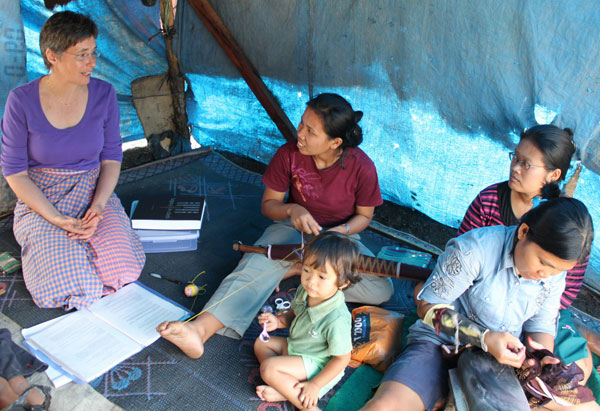
It was a memorable moment. In a lean-to constructed from scrap pieces of wood and an old plastic tarp, several women were working together on tattered mats made of woven plastic strips. One was twining an edging and the others were twisting fringes. They gave me permission to sit with them so I slipped a sarong on over my pants, took off my shoes and situated myself next to the twiner.
At first it felt a little like leading a seminar. I asked them to listen to me because I had an important message to share and then I explained that I was a student of their craft, that the results of my research were finished and that they, as practitioners, had a right to the final product. Passers-by started to gather at the doorway of the lean-to and those who had been there from the beginning quietly brought them up to date. It started to feel like a ritual and a happening.
I presented the book in the name of Sanggar Kreasi Batak because my primary contact with this New York group of immigrant Bataks is Wita Sitepu, a Karo woman. I told them a little about the group and explained the significance of the gift, not forgetting to let them know the price of the book and the need to care for it, but also to use it and enjoy it.
They were intrigued by the pages showing the different textile types and also the descriptions of the twining, immediately spotting the motifs that they were making. I told them that their techniques were very ancient and valuable and should be treasured. I read aloud the message that I had stamped on the first page, explaining the project and also the message from the donor, Sanggar Kreasi Batak.
They explained that their group was a voluntary, horizontal one and did not have a leader, but one woman agreed to store the book in her home. She thanked me and presented me with a Karo textile. All of the women would have liked to have had the honour of storing the book. I wonder how they will share it in the coming days?
It was a memorable moment. In a lean-to constructed from scrap pieces of wood and an old plastic tarp, several women were working together on tattered mats made of woven plastic strips. One was twining an edging and the others were twisting fringes. They gave me permission to sit with them so I slipped a sarong on over my pants, took off my shoes and situated myself next to the twiner.
At first it felt a little like leading a seminar. I asked them to listen to me because I had an important message to share and then I explained that I was a student of their craft, that the results of my research were finished and that they, as practitioners, had a right to the final product. Passers-by started to gather at the doorway of the lean-to and those who had been there from the beginning quietly brought them up to date. It started to feel like a ritual and a happening.
I presented the book in the name of Sanggar Kreasi Batak because my primary contact with this New York group of immigrant Bataks is Wita Sitepu, a Karo woman. I told them a little about the group and explained the significance of the gift, not forgetting to let them know the price of the book and the need to care for it, but also to use it and enjoy it.
They were intrigued by the pages showing the different textile types and also the descriptions of the twining, immediately spotting the motifs that they were making. I told them that their techniques were very ancient and valuable and should be treasured. I read aloud the message that I had stamped on the first page, explaining the project and also the message from the donor, Sanggar Kreasi Batak.
They explained that their group was a voluntary, horizontal one and did not have a leader, but one woman agreed to store the book in her home. She thanked me and presented me with a Karo textile. All of the women would have liked to have had the honour of storing the book. I wonder how they will share it in the coming days?
My only regret was that I couldn’t stay around longer as the fly on the wall to hear what they had to say when I was gone and how they will react to the book over time. They were respectful, curious and interested but it was also clear that they didn’t quite know what to make of what had just happened to them. Time will tell.
They seemed pleased at the idea of teaching their techniques to the group of textile practitioners that I will be bringing to the Batak area next year. It will be a super opportunity to follow up and perhaps get more insight into the reception of the volume.
See Back to the Villages - the map!
Last Gasp
Kaban Jahe. For centuries, because of the market, this town has been a centre of indigo dyeing for the Karo Batak. I wanted to see what had become of this activity and give books to the dyers that I wrote about in Legacy. The first stop was the market. The textile proprietors would be able to give me their addresses.
I was warmly received, but was very sad to note that not a single indigo-dyed piece was available to purchase. Moreover, all of the blue pieces that I looked at had been woven in Tarutung for the Karo market and the quality was low. Nothing was reminiscent of the thick, sumptuous teba and julu textile types of the past.
Nande Pulung, the proprietors told me, was still dyeing yarn. Jalan Irian, they said, in front of the SMA RK. It wasn’t far away, but Nande Pulung was in Medan attending to a sick child. Her neighbour, Nande Indra, who used to come over and assist with the dyeing, had become a market seller, they told me at Nande Pulung’s house, so off we went back to the market to hunt for her.
I found her sitting quietly and alone in her stall. I handed her the laminated page of Legacy in which she is depicted (p. 129) and sat down with her.
She tried to recall that moment 24 years ago and reminisced about the textile that she had that day on her head. It had been her mother’s and was from Aceh.
What she told me amounts to the story about the last gasp of indigo dyeing in the Karo area: she had stopped working with Nande Pulung long ago; Nande Pulung had stopped dyeing with natural indigo ten to fifteen years ago; she didn’t know if Nande Peringitten was still alive; the elderly woman in Kampong Kwala near Tiga Binanga had passed away; there was nobody left in Karo who worked with natural dyes, and the people in Kampong Tanjung had ceased to cultivate tajem, their indigo plant. The tradition was dead.
This is a momentous fact. The Karo, the “blue Batak” had once been renowned for their indigo dyeing and had provided for needs all the way to Si Tolu Huta (Tongging, Silalahi and Paropo). They were the only Batak to practice plangi and tritik because they wanted to decorate the imported white cotton that they dyed blue. I think that they were also the only Batak to cultivate the indigo plant. (According to my information the Toba tradition harvested a wild salaon growing on the hillsides.)
Decline set in early in the twentieth century. Sitting there in the market, talking with Nande Indra, it was beginning to sink in. The Karo dyers whom I met while researching Legacy: Nande Pulung, Nande Indra and Nande Peringitten in Kaban Jahe and the elderly weaver in Kampong Kwala, were the last ones in this great tradition. And it had slipped away, not with a bang but a whimper!
Nande Pulung was the only dyer left in Kaban Jahe and she now worked strictly with chemical dyes. I have a book ready to give to her as soon as she returns from Medan. For her, I selected the message from donor Tim Babcock who emphasized the importance of passing on knowledge to the younger generation:
Batak weavings give immense pleasure not only to people in
Indonesia but also to textile lovers all over the world. Please
keep dyeing beautiful high quality ulos as long as you are
able, and pass your skills on to as many of the younger
generation as you can!
I will ask her if she is willing to demonstrate indigo for the Dutch weavers whom I will bring with me next year to the Batak area to learn about the Batak traditions. Clearly, only a financial incentive can revive this tradition.
See Back to the Villages - the map!
I was warmly received, but was very sad to note that not a single indigo-dyed piece was available to purchase. Moreover, all of the blue pieces that I looked at had been woven in Tarutung for the Karo market and the quality was low. Nothing was reminiscent of the thick, sumptuous teba and julu textile types of the past.
Nande Pulung, the proprietors told me, was still dyeing yarn. Jalan Irian, they said, in front of the SMA RK. It wasn’t far away, but Nande Pulung was in Medan attending to a sick child. Her neighbour, Nande Indra, who used to come over and assist with the dyeing, had become a market seller, they told me at Nande Pulung’s house, so off we went back to the market to hunt for her.
I found her sitting quietly and alone in her stall. I handed her the laminated page of Legacy in which she is depicted (p. 129) and sat down with her.
Nande Indra in her market stall at Kaban Jahe, June 2010
She tried to recall that moment 24 years ago and reminisced about the textile that she had that day on her head. It had been her mother’s and was from Aceh.
Nande Indra and Nande Pulung, Karo dyers, 1986. Fig SR 3.8 Page 129 Legacy in cloth
What she told me amounts to the story about the last gasp of indigo dyeing in the Karo area: she had stopped working with Nande Pulung long ago; Nande Pulung had stopped dyeing with natural indigo ten to fifteen years ago; she didn’t know if Nande Peringitten was still alive; the elderly woman in Kampong Kwala near Tiga Binanga had passed away; there was nobody left in Karo who worked with natural dyes, and the people in Kampong Tanjung had ceased to cultivate tajem, their indigo plant. The tradition was dead.
This is a momentous fact. The Karo, the “blue Batak” had once been renowned for their indigo dyeing and had provided for needs all the way to Si Tolu Huta (Tongging, Silalahi and Paropo). They were the only Batak to practice plangi and tritik because they wanted to decorate the imported white cotton that they dyed blue. I think that they were also the only Batak to cultivate the indigo plant. (According to my information the Toba tradition harvested a wild salaon growing on the hillsides.)
Decline set in early in the twentieth century. Sitting there in the market, talking with Nande Indra, it was beginning to sink in. The Karo dyers whom I met while researching Legacy: Nande Pulung, Nande Indra and Nande Peringitten in Kaban Jahe and the elderly weaver in Kampong Kwala, were the last ones in this great tradition. And it had slipped away, not with a bang but a whimper!
Nande Pulung was the only dyer left in Kaban Jahe and she now worked strictly with chemical dyes. I have a book ready to give to her as soon as she returns from Medan. For her, I selected the message from donor Tim Babcock who emphasized the importance of passing on knowledge to the younger generation:
Batak weavings give immense pleasure not only to people in
Indonesia but also to textile lovers all over the world. Please
keep dyeing beautiful high quality ulos as long as you are
able, and pass your skills on to as many of the younger
generation as you can!
I will ask her if she is willing to demonstrate indigo for the Dutch weavers whom I will bring with me next year to the Batak area to learn about the Batak traditions. Clearly, only a financial incentive can revive this tradition.
See Back to the Villages - the map!
Monday, June 07, 2010
To Do List
Jantine and I have arrived in Medan. I prepare now for going Back to the Villages. It feels like a race against the clock. While still in Holland, I cut pages out of a volume of a desk copy of Legacy bearing pictures of weavers. In Jakarta, I began the task of laminating those pages. Upon arriving in Medan, I completed the task. I could have done that in Europe, too, but it would have been at more than 6 times the price.
An efficient little shop in Kampung Kling in Medan is making the four stamps that I need to prepare the books. A young Chinese woman used the computer software CoralDraw and laser technology. It was my luck to stumble upon her and we took turns at the computer so that I could edit the English but I confess to a touch of guilt in going with this option. Most stamp-makers are installed in little stalls on the side of the road and they make the stamps by hand. Aren’t I celebrating handicraft with this project? And can’t we attribute the decline of craft to the crush of time, among other things?
So far, my search for a good plastic envelope for the books has yielded only Tupperware-type cake-boxes. They might do the trick! These, too, are relatively inexpensive here and provide good protection for the books. I will keep looking for viable options.
Yesterday, we took a quick trip to Gunung Leuser at the Orangutang Rehabilitation project. During our guided walk through the jungle, we saw a rehabilitated old Person of the Forest (translation of the Indonesian “Orang Utan”) named Ucok. A huge fellow, we were frightened as he brachiated very close to us and watched us from close by. I used up my camera battery taking endless photographs of him. A gibbon swung in the trees further away. Later, a mother Forest Person, carrying her child, stole my water bottle and fed the water to her baby! She loved theatre and did it more to ape me than out of thirst! More than 15 years after being freed in the jungle, she still loved to visit human areas to swipe bananas.
The peace and beauty of the jungle were good for the soul. I was glad that I did not let my 'To Do' list dissuade me from taking this trip to the jungle. But it is now 6 in the morning and my 'To Do' list before departure to Berastagi is still very long. Till the next report!
See Back to the Villages - the map!
An efficient little shop in Kampung Kling in Medan is making the four stamps that I need to prepare the books. A young Chinese woman used the computer software CoralDraw and laser technology. It was my luck to stumble upon her and we took turns at the computer so that I could edit the English but I confess to a touch of guilt in going with this option. Most stamp-makers are installed in little stalls on the side of the road and they make the stamps by hand. Aren’t I celebrating handicraft with this project? And can’t we attribute the decline of craft to the crush of time, among other things?
So far, my search for a good plastic envelope for the books has yielded only Tupperware-type cake-boxes. They might do the trick! These, too, are relatively inexpensive here and provide good protection for the books. I will keep looking for viable options.
Yesterday, we took a quick trip to Gunung Leuser at the Orangutang Rehabilitation project. During our guided walk through the jungle, we saw a rehabilitated old Person of the Forest (translation of the Indonesian “Orang Utan”) named Ucok. A huge fellow, we were frightened as he brachiated very close to us and watched us from close by. I used up my camera battery taking endless photographs of him. A gibbon swung in the trees further away. Later, a mother Forest Person, carrying her child, stole my water bottle and fed the water to her baby! She loved theatre and did it more to ape me than out of thirst! More than 15 years after being freed in the jungle, she still loved to visit human areas to swipe bananas.
The peace and beauty of the jungle were good for the soul. I was glad that I did not let my 'To Do' list dissuade me from taking this trip to the jungle. But it is now 6 in the morning and my 'To Do' list before departure to Berastagi is still very long. Till the next report!
See Back to the Villages - the map!
Sunday, June 06, 2010
Engaged
Yesterday, Juara Ginting interviewed me for the on-line newspaper Sora Sirulo to which he is an important contributor. My Back to the Villages project is news, apparently.
When I reflect on the project I oscillate between perceiving it as extraordinary and chastising myself for the same. After all, isn’t it the most normal thing in the world to give a copy of the research product to those who made it all possible? That is what museums and archives expect if they loan a photograph for use. Funding agencies also have that expectation.
So why shouldn’t anthropological informants receive a copy? Moreover, why would this not be a funding stipulation? I received the most prestigious grants from Canada (Social Sciences and Humanities Research Council and Killam Foundation) and from The Netherlands (Netherlands Research Organization and Prince Bernhard Fund) who all demanded dissemination of the research findings. “Dissemination” among the peoples who supplied the information was not a requirement. Back to the Villages was considered a separate project. Knowledge production is what matters.
Juara has begun to work on a project to save and preserve important Karo Batak buildings from extinction. He found parallels with my project. We both are asking he general public for contributions: he collects coins and I have book donors. He asked me to reflect on his strategy. I pointed out that his coin collecting would raise awareness of the project and also spread ownership of the building over the general public. It encourages engagement.
Engagement is what it is all about. “Objective research” may be important for “scientific purposes” but it is also a conveniently “legitimate” way of turning a blind eye to the plight of indigenous peoples struggling for survival.
I am proud and thankful to have received prestigious funding for my anthropological endeavours, but I am ashamed that these agencies have not installed a stronger ethic in the interest of indigenous peoples. What I am doing with my book should not be exceptional but rather a routine matter!
See Back to the Villages - the map!
When I reflect on the project I oscillate between perceiving it as extraordinary and chastising myself for the same. After all, isn’t it the most normal thing in the world to give a copy of the research product to those who made it all possible? That is what museums and archives expect if they loan a photograph for use. Funding agencies also have that expectation.
So why shouldn’t anthropological informants receive a copy? Moreover, why would this not be a funding stipulation? I received the most prestigious grants from Canada (Social Sciences and Humanities Research Council and Killam Foundation) and from The Netherlands (Netherlands Research Organization and Prince Bernhard Fund) who all demanded dissemination of the research findings. “Dissemination” among the peoples who supplied the information was not a requirement. Back to the Villages was considered a separate project. Knowledge production is what matters.
Juara has begun to work on a project to save and preserve important Karo Batak buildings from extinction. He found parallels with my project. We both are asking he general public for contributions: he collects coins and I have book donors. He asked me to reflect on his strategy. I pointed out that his coin collecting would raise awareness of the project and also spread ownership of the building over the general public. It encourages engagement.
Engagement is what it is all about. “Objective research” may be important for “scientific purposes” but it is also a conveniently “legitimate” way of turning a blind eye to the plight of indigenous peoples struggling for survival.
I am proud and thankful to have received prestigious funding for my anthropological endeavours, but I am ashamed that these agencies have not installed a stronger ethic in the interest of indigenous peoples. What I am doing with my book should not be exceptional but rather a routine matter!
See Back to the Villages - the map!
Saturday, June 05, 2010
Bees knees
An idea has something in common with the pollen sacks on a bee's knees. As she goes from flower to flower a bee picks up pollen until the sacks are full and then she carries it all back to the hive. An idea is born through a process of meetings, discussions and ponderings. The idea to write Legacy in cloth, for example, fed partly off the flower of the Ethnographic Museum in Leiden. It was my access to that collection, many years ago, that inspired the plan to write a comprehensive catalogue of Batak textiles.
Yesterday in Jakarta, to my great surprise, I received a telephone call at my new Indonesian number from the S.E. Asia curator of that very museum, Francine Brinkgreve. She informed me that the director of research at the museum had supported her request to participate in the Back to the Villages project. The museum is very strongly in favour of returning the products of research to the indigenous peoples where the research was conducted, and has actively worked on several collaborative projects with Indonesian museums. They feel that my Back to the Villages project dovetails well with their own values and priorities. They wish to donate 5 books!
I am fully convinced that partnerships between museums and indigenous peoples, originating in collections of their material culture, constitute a foundation for the future of both. My Back to the Villages project is precisely that kind of partnership because my book is filled with depictions of museum textiles, many of which are no longer woven or remembered in the Batak area. As examples of the Batak weaving heritage, they can inspire the weavings of the future. Needless to say, I am thrilled with this contribution from Museum Volkenkunde in Leiden. I feel proud of this museum that played such a strong role in my development as an anthropologist and so honoured to have them on my list of donors to the project.
Only minutes after being given with this news from the Dutch museum, I received a visit from the Batak designer, Merdi Sihombing. He had brought sumptuous armloads of his own textile inventions with him for me to explore and enjoy. I saw ancient designs in new colours and materials. I saw cross-fertilization between other Sumatran traditions and the ancient Batak tradition. The Batak textile heritage is Merdi's clay that he is molding into new forms. He is making his Batak weaving tradition vibrant. In his hands it is vitally alive. He brought the copy of my book that had been donated to him by the Indonesian Heritage Society and explained that it was going to be a valuable source of inspiration for him. I was gratified to hear this as I could not have received a higher compliment! Of course this is how I hope the book will be received by Batak weavers as well. This is the reason for the Back to the Villages project!
As I write this blog, I have received my wake-up call. Alas, it is unnecessary. I am definitely awake. It is getting to sleep amidst all of this excitement that is my problem. Today we are off to Medan where the Back to the Villages project will unfold further.
See Back to the Villages - the map!
Yesterday in Jakarta, to my great surprise, I received a telephone call at my new Indonesian number from the S.E. Asia curator of that very museum, Francine Brinkgreve. She informed me that the director of research at the museum had supported her request to participate in the Back to the Villages project. The museum is very strongly in favour of returning the products of research to the indigenous peoples where the research was conducted, and has actively worked on several collaborative projects with Indonesian museums. They feel that my Back to the Villages project dovetails well with their own values and priorities. They wish to donate 5 books!
I am fully convinced that partnerships between museums and indigenous peoples, originating in collections of their material culture, constitute a foundation for the future of both. My Back to the Villages project is precisely that kind of partnership because my book is filled with depictions of museum textiles, many of which are no longer woven or remembered in the Batak area. As examples of the Batak weaving heritage, they can inspire the weavings of the future. Needless to say, I am thrilled with this contribution from Museum Volkenkunde in Leiden. I feel proud of this museum that played such a strong role in my development as an anthropologist and so honoured to have them on my list of donors to the project.
Only minutes after being given with this news from the Dutch museum, I received a visit from the Batak designer, Merdi Sihombing. He had brought sumptuous armloads of his own textile inventions with him for me to explore and enjoy. I saw ancient designs in new colours and materials. I saw cross-fertilization between other Sumatran traditions and the ancient Batak tradition. The Batak textile heritage is Merdi's clay that he is molding into new forms. He is making his Batak weaving tradition vibrant. In his hands it is vitally alive. He brought the copy of my book that had been donated to him by the Indonesian Heritage Society and explained that it was going to be a valuable source of inspiration for him. I was gratified to hear this as I could not have received a higher compliment! Of course this is how I hope the book will be received by Batak weavers as well. This is the reason for the Back to the Villages project!
As I write this blog, I have received my wake-up call. Alas, it is unnecessary. I am definitely awake. It is getting to sleep amidst all of this excitement that is my problem. Today we are off to Medan where the Back to the Villages project will unfold further.
See Back to the Villages - the map!
Subscribe to:
Posts (Atom)


