Showing posts with label Fashion. Show all posts

Sunday, January 18, 2026

Afterword: Dealing with the Violence of Fashion

Miguel Angel Gardetti, Director of the Sustainable Textile Centre in Buenos Aires, whom I have met through the Research Collective for Decoloniality and Fashion (RCDF), paid me the huge honour of inviting me to write the 'Afterword' for his forthcoming book,  Florecencia y Defashion: Desmantelande la violencía de la moda. In part, this was an acknowledgement of my having coined the term 'defashion', a word that we desperately need to indicate the radical and total change in the way fashion is perpetrated in the world. My response to Dr. Gardetti's invitation is now translated into Spanish and accompanies the other chapters on the publisher's desk, due to arrive on the market in April 2026. Stay tuned for more information about the events that will surround the launch of this significant book, and how you will be able to purchase it.

In the meantime, I am sharing my Afterword for English language readership. 

Afterword


By the end of COP30, it was still impossible for all the parties to agree to a reduction of oil and gas. The industry and its associated governments were recalcitrant. The willing were profoundly frustrated and signed the final text with reluctance. The urgent burden of building a world without fossil hydrocarbons felt heavier and more daunting than ever. And then something remarkable happened. Leading political figures from Colombia and The Netherlands, with the full support of the President of COP30, began to prepare the way for the First International Conference on the Just Transition Away from Fossil Fuels to be held in Colombia in April 2026.[1] If the roadmap to a fossil-free world could not be drawn on the formal stage, by dint of the will of the members it would be drawn nevertheless.  


Progressive and ambitious fashion community, take note! COP30 presents us with a model! It has become clear that the growth of industrial fashion, ever since its inception, has been a function of fossil fuels: as fuel, as synthetic fibres, and as bedmate and glamourous promoter, directly and implicitly, of high fossil carbon lifestyles. We will never cease to love and long for beautiful ways to adorn the body -- nor do we have to -- but the industry of fashion has exceeded its ‘best before’ date. Growth in the industry is sacrificing the planet. This is indefensible. It is clear that the industry of fashion must go. It is time for the radical concepts of Defashion and Florecencia to be made normal.[2]


The Roadmap 


Normalization is a process. Vision and goals are laid out in this volume, but there is no roadmap, only steps. The road will be made collectively and iteratively, by walking.[3] The good news is, we are already stepping out. 


This we know: a milestone will be reached when the industry of fashion is no longer recognized as having a leading role to play. Like the fossil fuel industry, it is unable to lead; it is entrenched in business as usual to expand profits. It is unrealistic to expect the industry to hang out a new north star. Collectively, we must build an alternative fashion world outside it, from the ground up. Decolonized, the road will be a coalescence of plural and multilateral paths. Those paths will bring us from centralized, industrial fashion dominance to the diversity of the pluriverse. Except intuitively and abstractly, most of us are unfamiliar with a fashion pluriverse. Aside from members of some relatively independent tribal communities, everyone alive today knows only the dominance of the industry of fashion. And yet we must assume the challenge of building the pluriverse of alternatives.[4]  


Industrial fashion has encouraged consumption addiction through many forms of social compulsion. This raises questions: What is fashion when it is not a pathology? When advertising is not a condoned pusher? When styles are not dictated from above? When cultivating shame is no longer part of the game? When the sell is not sexualized? When enslaved millions, especially women and especially in the Global South, are free to make clothes in their own traditions? When clothes are treasured and not squandered? The end of the extractive and predatory fashion industry may be as difficult to envision as the end of capitalism, but it also offers new latitudes for our creative powers. We can step into that world. Homo sapiens created the original fashion pluriverse; collectively, we can do so again. 


Initiatives ‘from below’ are already leading and building momentum: mending, second-hand, farm to fashion[5], earth-friendly fibres[6], reshoring and localizing clothing production[7], reduction[8], and recycling[9]. Central – though too often ignored – is the obligation to treasure what still remains of the fashion pluriverse that existed before the erosive industry emerged.[10] We are already in transition. But mending and sharing clothing are no silver bullets to reduce fashion consumption. Like research into earth-friendly materials, they are steps along the way. Early road construction. Lagos Fashion Week, recipient of the 2025 Earthshot prize for building a waste-free world[11], is another step. The prize sent the message that overproduction and overconsumption are complex problems that need to be tackled from multiple angles, in this case circularity, craft-driven innovation, and community empowerment. Indirectly, the message is that strategies from the Global South are innovative and indispensable. Notably, however, Lagos Fashion Week still operates within the idiom of the conventional fashion system.


How can the ante be upped? What should be the next steps, proportional to the current urgency, to call a halt to fashion’s sacrifice zones, including waste, toxins, unfair labour practices, erosion of alternative and indigenous systems of dress, insidious fashion advertising, and fashion’s support for fossil-heavy lifestyles?


There is a need to call the parties together in an International Conference to Design the Pluriverse of Fashion, to transition away from the Industry of Fashion. The behemoth must be superseded consciously and systematically. This volume, sharing visions for a fashion pluriverse, is a flagstone in the groundwork for a multilateral conference. A roadmap can be drawn to assemble the willing, to note and track, COP-style, their contributions to reduce dependence on the industry, as well as their heightened ambitions as time progresses.  This is an indispensable step to be embarked on immediately. However, the frustrations and failures of COPs also warn of its limitations.


Fashion as Ecosystems


The more profound transition is ontological shifting. For this, there is no roadmap. Without it, fashion can be reined in, but not replaced. Shifting from where we are now to where we need to be, will be iterative because it is transformative. Walking that road into existence will change the players as much as the landscape. Alarmingly, current trajectories of climate, soils, water, and species diversity, in short, physical landscapes, will be steadily degrading en route, and this will require unprecedented adaptation in the process of building fashion systems in synch with planetary boundaries. The possibilities available to us dwindle as we dawdle.


Dress in the pluriverse will be plural because it is cued to local circumstances, expressions of local genius rooted in unique historical and cultural relationships. Dress is not just a series of objects, but material expressions of relationships with the many environments in which those items are embedded. Recently Agus Ismoyo, batik maker in Yogyakarta, Indonesia invited an American audience to “look beyond batik as a finished product and instead experience it as a living process — one shaped by ecological rhythms, philosophical inquiry and spiritual intention.”[12] An ecological perspective would generate a different, more holistic definition of fashion. It is instructive to compare fashion to a flower. The conventional point of view is focused on the flower. An ecological perspective will see that the quality of the flower depends on the whole plant: leaves, stem and roots. The health of those parts requires rain and sunlight and an enabling climate. The quality of the soil is also at issue, with all of the minerals, fungi and micro-organisms that are requisite for plant growth. In addition, there are insects that visit the flower, without which the plant cannot reproduce, and the insects cannot survive[13]. To adapt the question posed by ecologist, Rex Weyler[14], where are the boundaries of the flower – ergo fashion? The latter intersects fully with history, technology, the physical environment, culture, economy, politics, and people from makers to wearers. To limit the focus to the flower is to miss the fullness of the phenomenon of fashion. Ismoyo’s holistic insights echo a recently-penned definition of fashion (Niessen 2023) that emphasizes its ecological connections in the broadest sense.[15] The current pathology of fashion is systemic and not to be cured through any single component or intervention, but rather a collective shift in ways of being on our planet. 


Ismoyo may be a harbinger of this kind of change. “I am part of nature,” he explains, “I grow within it. I am not separate from it.”[16] He is quick to note that his process of learning the spiritual depths of batik cannot be steered because control and domination are antithetical to living within planetary boundaries. His path is iterative and made by listening care-fully to his natural and cultural environments. 


Christiana Figueres, Chief Negotiator of the landmark Paris Agreement of 2015, now chair of the Earthshot Prize, has consistently assumed the burden of goading and guiding the globe’s dominant economic and political players towards a fossil-free world. Now, ten years after the agreement was endorsed by the parties, she expresses concern about the failures on the part of those same players to step up to ensure the future health of the planet. In her ever-optimistic struggle to find a way out of the impasse, she, too, has recently (2026) underscored the need to ‘shift our worldview’: to recognize belonging within the entire web of life, rather than dominance; to replace short or long-term thinking with continuity; and to move away from extraction and toward relationships and reciprocity. She expresses her debt to Indigenous wisdom, “grounded in care and balance, harvesting only with intention and always giving back in recognition of what has been received…this wisdom is not optional, it is fundamental.”[17]


The concept of defashion was conceived in the awareness that the indigenous dress systems – although currently being sacrificed by the growth and dominance of the industry of fashion -- need to be recognized as signposts on potential paths towards planet-friendly ways of dressing. They are proof of how the task of dressing in harmony with cultural and natural surroundings has been accomplished many times, in every culture, throughout history. Learning to read and understand the wisdom inscribed in these traditions is as urgent as the need to reclaim our clothing from the dominance of the fashion industry. 


If fashion represents ecologies of being, not just a succession of styles (as the industry is advantaged by having us believe), then conclusions must be drawn. Then shifting from fossil-based clothing is of no trifling significance. Dressing the body is a cultural universal; it is culturally ubiquitous, deeply rooted in the history and culture of every society throughout time. Ingredients of dress are prominent in histories of the earliest trade; textile idiom has informed thought and language; textile-related techniques have shaped human capacity through engineering, medicine, farming, shipping, the list is long. Currently, the monetary wealth and CO2 footprint of the industry is ballooning. Coming off fossil fashion would contribute significantly to lowering the temperature of the climate crisis. But more than that, the conceptual ecosystems of fashion, developed since it was industrialized, must not be underestimated. Fashion’s role in proliferating conceptions of modernity and linear time is an example. Taking back not just our physical items of clothing, but also the conceptualizations of fashion, is an enormous and daunting challenge. Sustainability will not come with new fibres, linking with craft production, reductions in production and consumption, nor mending and recycling. It will come from all of that, in addition to a process of learning to live gently on our planet, with respect and care. Changing the way we do fashion has the potential to alter the very fabric of our existence. How profoundly reclaiming our clothing from industrial reliance on fossil fuels can shape the trajectory of getting off oil and gas is difficult to say, but it has significant potential. The urgency to kick our fossil addiction weighs heavily. Let us endorse the onus to reclaim our clothing from fossil hydrocarbons and thereby assume a significant role on the path towards a healthy planet. 


Let us call together the parties to liberate our clothing from the industry of fashion and (re-)build the Pluriverse of Dress. Let us defashion and flourish. 


Selected Sources


Figueres, Christiana and Rivett-Carnac, Tom. – The Future We Choose: Surviving the climate Crisis. Manilla Press. 2020.


Freire, Paolo. Pedagogy of the Oppressed. 1970.


Interbeing  

https://en.wikipedia.org/wiki/Interbeing


Ismoyo, Agus, personal communication, 2 january, 2026.


Machado, Antonio. Campos de Castilla, 1912.


Niessen, Sandra. ‘Violence by Definition’. In Pierre-Antoine Vettorello (ed), The Yarn [Zine] Issue 1. Antwerp, Belgium. 2023.                  


Niessen, Sandra. ‘Fashion, its Sacrifice Zone, and Sustainability’In Fashion Theory: The Journal of Dress, Body and Culture 24:6.  pp. 859-877.  2020. https://doi.org/10.1080/1362704X.2020.1800984


[1]The roadmap proposal https://fossilfueltreaty.org/first-international-conferencewas the initiative of the Minister of Environment of Colombia, Irene Vélez Torres, and the Deputy Prime Minister and Minister for Climate Policy of the Netherlands, Sophie Hermans. They worked with the support of the COP30 president, André Aranha Corrêa do Lago https://cop30.br/en/brazilian-presidency

[2] The US Senator Bernie Sanders from Vermont argues repeatedly that extreme wealth in the hands of the few is what is radical, not moves to reduce disparity in wealth, which are often what are deemed ‘radical’. The claim being made here is parallel: a clothing industry that sacrifices the planet is radical in the extreme, and begs for reform. In this light, the sanity of doing away with the industry must be normalized.

[3] ‘The road is made by walking’ has been inspired by Paolo Freire, (author of Pedagogy of the Oppressed) who may have taken it from Antonio Machado’s Campos de Castilla (1912): “Wanderer, your footsteps are the road, and nothing more; wanderer, there is no road, the road is made by walking. By walking one makes the road, and upon glancing behind one sees the path that never will be trod again. Wanderer, there is no road– Only wakes upon the sea..“ https://brianmclaren.net/we-make-the-road-by-walking-where-did-the-title-come-from/

[4] The conclusions to The Future we Choose (2020), an inspiring work by Christiana Figueres and Tom Rivett-Carnac, written after the Paris Agreement to set out the steps that must be taken to get off fossil fuels, concludes with a chapter entitled, ‘The New Story’. It starts with two premises:

“First, even at this late hour we still have a choice about our future, and therefore every action we take from this moment forward counts.

Second, we are capable about making the right choices about our own destiny. We are not doomed to a devastating future, and humanity is not flawed and incapable of responding to big problems if we act.” (p. 163)

[5] Many exciting initiatives are happening here, including increased adherence to bioregionalism. Liflad https://liflad.substack.com  and Fibershed https://fibershed.org are initiatives to watch. 

[6] Earth-friendly fibres – A tremendous amount of successful and productive research is being devoted to this theme, but this focus is often, narrowly and erroneously, perceived as being synonymous with ‘sustainability’.

[7] Technological developments will enable the ambition to make clothing local. Fantasy Fibre Mill is an example of an initiative to invent machinery suitable to the task at a local level. https://www.fantasyfibremill.com

[8] No great successes have been booked in this regard, aside from urging individuals to change their consumption habits (e.g. https://www.sustainablyurban.ca/blog/the-10-garment-challenge-year)

[9] To date, recycling initiatives have yielded disappointing results. In the end, little clothing is ultimately recycled, only 1% becoming new clothes due to issues with technology, finance, and fibres. There are expectations that technologies will improve and, with time, the other conditions as well. https://www.europarl.europa.eu/topics/en/article/20201208STO93327/fast-fashion-eu-laws-for-sustainable-textile-consumption

[10] Our Common Market highlights alternatives https://www.ourcommon.market

[12] Agus Ismoyo, together with his wife, Nia Fliam, and son, Desmond, recently invited an audience in Washington, D.C. to “look beyond batik as a finished product and instead experience it as a living process — one shaped by ecological rhythms, philosophical inquiry and spiritual intention.” https://museum.gwu.edu/artist-talk-and-trunk-show-batik-character-cosmos-and-creation

[13] Credit is due the notion of ‘interbeing’ given profile by the Vietnamese Buddhist monk, Thich Nhat Hanh. Coincidentally, he used the figure of a flower in one of his explanations of interbeing: “When we look deeply into a flower, we have the impression that the flower is full of everything. There is sunshine inside, there’s cloud inside, there is earth, minerals – even our consciousness is in the flower. Time, space, everything… It looks like everything in the cosmos has come together to help the flower to manifest as a wonder. So the fact is, the flower is full of the cosmos.” (2021) be’https://plumvillage.app/to-be-means-to-inter-be/ July 12, 2021.

[14] Rex Weyler, one of the founders of Greenpeace, during an interview with Nate Hagens (Roundtable #2, Deep(er) Ecology: William Rees, Nora Bateson, Rex Weyler, 2024, 22.00 – 24.08) posed the question, ‘when does the nitrogen of an apple being eaten cease to be of the apple and started to be of the person eating the apple?’ He argued that individuals are integral expressions of entire ecosystems, and emphasized the importance of species diversity for the success of the entire ecosystem. https://www.youtube.com/watch?v=GE39xfNRRyw

[15] “Fashion is ecologies of dress and bodily adornment through which we express our relationships with our environments.” (Niessen 2003)

[16] Agus Ismoyo, personal communication, 2 January 2026.
 

Monday, January 24, 2022

Uli / Beauty

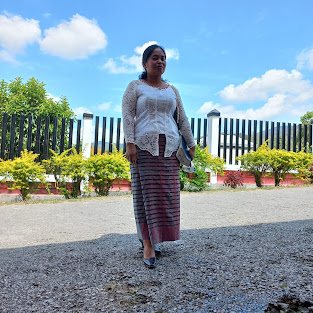
 Uli, whose name means ‘beautiful’, is a lovely Indonesian woman of the Batak ethnic group who is thoughtfully sorting through her relationship to clothes. She is a skilled weaver who tries to earn a living by making the traditional clothing of her ethnic group. As she whiles away hours every day throwing weft between warp yarns, she ponders her challenges and then posts her thoughts on Facebook in the evening when her mother and daughter are asleep. 

It is fascinating to read her take on fashion. Here in the Northern nations we are pummeled by a barrage of fashion advertising that incessantly invites us to enhance our beauty and achieve our individual dreams through the purchase of new designs and styles. Uli is not exempt from this bombardment, even in North Sumatara, but on top of that she is situated in a cultural and temporal crossroads that influences her thoughts and choices. 

 She begins her clothing memories in her post on 17 January 2022 with what she learned at junior highschool – no doubt an element of the Dutch curriculum brought to the region during the colonial era: tall, slender people can wear bright colours and large patterns while heavyset people are better off wearing dark colours and small patterns.  She perceived of herself as being on the heavy side, not overly so, but enough that her mother bought clothing for her with small patterns and dark colours. When she reflects on her teen years, it is as though she had been “made to wear hotel curtains or bedspreads from the 19th century”. She grew up in a small Batak village far from a big city. 


When she eventually left the village to find work and earn her own living, she developed a new relationship to clothes. She got caught up in the world of fashion. Not only did she have access to a variety of styles but she had the means to purchase them! That was when “all clothes fit my body”. “…hot pants, ¾ length trousers, long straight pipes, bellbottoms, standard, everything looked good.” Uli used the word ‘tangkup’ to describe her appearance, a Batak word used to denote the “fitting” appearance of clothing being worn. “Whether a midi, mini or long dress, it was ‘tangkup’.” She regarded herself as blessed because she had the quality of 'tangkup'.


Now that Uli is older and has returned to her village, she has become critical of fashion, which she sees as “making us all dependent.” Consequently “we no longer see our bodies as beautiful in accordance with the intent of the Almighty,” but “we see our bodies as full of problems... Because of fashion and also imported beliefs, we see ourselves as having bodies full of problems and so we leave everything to the opinions of clothing designers.” She knows this from personal experience. She used to see her calves and thighs as “too big” even though she knows they are beautiful. She felt the need to hide them and they became “white from sunlight deprivation.” She also has “full breasts and in accordance with the dictates of fashion and fanatical Christianity, I covered myself up like a nun.” 


Uli’s frustrations with the world of clothing run deep. She is wedged in among a variety of forces. One is mechanization. She learned how to weave as a child, in the tradition of her ethnic group, and today she makes the traditional clothing of her ethnic group. These are oblong pieces of cloth that are hung over the shoulder or wrapped around the waist. However, in the neighbouring town there are mechanical looms, brought in during the colonial era, which produce variants of her laborious and time-consuming hand loomed work much faster and at one fifth the price. Competing with a mechanical loom is no recipe for well being for a hand weaver. It drags the price of textiles down. Uli’s work is vastly underpaid and she barely scrapes by.


But that isn’t all. The fashion system, she observes, has been “colonizing them” for a long time. “We live accordance with fashion trends. Fashion becomes ‘expired clothing’ because of the style [which becomes outdated].  [The fashion purveyors] are the ones who determine which [styles] are viable and which should be thrown out”  even though “Every 30 years, old clothing styles become trendy again…”. One senses how difficult it is for Uli to eke a living in the midst of the external  fashion forces over which she has no control. For her as a weaver of clothing, this is devastating. Fashion “makes many people, especially Batak people like me, reluctant to wear [our traditional clothing].” It whittles away her market.


Even in the world of traditional textiles, there are competing trends. Hip wrappers can be worn in the styles of the neighbouring ethnic groups, Minangkabau, Javanese, Malay, all of them considered more fashionable than the Batak style. Uli recounts how she once spent an entire day learning from her mother how to wrap her hipcloth in the Batak way. “We say that wearing our [traditional clothing] is complicated. Yes, in the beginning it is very complicated. But in the end wearing a sarung isn’t as complicated as wearing a dress with buttons, which is often very tight. If you buy a dress in the style and size worn by the masses, it often feels like you are wearing someone else’s clothes.” At some point Uli was struck by the absurdity of it all. “Why would we sell our own weavings, which are more beautiful and better made, for a low price to buy factory clothing which is expensive?”  She compared this kind of irrational behaviour to selling her Indonesian chickens to purchase Australian eggs, and only because the Australian eggs were imports and therefore had the allure of being somehow better. 


Uli has chosen to wear the fruits
of her own loom to Church
Now Uli has chosen to wear the fruits of her own hand loom to Church on Sundays instead of a purchased dress. She noted the progression in her thinking: “… after I started to weave, and read many perspectives about weaving, about heritage textiles of Nusantara, I discovered that the right way to dress was the way our ancestors dressed. They spin, weave textiles for all occasions, and suitable for all circumstances; it is the strength of the patterns, fibres, that they are able to handle nature’s elements and are so durable that they can be passed on to the next generation. Therefore, these are the clothes that are appropriate for these tough economic times. Moreover, clothing that is not cut and sewn highlights the ‘tangkup’ side of every person.” 


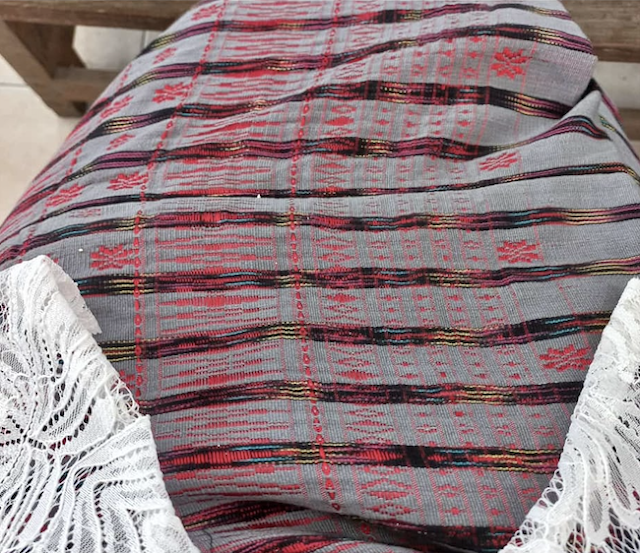
Uli took a photograph of her lap showing a close-up of her 
fine weaving. She explained that she is using kain and
kebaya, her traditional dress, to express her opposition to the
industrialisation of her weaving tradition and the
garment industry.


Uli gave her writing the title, ‘tangkup’ and explained that it denotes ‘fitting clothing’. She had been blessed with the quality of ‘tangkup clothing’, she noted – although there was nothing exceptional about her birth that had augured this good fortune. ‘Tangkup’ means that “I and the clothing I wear are mutually enhancing”. ‘Tangkup’ is not about the quality of the clothing per se, because “if anybody else wears my clothes they may suddenly no longer be nice to look at.”


I find this word 'tangkup' interesting and sense that it offers a glimpse into the traditional world of Batak dress. It seems to denote the combination of wearer and clothing. The emphasis is not on the material item. Uli’s perspective reminded me of the words of a Javanese photographer (MJA Nashir) who explained to me years ago that when some people wear clothes, regardless of the quality of the clothes, they look nice, while others don’t look nice regardless of the beauty of their clothing. This was a new perspective on clothing for me at the time and I wondered if there was a spiritual dimension to this talent. When I asked Uli she said she was not aware of a spiritual quality but she thought that charisma and grace figured in the nature of ‘tangkup’. 


It strikes me that as we, in the North, search for ways to make our clothing systems relevant once more, and less harmful to people and the physical and animal environment, we might gain from Uli’s insights, quandaries and challenges. The word ‘tangkup’ in the Batak language also denotes the ‘capture of objects and concepts’. May we ‘tangkup’ the Batak perspective on grace and charisma in dress. As an aspiration it holds a promise of beauty. And may the Batak clothing system survive to demonstrate the concept of ‘tangkup’ – even wile this may entail an overhaul of the fashion industry. 


....


 Postscript


I show Uli my blog, what I have made of her Facebook post, to request her permission to publish it on line. She is concerned that her criticism of the West (the Netherlands in the colonial era) is harsh and she asks me to receive her words in the spirit of friendship. She knows how hard it is for her when people criticize her country.


I reassure Uli that her words are not too radical and that we at Fashion Act Now are all about reforming the Fashion industry. Moreover, the fashion industry is multinational and not perceived as being owned by a single country. Currently it operates as a cancer throughout the world. 


I point out how important it is that we, in the West, become more aware of the ills of the fashion industry in other regions of the world and that this explains why we are so happy with her posts. The industry is already much, much, much too large and is not concerned with other dress systems, except perhaps to exploit them.


Uli immediately understands my perspective.  “The problem is that up until now, in the Batak area, the West has been the model of what clothing should be. Even if the clothing is produced in China or Korea. And then there are also the problems of waste, consumerism, and addiction to shopping,” she points out.  


“Yes, we are all victims,” I say in response. “What is distinctive regionally in Western countries is also erased by this huge industry. These are some of the sacrifice zones of fashion. We write about this on our FAN website (fashionactnow.org).”


The penny drops. “This means that we are all ruined by the industry,” Uli responds.


 “Yes, in this age, we are all victims of all kinds of large industries, oil and gas, palm oil, fishing, fashion, electronics, everything. And we must oppose this. Already 75% of wild animals have disappeared. The number of bees is declining drastically, and so on.”


“In Indonesia there is the view that if we don’t embrace development, we will be ‘without clothes’ forever,” in other words "that Indonesians will continue to wear their traditional clothing." This perspective saddens her. 


I concur. “This is colonial thinking,” I say. 

“It is the kind of thinking that justifies all exploitation, including of nature,“ says Uli. 


I confide that it is my crusade to try to raise awareness that every culture has its own clothing tradition and that all are valid. The Western variant is destructive to all others Why? For monetary gain. The industry prioritizes its own dominance and that entails continued growth. 


“We sacrifice land, rice paddies, forests, farmland and water for the sake of development,” Uli confirms. “Development for Batak people shows up in clothing and cars. This is obvious on ritual occasions such as weddings when people wear every kind of blouse (kebaya) and so on. They feel ashamed if they don’t wear flashy new clothes. My clothes have a minimum of glitter and I only wear the old style of kebaya (blouse). I do this intentionally. I am a model for the campaign. I also wear my grandmother’s sarung. I purchase second hand clothing for myself, and new clothing only for my daughter.”


Once again, she is on the same page with Fashion Act Now. We, too, purchase a minimum of clothing and try to salvage and utilize what is still wearable. 


Saturday, October 02, 2021

Batik Day 2021: Leading the World of Fashion


 For awhile now I have engaged with various groups to work on ‘the problem of fashion’, an out-of-control industry that over-produces, pollutes, and emits life-threatening amounts of carbon dioxide. For decades I have argued for a more inclusive definition of fashion, or better said perhaps, for the recognition that the fashion behemoth that we currently know and reify, is just a culturally-specific narcissistic fat-cat that needs to be cut down to size to allow the clothing expressions of all other cultures to flourish once again. How to accomplish this goal?


This entails, on the one hand, helping people recognize that ‘fashion’ is not a ‘thing’ out there, but a creation of our own doing. The real human universal is not ‘fashion’, but creativity in dressing, regardless of how you adorn your body, regardless of your cultural medium. That is what we have in common with all other people, not a globalized industry.


On the other hand, the task entails helping people to recognize that the clothing produced by the industrial system is an expression of deep psychic poverty and wafer thin superficiality, all in the interests, perhaps, of deflecting our thoughts away from the great harm that it is doing to our planet. It is a status commodity and pretends to help us construct dreams and myths about who we would like to be in this world, but in reality most is cheap, disposable junk. Coming from the West, where cheap, disposable clothing has been normalized, it is challenging to figure out how to convey to people just how deeply meaningful clothing in other cultures can be, has been, and sometimes still is. 


Today I saw an image that captures the essence of what I would like to convey: a poster about Javanese batik inspired by the spiritual and philosophical essence of batik. My photographer and artist friend in Central Java, Mas MJA Nashir, sent the image to me in a chat this morning. Memayu hayuning bawana means laku secara spiritual, to perform in a spiritual way, he explained. Literally it means to ‘beautify this beautiful world’ (mempercantik bumi yg cantik). The beautifying that he meant runs so deep. It means to perform in a beautiful way towards the earth, towards nature and towards life (terhadap Bumi, terhadap Alam, terhadap Kehidupan). Life for the Javanese, for the batik maker, for the batik lover, is beauty.  The root word in memayu and hayuning, is the same, he pointed out; it is ayu, ‘beautiful’. Memayu is ‘to make beautiful’  (Hayu=Ayu=Cantik . Memayu = membuat cantic). 


“I always remember Mas Ismoyo saying that memayu hayuning bawana is the essence of batik for the Javanese,” Mas Nashir confides. Mas Ismoyo is a mutual friend and master batiker, living in Yogyakarta, whose studio has been an inspiration for Nashir and me for more than a decade, a place where we go for stimulating conversations and to get in touch with spiritual roots. I always leave that Eden in a spirit of peace and wonder. 


I perceive their batik workshops as teaching the essence of the environmental movement: loving the earth and all creatures in it. This is what inspires all the batiks of Mas Ismoyo and his beautiful wife, a master batiker in her own right, Mbak Nia.


Mas Nashir has a small patio behind his house. During the corona lockdown he has been fixing it up and collecting plants to decorate it. “I made this photograph this morning and used it in my poster to celebrate Batik Day,” he wrote.


His poster is inspired by Mas Ismoyo’s words and the workshops that he gives with Mbak Nia, by the plants that Nashir tends, by Nashir's love for batik – both his mother and his brother are involved in the batik world – and not least, by his cultural activism. Nashir’s soul is dedicated to memayu hayuning bawana; it is what he longs for in this world of rapacious business, this Anthropocene. He knows that Anthropos can do the opposite, can beautify instead of making sacrifice zones of peoples, cultures, nature and even our future.

Suddenly tears prick my eyes. The penny drops.  This poster shares what I would like to convey to people about indigenous clothing traditions of other cultures. Depth, beauty and going further than ‘doing no harm’: doing good to planet, nature and people; living a spiritually true life; aspiring to beauty.  To wear beauty, to create beauty, to insist on beauty. That is when you have desirable clothing. 


(blog dedicated to Sara Arnold, who understands)

Sunday, May 16, 2021

More Webinars

 Here are additional webinars that I have given on the topic of sacrifice zones, related  to my article, "Fashion, its Sacrifice Zone and Sustainability"


Decolonizing Fast-Fashion: A Living Wage and Good Working Conditions for Women of the Global South

NGO CSW

Sponsoring Organization: Unitarian Universalist Association Office at the UN

24 March

https://ngocsw65forum.us2.pathable.com/meetings/virtual/DGpWB6vxfvie2b8K2

You’ll find my contribution here:  0:52:53 – 1:08:00


Extinction Rebellion: Fashion Act Now 

Fashion and Degrowth – Exploring the link between decolonisation and sustainability, May 11

https://www.youtube.com/watch?v=Pkyf3IBgT0U


You can find more about Fashion Act Now on their informative web page

https://www.fashionactnow.org/about


Sunday, May 31, 2020

What has become of the people who made our clothes?

In 1984 the late governor Mario Cuomo borrowed the title of Charles Dickens's 'Tale of Two Cities'  to call attention to the deep rift in New York between the Haves and the Have Nots
Yesterday, his son, the CNN host, Chris Cuomo, dusted off his father's words to remind Americans that there are two Americas. This was in the wake of the video-documented murder of the handcuffed, black man, George Floyd, through the actions of police officers in Minneapolis. It was an impassioned speech to remind the Haves that America cannot be a peaceful and happy place until that gap between the Two Realities is closed. 

Racism is the gap: the alienation of the Have Nots by the Haves. The myriad processes of alienation/discrimination occur at all levels of society, locally, nationally and internationally, many of which are such a 'normal' part of daily life that they become invisible to the Haves who are often not aware of perpetuating them.

The Western fashion system is one of these 'normals'. Perpetuating it is as easy as purchasing clothes produced by the exploitative production system. And every single one of us does that, even when demonstrating against racism.

It is the business of the RCDF to make the racism in fashion visible, to raise awareness, to enable change for the better. The first step is creating awareness that fashion's definition and function was created to highlight and celebrate the difference between the Haves and the Have Nots locally, nationally and internationally. 

Those who had the power to define fashion divided the world into 'those with fashion' and 'those without fashion'. The former were white people of means in Europe and North America. The latter were peasants, tribals, the poor, people of colour.  They didn't have fashion, they just wore clothes. Fashion became something to aspire to, to show off capability and 'advancement'. Today those 'fashion have nots' are the same ones who make the clothes for the 'fashion haves'. And today they are suffering because the production system has been shut down by measures taken against Covid-19.

I heard today that those who lost their jobs in the textile factories in Pekalongan, in Central Java, have not been able to find new work. They face hunger. I hear the same is happening in India.  I invite our readers who have first-hand knowledge of one or more of these workers to share their stories. Please tell us what is happening to these people (mostly women) who produced our clothes. Their life of dependence is perilous. Will they find a way out of this life-threatening mess? What are the options they are choosing? What will be the new order in the post-covid world? How can we strategize to close the fashion gap?