Showing posts with label solar energy. Show all posts

Monday, November 18, 2013

Light at the Lake

Lake Toba, a 75,000 year old crater and one of the most beautiful places on earth, suffers from severe environmental degradation. A central reason is that the outflow from the lake is used to generate electricity. The outflow has been increased so that now more water flows out than flows into the lake and there has been a consequent rapid and disastrous drop in the water level.

The Boat Budaya on Lake Toba September 2013 (Photo by MJA Nashir)
In September 2013, I went to the region to return elements of cultural heritage to the Batak people living near the Lake. I chose to conduct the project by boat because of the lake’s tremendous proportions in local mythology and because of the ease and romance of using it. Our boat was a simple, local market-cum-tourist boat and we had essentially no electricity. I brought along Wakawaka lights for my repatriation team, four of them young local people, to provide us with light and enough power to keep our mobile phones running 
Paul Manahara Tambunan shows how he connects his mobile telephone
to his Wakawaka light. 

and, even more importantly, to demonstrate the production and use of solar electricity to the people with whom we came in contact. The lake needs a fix and quickly!

Febrina Pakpahan, one of the young women on the team, showed students at DEL University in Laguboti her Wakawaka light/charger (Photo MJA Nashir)
The lights proved indispensable. We sunned them carefully on the deck every day and then used them for our phones and for light. 
We sunned our solar lights (Luminaid and Wakawaka everyday on the deck.

Everybody who saw them and received our explanation immediately recognized their functionality. Our auto chauffeur (Pak Jerry) perceived that they were perfect for his needs, as did the captain of the boat (Amang Siregar). The local regent (Pak Mangindar Simbolon) wanted them for remote areas that don’t yet have electrical supply. And of course there was an immediate recognition that sunlight is cheaper than electricity.


The journey was about repatriation of cultural elements from the past, but not just about that. It was about a future in which the culture and also the environment would recover their health. Wakawaka generated a kind of Eureka reaction! Solar power is one viable and important choice in a region that needs a panoply of changes to make a better future!
Wednesday, August 14, 2013

Oosterbeek paints the Boat Budaya green

Things are suddenly coming together. An unexpected, generous donation for solar support for the Pulang Kampung journey meant that I could go to Bureau Cambium in Oosterbeek and discuss the options.

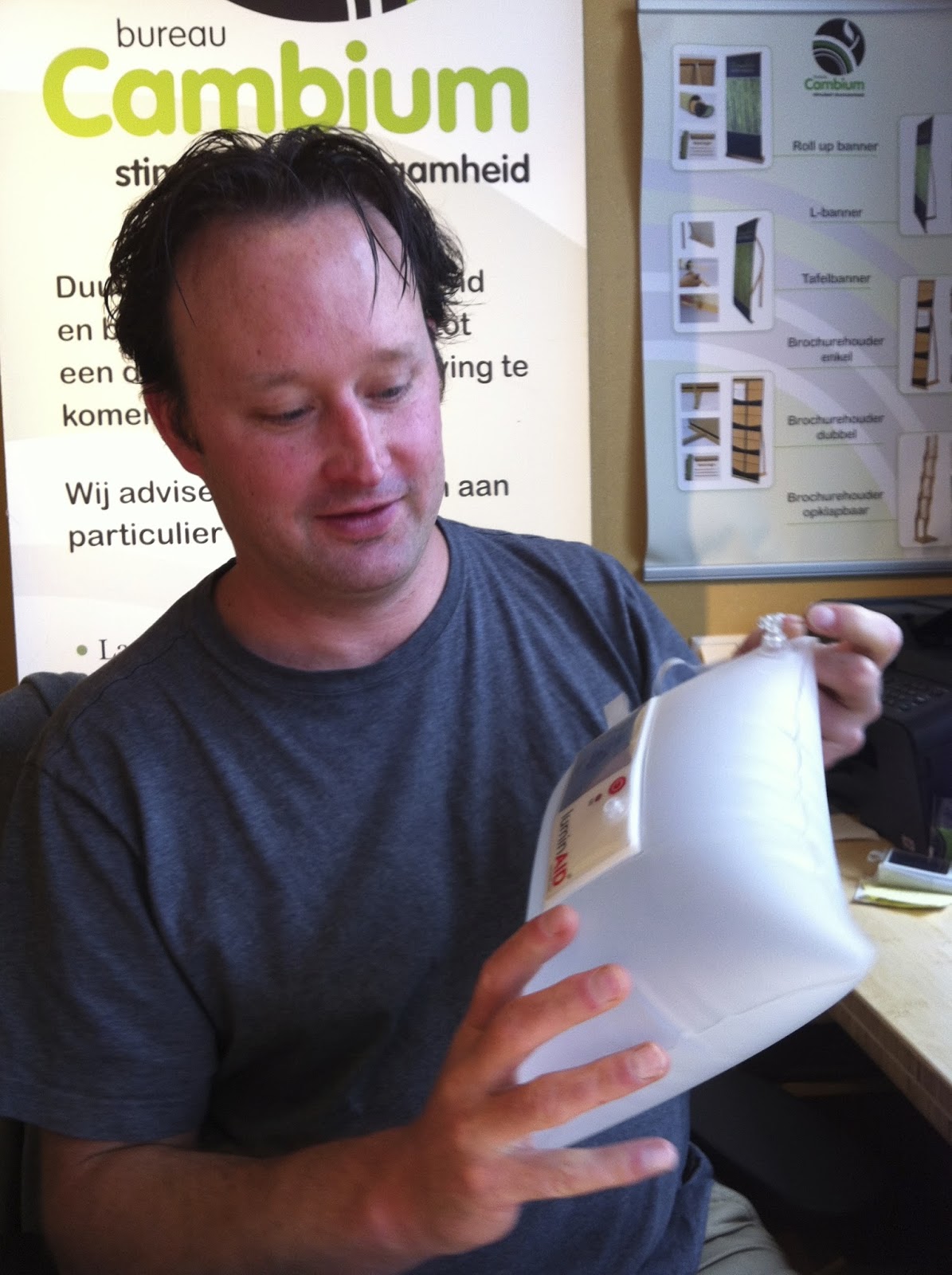
Wibo Teerlink showed me the Luminaid. He blew up the little cushion and then turned on the solar lamp. We tossed around how the little cushions would look in the evening - when the musicians are on stage or when Rangsa ni Tonun is being shown in the villages. I have just stuffed ten of these aids in my suitcase.


And then there were the Wakawaka power to power the cell phones and other small gadgets (we will try them out on the second-hand cameras that I bought).


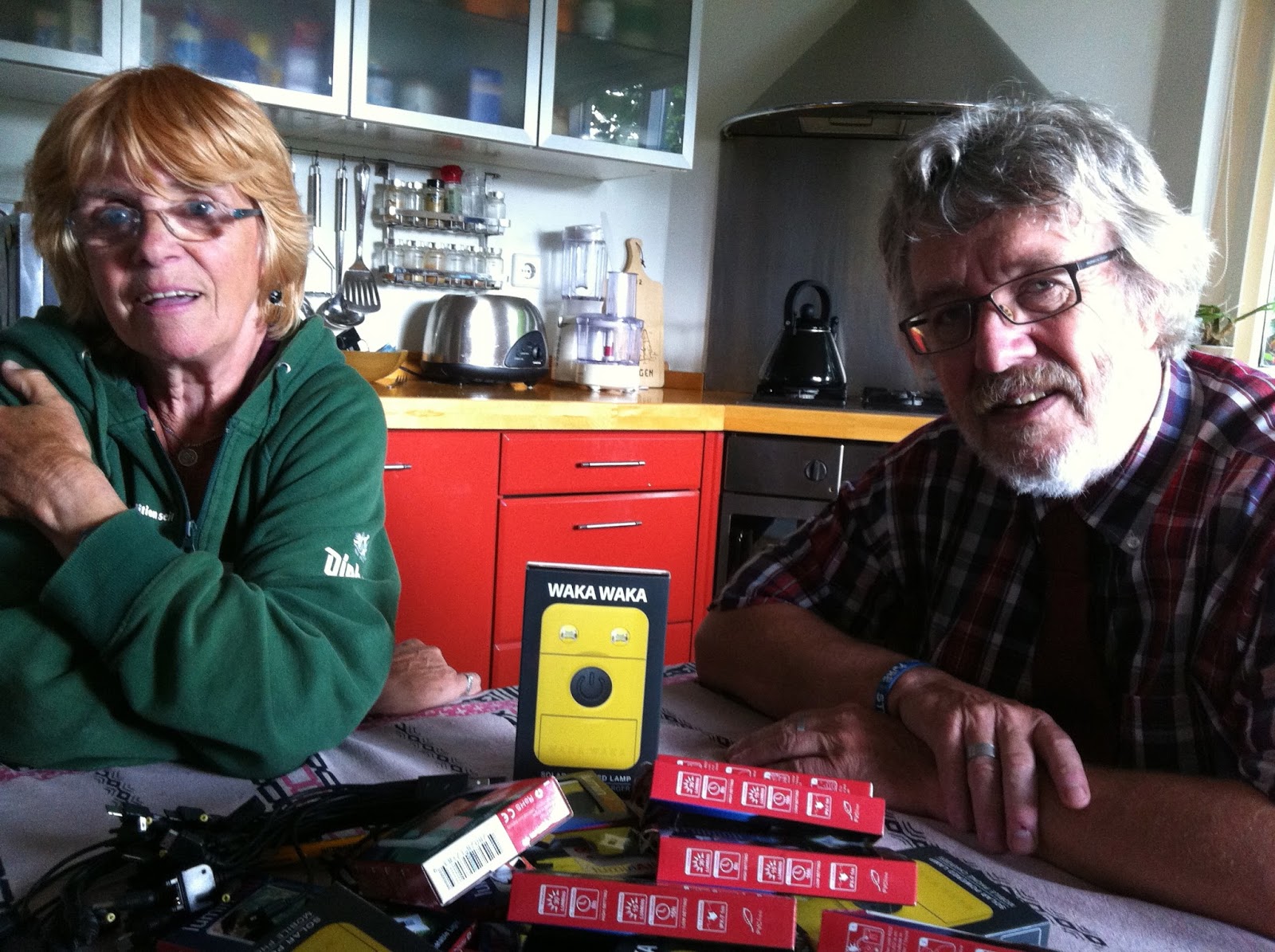
Wibo's neighbours, Dirk and Sineke van Uitert, were the generous donors of the solar aids for the journey. (They had also donated generously to the first Pulang Kamung journey.) I couldn't refrain from knocking on their door after leaving Bureau Cambium to show these supporters what they had provided for the young people on the Pulang Kampung journey. I stacked up the goodies on their kitchen table and then took this photograph.


It will be fun to show the four young people who are joining the journey how solar power works. I will invite them to blog about it. We'll see what comes out. I hope that my kind donors will be pleased. I think that my boundless appreciation for their kindness will be contagious.

Saturday, May 11, 2013

14. Gonna Take a Sustainable Journey


Today I wandered down to the Weverstraat in my town where Wibo Teerlink has his shop, called Cambium. Wibo is an idealist with great understanding and knowledge of modern products that contribute to a more sustainable lifestyle. I purchased the new WAKAWAKA gadget from him. It is a solar-powered lamp that can also charge the mobile telephone and tablet.

We talked about strategies for making solar energy available to all participants on the Pulang Kampung III journey. Wibo showed me the American-made LUCI lamps that produce as much light as kerosene lamps to light up cozy gatherings in the night. These would be ideal in the Batak villages at night when we show our film.

And of course, there is the indispensable WAKAWAKA power to charge the mobile telephones. I would like everybody on the voyage to have one of these chargers. These will allow everyone to keep their telephones charged during the journey, even when we are traveling in boat and bus. The youth will be able to keep theirs and afterwards show everyone in the villages how they charge their telephone using the light from the sun. 

The total bill for this solar requirement for the Pulang Kampung III journey will come to 1000 euro, a reasonable price due to Wibo’s goodwill and desire to make this project work. I told him that we would be documenting the journey in film and that useful images will come out of the project that he and the manufacturers of the solar products will be able to use for promotional purposes.

Wibo and I are going to pool our efforts to realize this “solar goal” of Pulang Kampung III. He was very pleased with MJA Nashir’s design of the Pulang Kampung III proposal and will use it when we look for support for the project. When he shook my hand at the end of our meeting, he said confidently, “It is going to work.”

In the meantime, I have my mobile telephone charging at the rate of 1%/minute as my solar charger transforms sunlight into electricity on this cloudy day.


Wednesday, April 17, 2013

11. WAKAWAKA


WAKAWAKA is a company that I approve of. It excites me that such a company exists. It is a shining example to light up the path of any idealist.

WAKAWAKA makes the best little solar powered light in theworld. It asks a relatively high price for its product, but that’s because every light that is sold donates a light to the poorest regions of the world. It is a brilliant model:


I decided that WAKAWAKA lights are indispensable for our Boat Budaya voyage. 
We will need electricity on board for our mobile phones, and especially the ones who will sleep on board will need the light at night. So I approached WAKAWAKA. I wondered if it would be possible to buy their product so that the donations could be given to the less well-off youth on our voyage rather than to the poor in Haïti and perhaps be given away in the villages. Lake Toba suffers from a multi-layered environmental crisis. The presence of the WAKAWAKA would light up a new road to the future.

My contacts with the company were very pleasant -- a lot of mutual admiration for our respective projects. But the contact did not yield a donation of WAKAWAKA lights for our voyage in any form whatsoever. My project does not fit their established criteria of eligibility. For even this facet of the journey, I will have to look for sponsorship. This does not dim my respect for WAKAWAKA; for me their light shines as brightly as it ever did.  I still consider these lights indispensable for the voyage. 

Perhaps there is donor out there who believes in WAKAWAKA’s product and also in my Pulang Kampung project and will want to marry the two. I continue to dream of a Lake Toba gone solar.