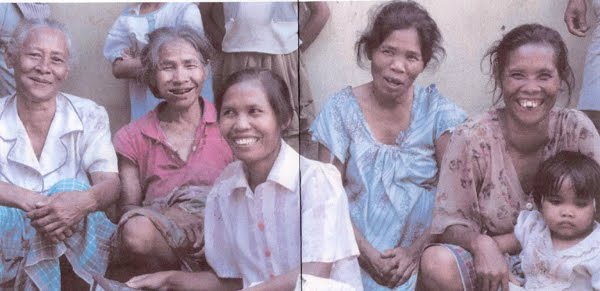
I wanted to give a book to the elderly weaver depicted on page 461 (it is her loom on page 6) – she had been wonderful to talk with - but I knew that she would be deceased. We made a few stops but were not able to find her descendants or anyone who knew her. Still, I wanted to make sure that I left a book behind in the Lumban Julu region where she had lived. I admire the textiles from this region. It was annexed relatively late and some of the nicest old pieces still come from there, but it still feels like one of the most difficult regions to connect with.
By once again letting the spirits of Toba guide us, we found Ompu Okta, and it was both one of the most richly satisfying and one of the saddest meetings of the project (see the description in blog entitled Dilepaskan).

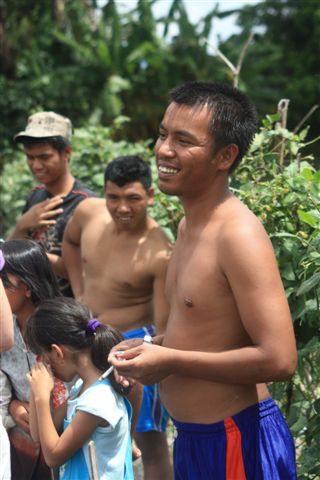 The villagers fetched him and he arrived, all vibrantly grown up, half wet and half naked, apparently interrupted in his work at the fishpond in the back. Overjoyed with the book, he offered me a goldfish in return and we joined him on the trek to the pond. From the clutter and chaos of his village we were suddenly greeted by a beautiful, green and peaceful vista and we expressed our admiration spontaneously and bountifully. The villagers warned us that our delight was a delusion because if we looked carefully at the hills in the background, we would see that they were being clearcut and it was already disturbing their peaceful pond. Such is the environmental drama unfolding right now in Porsea.
  In the end, I came to my senses and turned down the goldfish, pointing out that I had no tank in the car in which to carry it and, at the end of the road, no fire to cook it with (I didn’t say that I was vegetarian). They understood my argument and forgave me and we undertook the trek back to the chaotic, tumultuous village and said our good-byes. The villagers promised that they would show the book to the weavers (probably of ragi hotang textiles) they knew living close by Porsea.
The book was a gift from Sandra Sardjono who is using textiles to explore the mysteries of her homeland.
The next stop was Laguboti. I was anxious to find Ompu Si Masta (depicted on page 143 of Legacy). I last met her in 2003 in the Balige market. Although we had built a strong tie during my research in 1986, we no longer recognized each other; we had both changed. I sat in her stall and began to ask questions, apparently just as then, about the names of textile types. She gave me the superficial answers typically given to the casual shopper but I kept pestering her for more details. Finally she looked at me and said, “There used to be a Canadian girl who knew all the names of Batak textiles. She used to come to me to learn them all.” “What was her name,” I asked, suspecting that she would mention my name. When she did, I let the cat out of the bag. “That’s me”, I said. “I’m her.” Then she fell on me and smothered me with hugs.
It was a long search, but we finally met up with her in her home. Her son led us there and we waited until she emerged from a meeting with a Bibelfrau. I warned Mas Nashir to be prepared for her exuberance and keep his finger on the shutter release of the camera... And so we were launched into a joyful afternoon. She took us all out for an extended lunch and entertained us in her extroverted way, remembering so many incidents and details. “You were my friend,” she said. “I treated you fairly and we never haggled on the prices of the textiles I found for you.” She had been a wonderful source of textile types and taught me a great deal.

Now she was well into her 70s but had too much energy to stop her work. She still sold textiles at the market, three times a week, still liked it, and wanted to continue with it for as long as she could. I didn’t get a sense of what she thought of the book. Perhaps she will only formulate her impression after she has found the time to study it. I wonder if she will take it with her to the market? May it remind her of our many discussions about textile types the way it reminds me of her. I had been so worried that I would never have the opportunity to see her again and rejoiced at this opportunity to meet her in her home together with her family.
Her book was donated by the Soroptimists of Arnhem.
See Back to the Villages - the map!