Showing posts with label Restuala Namora. Show all posts

Thursday, October 03, 2013

Another Experiment in Muara


 The afternoon showing of the film in the Muara market was successful, but we still felt obliged to give more of the people who appear in the film access to the film (especially the indigo dyers in Huta na Godang). I remembered the beautiful evening arranged for us by Restuala Namora two years earlier when Threads of Life came to visit Muara. Behind Hotel Marsaulina there is a small conference room surrounded by four glass walls overlooking Lake Toba. It really is spectacular. Restuala had brought musicians and the tables and chairs could be rearranged to suit the discussions that took place. There is no better backdrop in all the world.

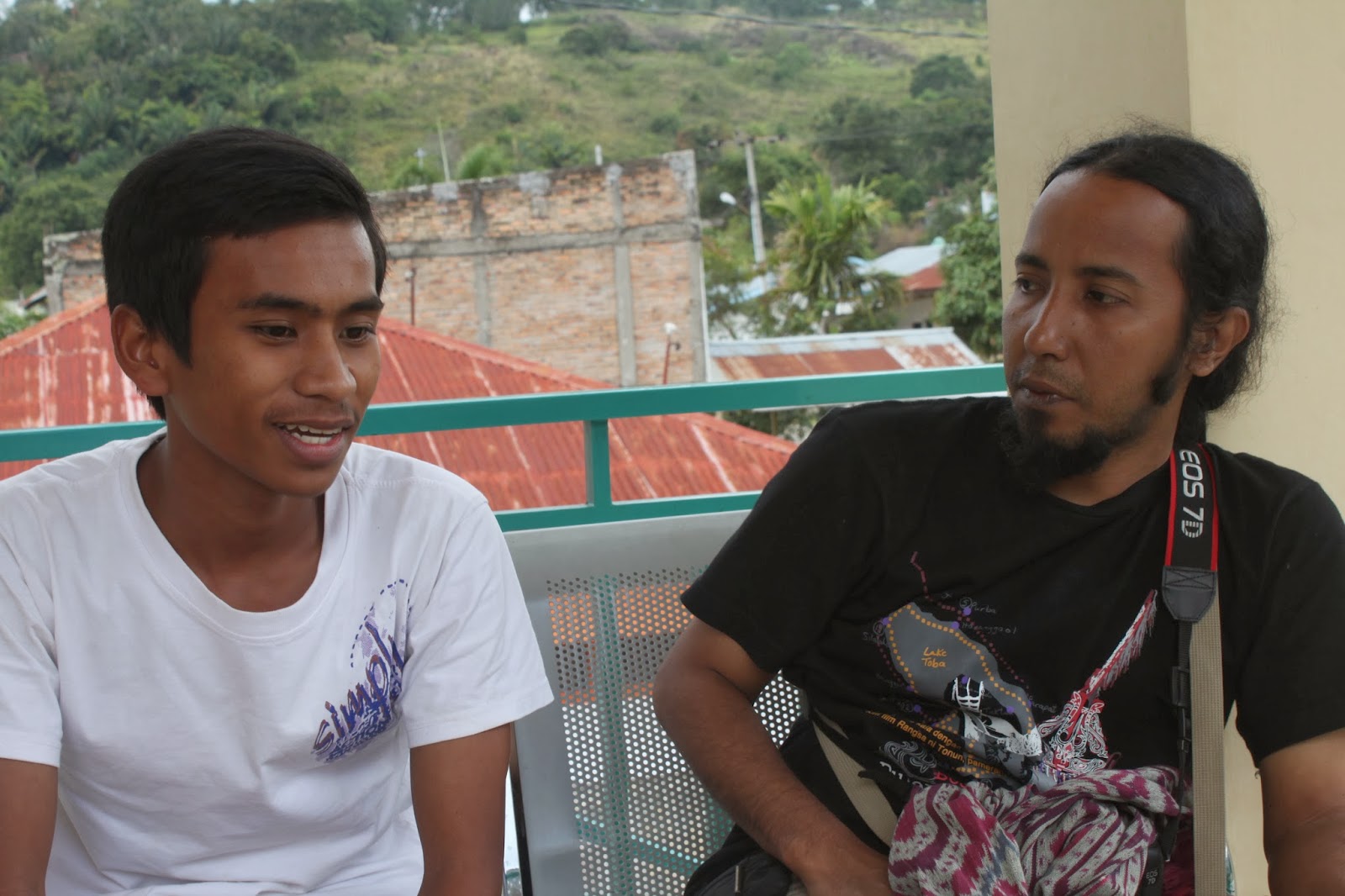
Mas MJA Nashir shows pictures of Rangsa ni Tonun to our youthful helper.  The picture gives a good sense of the room and the backdrop.

Br. Situmorang, who works for Marsaulina Hotel, was very interested in our work. Here we see the view off to the right. Beautiful Lake Toba.

There were other advantages as well. It turned out that the Boat Budaya could be moored there. This was important because all of our equipment was on board and we have to carry it to the film-showing venue and also guard the boat. The part that I liked was that I, the Westerner who couldn’t get used to sleeping on the floor of the boat, could have a comfortable bed in the hotel.  Nashir and I were both charmed by the venue – but would people come? They would have to make the effort to leave the villages at night, maybe hunt for a becak (there are a couple of becak’s in Muara!). Muara doesn’t have a nightlife, there are few streetlights and it would be a bit of a walk – a long walk for the ones who lived up the hillside..

Nashir still had the telephone number of Ishak Aprianto Aritonang, one of the youth that Restuala had selected to participate in the Forum Anak, a program to teach cultural knowledge to selected young people in Muara. He called him and we sat in front of the hotel and discussed the possibilities with him. 
He agreed to drive around on his motorcycle and drum up enthusiasm so that people would come to the showing. So we made the decision and rented the space from boru Situmorang who works in the hotel, and we phoned Captain Siregar so that he would shift the Boat Budaya from the market to the hotel. Then we got to work rigging up the screen and setting up the sound equipment. Lasma and Febrina were at Ompu Rido’s house and would come in time for the evening screening.

….

Ompu Rido warned us that few would come. She wanted us to show the film at the intersection of the two main streets in front of the bank. It sounded awkward and difficult to manage so we stuck to our plan in the back of the hotel. In the end she was right. She came that evening and her enthusiasm infected her neighbours who came as well, but nobody else from Huta na Godang came. (The next day Ompu Josua told us that she was too old to go out at night; they go to sleep at 9 p.m. and get up very, very early in the morning.) We learned an important lesson.

Nevertheless, the evening was a success, even a resounding success. A lot of young people came and especially other members of the Forum Anak. The leader of the youthful traditional Batak orchestra,  Hendra Siregar, brought his hasapi (guitar-like instrument) and after the film and discussion, he played and several of the young people sang. Brilliantly! They inspired us all and we were truly impressed.

Hendra Siregar with a budding fluit player and a 15-year-old female vocalist. (Photo by MJA Nashir) 
I sat beside former weavers, Ompu Rido's neighbours. (Photo by MJA Nashir) 


The discussion after the film was played was valuable. The theme was becoming familiar to us. “Of course we would like to continue to weave, but if the market is not strong enough, of course we have to stop.” Weavers look for other ways to earn money, mostly through farming-related activities. Of course there is regret – but they have to be able to feed their families!

Thursday, December 15, 2011

I Gave a Teg Talk!

No, that’s not a spelling error. TEG stands for Textile Enthusiasts Group and the group gathers in Singapore.

It was Genevieve Duggan, well known for her book, Ikats of Savu (2001, White Lotus Press) who got the ball rolling. I was going to drop in for a day in Singapore on my way home from Jakarta anyway, so, she said, why not get to know the textile enthusiasts in Singapore while I was there? Why not, indeed! I would have my exhibition textiles with me, and the co-ordinator of this TEG event, Shook Fong Tan, and her husband would be kind enough to pick me (with my heavy bags) up at the airport.

Photo by Lewa Pardomuan of me delivering my TEG Talk
The obvious thing to talk about, it seemed to me, would be the Pulang Kampung expedition and the upshot of the journey. I had all of MJA Nashir’s pictures with me to make a slide show and one of Restuala Namora Pakpahan’s first “revival textiles” from Muara coloured red with natural dye. He gave it to me just before I left Jakarta to remind me that I am the “International Ambassador of Sopo Sorha Harungguan”. I wanted to highlight the importance of bringing research findings back to the peoples from whom the information originated: they who are so deserving, have so little access to libraries and knowledge about their own culture and history, and yet are more often than not forgotten when it comes to “dissemination of findings”.

It was a warm group of enthusiasts (the name fits!), many of whom clearly had a very sophisticated level of knowledge. Spontaneously, I asked them for support for Restuala’s revival work. I had shared with them the importance of North-South partnerships when it comes to keeping indigenous art/craft traditions alive, so I decided to “walk the talk.” The donations that flowed in were so generous that I was gratified and touched.

I was pleased that Lewa Pardomuan, a new acquaintance and passionate textile collector, was in the room as well as Kim Jane Saunders (author of Contemporary Tie and Dye Textiles of Indonesia, 1997) with whom I had apparently corresponded in years past. A new acquaintance was Yvonne Koh, who contacted me through my website shortly before my talk. Because she lived in Singapore, it was possible for her to attend. She turns out to be an inveterate blogger, so I have been able to get to know her a little bit after the fact. These three people, and many more in the room, shared my sense of urgency for undertaking action to keep indigenous weaving traditions alive.

The TEG group kindly arranged for me to pre-view the spectacular Patterns of Trade: Indian Textiles For Export, 1400–1900 exhibition (15 Nov 2011 - 03 Jun 2012) in the Asian Civilizations Museum just after my talk. The tour with the Southeast Asia curator, David Henkel, was a rather special privilege as the exhibition had not yet opened. Indeed, I would not have wanted to miss it. It was inspiring, spell-binding and endlessly insightful to witness dozens of Indian trade textiles together in one place.

At the end of the day, Digna Ryan, one of the co-ordinators of the TEG group, invited some of us to dinner in her beautiful home: a gracious and delicious send-off before settling into a night of flying.

Thank you, TEG Singapore for an excellent experience.

Thursday, October 06, 2011

Batik, Batak, Batak, Batik

Last night MJA Nashir’s mother showed me her old batiks: one from Cirebon and the rest from Pekalongan, beautiful old batiks as they are seldom, if ever, made anymore.

We had just arrived from Yogyakarta. I hadn’t been to Pekalongan since 1980. At that time I fell in love with the colourful batiks that are typical of here. MJ de Raadt-Appell’s book (in Dutch) entitled De Batikkerij Van Zuylen te Pekalongan, was published in that same year but I didn’t find out about it until considerably later when both Rita Bolland and Harmen Veldhuisen asked me if I was related to Eliza van Zuylen Niessen to whom De Raadt Appell had dedicated her book. I had never heard family stories about her, and knew of no family members except my uncle who had been to Indonesia. I did not believe that I was related to this talented and now-famous woman.

Eliza Charlotte Niessen was born on 23 November 1864 in Fort de Kock (now Bukit Tinggi in West Sumatra), a century and six days before I was born. She married Alphons van Zuylen from Pekalongan. Her sister Christine married Jan van Zuylen, his brother. Christine moved to Pekalongan and one of her sources of income was a small batik workshop. When, in due course, Eliza and her family also moved to Pekalongan she helped her sister with the batik. Eventually, she started to produce it on her own turf. Eliza gave birth to twelve children. She was widowed in 1918 at the age of 54 and the war put an abrupt and ugly end to her batik workshop. It was plundered and destroyed by the Indonesian freedom fighters and she and her daughter Clementine were imprisoned. When Eliza became ill, they were transferred to the Franciscan monastery in Pekalongan. She died there in 1947 at the age of 83 and her remains were buried beside those of her husband in Pekalongan’s European cemetery.

Eliza Niessen’s workshop was one of the most famous of its time. Her signed batiks have become collectors’ items. Harmen Veldhuisen has written eloquently about them and Rita Bolland, former curator of textiles at the Tropenmuseum in Amsterdam, wrote the Foreword to De Raadt Appell’s book.

Thirty years after shrugging off their question about kinship with Eliza Niessen I started to do genealogical research to find out whether my black eyes originated in Indonesia. I found some records about Niessen ancestors going off to the Netherland East Indies, but I do not know what became of them. I did enough research, however, to conclude that all of the Dutch Niessens are related.

The subject of Eliza Niessen re-emerged when I met MJA Nashir, my photographer and now author of the newly-launched book about our journey together in 2010 (Berkelana dengan Sandra, 2011). His mother was a batik maker who worked for a Van Zuylen competitor, Oey Soe Tjoen. With this surprising information I was compelled to return to the famous Niessen of batik….hence this short pilgrimage to Pekalongan.

Last night was special because Nashir showed his mother his book for the first time, just as she showed me her batiks. Nashir has gone from batik to Batak. I have gone, ever so briefly from Batak to batik and it all came together around the living-room table.

In the meantime, in the heart of Batakland, our friend Restuala Namora, the central figure in the revival of Batak textiles, has just launched Nashir’s book at a gathering of government people. In a week’s time, Batak and batik will once again mingle when he weds his love from Solo. Batik-making is among her many accomplishments.

Sunday, January 23, 2011

Muara, O Muara II

I wake up to the sound of boat engines. It is market day in Balige and the traffic from here to there across the lake will be heavy. Although it is still dark I can see the lake from my balcony.

The view from my balcony in the morning
I have jetlag and I want to sleep longer, but Restuala Namora said he would be coming by to fetch us at 7 am. When we arrived yesterday evening, we immediately had a planning meeting.

Restuala Namora Pakpahan, MJA Nashir and Goodman Ompusunggu
watching the first edit of Rangsa ni Tonun on the balcony of our palatial acommodations.

The scene is now set and today we must try to finish filming as much as possible of the still outstanding parts of the film, Rangsa ni Tonun.

That is why I am here.

I made the decision to come only last Saturday as I was checking flight availability for the first week of February. It became clear that I could fly right away and it wouldn’t cost me extra. Moreover, my photographer/filmer needed some assistance finishing Rangsa ni Tonun. I was beginning to realize that if I flew to Indonesia immediately, as the film’s producer, I would actually be able to be present at all of the filming and the fine-combed editing. It suddenly seemed grossly unfair to have thrust all of this work into the hands of my filmer. As enthusiastic, capable and willing as he is, he is neither a weaving expert nor a Batak scholar and the Rangsa text is difficult and esoteric. It was time to assume my responsibility. I started to pack and within three days, I was in Medan.

Last night was my second night in Indonesia. I am back in Muara, the valley that received me so indescribably warmly last November (see blog Muara, O Muara). Once again my team is complete. Pak Jerry, my beloved chauffeur was available and Mas Nashir was ready to return to the lake.

And then there is Restuala, my host in Muara last November. Here in Muara, he is a key member of our team. While I was working in Holland during the past six weeks preparing the Fiber Face 3 exhibition “spotlight” on Batak textiles (Exhibition Yogyakarta 12 – 25 February), he was working on our sorha (spinning wheel). When we arrived last night, it was sitting tidily and ready for use on his living room floor. Nevertheless, for me it was like a phantom, a mirage; it was eye-rubbingly unbelievable to once again see a spinning wheel in the Batak area. And when I turned its handle, it worked!

Restuala knows everyone in the village. He was born and raised here. Like all Batak children of his generation, his aspiration was to leave the village and seek his fortune in the wide world beyond. He was successfully and energetically building his career in Jakarta when he was called back home. He is the youngest son (siampuan). It is his responsibility to return and perpetuate the family presence in the village. Restuala has embraced this fate with the same energy that so far characterizes everything that I have seen him do.

He is an enthusiastic fellow and he has a vision. His dream for Muara is to bring the village into the future in a way consistent with what the future needs: a sustainable community socially, culturally, economically and environmentally. He sees that the best talents of Muara have left, just as he did. This successively erodes the culture. It is a vicious circle: the village has little to offer to the youth and they leave, whereby the village builds little to offer to the youth of the future. Restuala wants to break this cycle.


       I decided to do an "Edward Curtis photo" with Restuala.


Muara has everything, he is fond of pointing out: a beautiful location on the edge of one of the most extraordinary lakes in the world set against a backdrop of steep hills offering panoramic views as stunning as one would ever want to see. The soil is fertile, fresh water is abundant; fruit trees, rice and fish are plentiful. The culture is sufficiently intact to build on. If handled properly, Muara could become a tourist destination of allure. Restuala has assigned himself the goal of realizing this potential. From our discussions last night, it is clear that he is not wasting a single moment.

But our focus for the moment is on the filming of Rangsa ni Tonun.

The enterprising Restuala has managed, courtesy his connections, to put us up in a palatial white house with pillars, with every possible comfort (the owner is in the city).

My unexpectedly palatial accommodations in a Batak village.
This morning, the world outside is beginning to throb. A man has gone to fetch a group of children to bring them to school and he is teaching them songs under my balcony; their sweet and trusting voices fill the air. The future of Muara is waiting for us. Restuala will be here at any moment and we will see what the day will bring. In the evening, we will hear more about Restuala’s plans and activities. He is a person to watch. Ten, twenty, thirty years from now, I will be able to say, “I met Restuala when he was just beginning to work on his vision. He started with ulos, the textiles that represent the soul of Batak culture.”