Showing posts with label Karo. Show all posts

Tuesday, June 08, 2010

Enlightened

Today I gave away a book in a slum in the Karo city of Kaban Jahe on a narrow street called Gang Persatuan. It was the first of the series that I hope to present to textile makers. As I walked back to the car afterwards, I felt light and happy. I hadn’t realized how heavily the books had been weighing on me.

It was a memorable moment. In a lean-to constructed from scrap pieces of wood and an old plastic tarp, several women were working together on tattered mats made of woven plastic strips. One was twining an edging and the others were twisting fringes. They gave me permission to sit with them so I slipped a sarong on over my pants, took off my shoes and situated myself next to the twiner. 
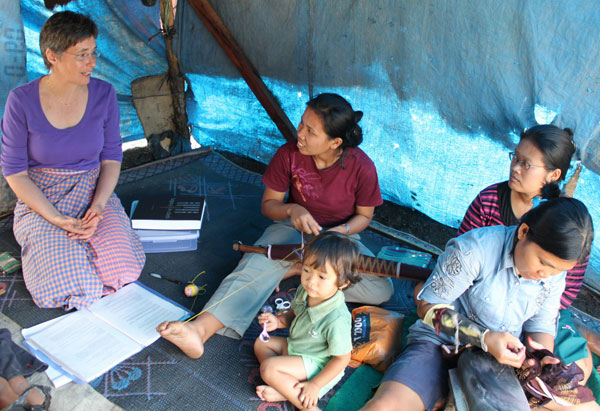

At first it felt a little like leading a seminar. I asked them to listen to me because I had an important message to share and then I explained that I was a student of their craft, that the results of my research were finished and that they, as practitioners, had a right to the final product. Passers-by started to gather at the doorway of the lean-to and those who had been there from the beginning quietly brought them up to date. It started to feel like a ritual and a happening.

I presented the book in the name of Sanggar Kreasi Batak because my primary contact with this New York group of immigrant Bataks is Wita Sitepu, a Karo woman. I told them a little about the group and explained the significance of the gift, not forgetting to let them know the price of the book and the need to care for it, but also to use it and enjoy it.

They were intrigued by the pages showing the different textile types and also the descriptions of the twining, immediately spotting the motifs that they were making. I told them that their techniques were very ancient and valuable and should be treasured. I read aloud the message that I had stamped on the first page, explaining the project and also the message from the donor, Sanggar Kreasi Batak. 


They explained that their group was a voluntary, horizontal one and did not have a leader, but one woman agreed to store the book in her home. She thanked me and presented me with a Karo textile. All of the women would have liked to have had the honour of storing the book. I wonder how they will share it in the coming days?

My only regret was that I couldn’t stay around longer as the fly on the wall to hear what they had to say when I was gone and how they will react to the book over time.  They were respectful, curious and interested but it was also clear that they didn’t quite know what to make of what had just happened to them. Time will tell.

They seemed pleased at the idea of teaching their techniques to the group of textile practitioners that I will be bringing to the Batak area next year. It will be a super opportunity to follow up and perhaps get more insight into the reception of the volume.

See Back to the Villages - the map!

Last Gasp

Kaban Jahe. For centuries, because of the market, this town has been a centre of indigo dyeing for the Karo Batak. I wanted to see what had become of this activity and give books to the dyers that I wrote about in Legacy. The first stop was the market. The textile proprietors would be able to give me their addresses.

I was warmly received, but was very sad to note that not a single indigo-dyed piece was available to purchase. Moreover, all of the blue pieces that I looked at had been woven in Tarutung for the Karo market and the quality was low. Nothing was reminiscent of the thick, sumptuous teba and julu textile types of the past.

Nande Pulung, the proprietors told me, was still dyeing yarn. Jalan Irian, they said, in front of the SMA RK. It wasn’t far away, but Nande Pulung was in Medan attending to a sick child. Her neighbour, Nande Indra, who used to come over and assist with the dyeing, had become a market seller, they told me at Nande Pulung’s house, so off we went back to the market to hunt for her.

I found her sitting quietly and alone in her stall. I handed her the laminated page of Legacy in which she is depicted (p. 129) and sat down with her. 


 Nande Indra in her market stall at Kaban Jahe, June 2010

She tried to recall that moment 24 years ago and reminisced about the textile that she had that day on her head. It had been her mother’s and was from Aceh.

Nande Indra and Nande Pulung, Karo dyers, 1986.  Fig SR 3.8 Page 129 Legacy in cloth

What she told me amounts to the story about the last gasp of indigo dyeing in the Karo area: she had stopped working with Nande Pulung long ago; Nande Pulung had stopped dyeing with natural indigo ten to fifteen years ago; she didn’t know if Nande Peringitten was still alive; the elderly woman in Kampong Kwala near Tiga Binanga had passed away; there was nobody left in Karo who worked with natural dyes, and the people in Kampong Tanjung had ceased to cultivate tajem, their indigo plant. The tradition was dead.

This is a momentous fact. The Karo, the “blue Batak” had once been renowned for their indigo dyeing and had provided for needs all the way to Si Tolu Huta (Tongging, Silalahi and Paropo). They were the only Batak to practice plangi and tritik because they wanted to decorate the imported white cotton that they dyed blue. I think that they were also the only Batak to cultivate the indigo plant. (According to my information the Toba tradition harvested a wild salaon growing on the hillsides.)

Decline set in early in the twentieth century. Sitting there in the market, talking with Nande Indra, it was beginning to sink in. The Karo dyers whom I met while researching Legacy: Nande Pulung, Nande Indra and Nande Peringitten in Kaban Jahe and the elderly weaver in Kampong Kwala, were the last ones in this great tradition. And it had slipped away, not with a bang but a whimper!

Nande Pulung was the only dyer left in Kaban Jahe and she now worked strictly with chemical dyes. I have a book ready to give to her as soon as she returns from Medan. For her, I selected the message from donor Tim Babcock who emphasized the importance of passing on knowledge to the younger generation:

Batak weavings give immense pleasure not only to people in
Indonesia but also to textile lovers all over the world. Please
keep dyeing beautiful high quality ulos as long as you are
able, and pass your skills on to as many of the younger
generation as you can!


I will ask her if she is willing to demonstrate indigo for the Dutch weavers whom I will bring with me next year to the Batak area to learn about the Batak traditions. Clearly, only a financial incentive can revive this tradition.


See Back to the Villages - the map!