Sunday, June 27, 2010

Dilepaskan

Immediately upon arriving in Medan yesterday (June 26), I grabbed a flight to Banda Aceh to visit a dear friend whom I met and often stayed with in Medan in 1986. I would come back from the villages tired, often sick, worn out psychically. She would patch me up and when I was ready, I would go back again. Yesterday, she commented that I didn’t appear to be thin and worn out and indeed I am not, but she is definitely patching me up again.

In the evening, we spent hours at her home going though the photographs that Mas Nashir had taken during the past week and I shared many stories with her. This morning, I feel as though all the emotions stored up during the past month of intensive travels and meetings are pouring out.

My friend asked me yesterday if there was anyone with whom I could share the pain of the loss of Batak culture and weaving in particular. Her question stands out in my mind. It reminded me immediately of the need of environmentalists to accommodate the deep and very unique pain of loss of quality in the physical world. As usual, she has made an astute diagnosis. And I am intuitively convinced that environmental and cultural pain are close twins.

My journey back to the villages has been undertaken at a very special time. Many of the people whom I wanted to meet are still alive but most of them represent the end of the Batak weaving tradition. Either they have stopped weaving and dyeing, or they have nobody to continue their trade when they are gone. Throughout the past month, I have been trying to come to grips with this. What has changed? Why is this happening? Is a recovery possible or is it too late? What would a recovery look like? What are the avenues available? What will the future hold? Am I really seeing the end of it all?

I know that my journey back to the villages has been historically significant. I am grateful to Mas Nashir more than I can ever express for documenting the journey in images. That he understood. That I could share it with him. It feels too big. My distress would have been so much greater had I gone back to the villages alone; I would not have been able to share it with anyone.

I think of the anthropological reports and stories that I have read about the last representatives of Indian tribes. What did those singular, last members feel? How did they cope with their awareness?
 

I think of the weaver, Ompu Okta, Tihar Sitorus, that I met in Lumban Lombu. The fellow weavers in her village had already passed away. Her children did not learn her craft. She wove, all alone in her home. When she is gone, there will be nobody left there who weaves. She put her hand in mine while we walked to the exit of her village and we paused in front of the ancient Batak house on stilts, the only one in the village with gorga (painted, etched wood). Her parents had lived there and she had grown up there. We stood there and looked at the house and when I looked down at her, I saw that she was close to tears. How was she coping with the loss? “It is painful, isn’t it?”  I said to her. “Yes,” she said, “It hurts.” She is known for the excellence and beauty of her work.


 When we went back to visit her the next day, she asked me if I would like to sit in her loom. She showed me how she did putik, the counting out and division of the warp to make a throw of supplementary weft. My clumsiness was apparent to us all, but that wasn’t the essence of it. The essence was her longing to share her knowledge with someone. When we talked about the issue, I know that she hoped that I would be able to do something about reviving the art of Batak weaving.


The last weaver in the village
Ompu Okta making the end field of the Pinunsaan. The sticks in the warp are all shed-savers.

Before our departure to the villages, Mas Nashir had introduced me to his friends, Irwansyah Harahap and Ritha Hutajulu, ethnomusicologists who teach at the University of North Sumatra. Ritha told me of their struggle – because it is a struggle against time – to gather indigenous melodies and instruments, to record performances of indigenous Batak music. In far too many of the cases, they were speaking with the last performers, singular persons, most of them old, who represent the end of the tradition. I did not know, at the time, that my findings in the area of weaving would be so parallel (although it makes sense; clearly, denial was easier to cope with). I do know that this time, walking through the rice fields, and when I went to sleep at night, there was no throb of the gondang (Batak ritual percussion orchestra) to accompany me in that mysterious way that I had accepted just as a matter of course twenty years ago. There is only the sound of vehicular traffic, in its own way a kind of deafening stillness. In many respects, the regions I visited are materially better off, but I saw that they had become culturally deeply, perhaps irrevocable, impoverished.

Back to my friend’s question: with whom can the pain of all of this be shared? In a sense, I share it with everybody because we are all living this moment. In another sense, it can only be shared if it has been given a name and its dimensions have been sketched. I can share it with Irwansyah, Ritha, Nashir and my Batak weaver friends.

Uppermost for me have been other questions. The elderly weavers tell me that young people have no interest in learning to weave and that the youth claims to have no capacity to do so. The weaver in Lumban Lombu diagnosed it by saying that they had no depth of concentration, were only interested in communicating by telephone and rushing around from here to there. The quality of time and concentration is different. Weaving requires intense focus and long periods of relative quiet. It is difficult work and you have to keep your wits about you. It is almost meditative; it is rhythmic; it requires patience; it reforms the physical body. I think of advertisements on the television and how they encourage human capacities that are exactly the inverse of those needed to be able to weave. I wonder what an advertisement would look like that would encourage people to love and enact their culture, and weaving in particular?

I know that if I were to learn to weave now, at my grand old age of 55, I would never gain the physical skill of someone who had learned to work with yarn at the same time as they were learning to walk and talk. That physicality of weaving is lost within one generation. Batak weaving is at least 4,000 years old, but life today is demonstrating that it only takes the gap of one generation for it to disappear. It needs to be inculcated, integrated, woven together with daily life starting at an early age. This fact means that the Batak weaving tradition is dead. Henceforth, people interested and skilled in weaving will be able to manipulate Batak looms and make Batak textile patterns, but they will not be Batak weavers in the sense of continuing the tradition. They will be weavers who accommodate, in some ways, the Batak tradition.


 My weaver in Lumban Lombu repeatedly said that she was happy with our visit. She had a moment of optimism, proudly displaying the “diploma” that she had received acknowledging her expertise at a weaving demonstration in Medan. She pulled out the beautiful textiles that her mother had woven and was delighted to have them admired (she wanted me to put pictures of them in my book). It was a magical moment. How grateful I am to have experienced these moments. But the weight of them is heavy. I have been entrusted.

See Back to the Villages - the map!

Saturday, June 26, 2010

The Last Day of the Project


I made it back to the Karo dyers on the eleventh hour: the last day of the Back to the Villages project (June 26). Back to where the project had begun.
Nande Pulung was at home preparing to go to a pesta (ritual) so she and her husband were dressed in their finery. The large sitting room was empty except for a few chairs and several large sacks. During the course of our visit, someone came to bring Nande Pulung some ikat-tied yarn to dye and she stuffed it in one of the sacks. The other sacks, as it turned out, were filled with dyed yarn.

She explained that it was no longer possible to work with natural dyestuffs (i.e. indigo). The village that had provided the tajem (indigo plant) had decided to use the land to cultivate truck crops. (I often say that in the Karo area the onions are the reason for the decline in textiles.) Even when I asked if I could order indigo–dyed yarn and pay for it well, even if I supplied the indigo, she claimed that she would not be able to fill the order because “the materials were not available.” It was unclear which materials these might be.

She remembered me, my thank-you letter to her from 24 years ago and everything we did during my visit. She seemed happy and thankful for this follow-up visit and looked long and hard at the photograph of the giver, Tim Babcock (who encouraged her to pass on her skills; see blog Last Gasp).  Her husband read Tim’s message aloud in Indonesian and then explained it to her in Karo Batak.


She and her husband also closely examined the photograph that I had brought with me of a rare Karo textile in the Tom Murray collection, but she did not recognize it. She identified the ikat as bayubayu dua lapis and the stripes as kayuna, but could not assign a specific name to the cloth. She told me to visit the owner of the ATBM workshop (with semi-mechanical looms) close by as he wanted to revive old patterns. In addition to the weaving that he does, he dyes ikat patterns in yarn.

We went off to visit him immediately but he was not at home. We gave a copy of the book to one of his employees and his sister. Of course, I had mixed feelings about this presentation because my intent has always been to give the book to weavers (they referred to the backstrap loom technique using the word gedogan), but I gave the gift deliberately and with resolve, hoping that Helmy de Korver, the donor of the book, would support my choice. I assumed that the owner of this little factory was a textile enthusiast because of his reputation for trying to revive old patterns. The chances are good that he will value the catalogue portion of the book. He could well be someone who, if he has enough capital, will conduct textile experiments that can usher the craft into the future. (Oil companies, for instance, are at the forefront of research in solar energy. May that represent a parallel!) This is a time of planting experimental seeds. I hope to visit him again in the future to see if this seed has fallen on fertile ground. [I am now at home in The Netherlands before this blog has been posted. I came home to a gratifying thank you note from Mr. Tambun on my email!]


The presentation to the ATBM workshop owned by Ir. S. Tambun in Kaban Jahe. His sister is looking at the photos that I brought of Tom Murray's  unusual textile. Nobody had ever seen that textile before -- but they knew that they could replicate it!

From there we went to Nande Peringitten’s house. It had not changed at all and although Nande Peringitten died 15 years ago, two of the young people in the photograph with her were still living there (her grandson and daughter-in-law). Her daughter-in-law (Mamak Eka) had taken over the business -- except for the indigo dye component. Her explanation corroborated Nande Pulung’s and Nande Indra’s story: this dye technique was just not viable anymore. Moreover, Mamak Eka had to supplement her income by raising pigs, just as Nande Peringitten had done. I presented a book to her in the name of my friend, Heather Wilson, and asked her to show it to as many people as possible. Nande Peringitten’s descendants shared the general regret that indigo was no longer used, explaining that the natural dye yielded much more beautiful results than the synthetic dye.

Giving the book to Mama Eka, Nande Peringitten's daughter-in-law

From there, we returned to the market to meet up with Nande Indra to whom I had promised a book a few weeks earlier (see blog Last Gasp). Unfortunately, she had gone to the same pesta (ritual event) as Nande Pulung. Her granddaughter in her market stall explained that she had never received my telephone message that I would not be able to visit that evening a few weeks before and she had waited up for me until deep in the night. She was terribly disappointed when I didn’t show up. I was pleased to be able to alleviate that disappointment by handing over a copy of the book in the name of Pamela Cross – a textile lover who is very faithful and punctual and almost never disappoints anyone by failing to live up to her promises.

See Back to the Villages - the map!

Wednesday, June 23, 2010

Student Needs


Occasionally, I receive requests for my books by email from Indonesian students. I know that I have received at least one such request from someone at the Universitas Si Singamangaraja near Si Borongborong. I decided, therefore, to grab this opportunity to bestow a copy of Legacy in cloth on that University for their library.

On June 23, we stopped the car at a wing of offices and I transferred the book very quickly and unceremoniously (it was late and we were still far from our destination of Parapat) to a certain boru Si Aloha from Parbaba on Samosir Island who agreed to give it to the library – and also to send me a receipt by email. 


There is a tremendous hunger here for information and an equally tremendous lack of means to acquire it. This had been impressed on me strongly in Muara (on June 22) when my presentation to Ompu Josua (one of the weavers on the two-page spread in the front of Legacy; see blog The Muara weavers in the opening photo) had become engulfed by students from the Tourism School (SMK Negeri I Muara) next door.  


As soon as the little ceremony with Ompu Josua was completed, one of the teachers cornered me and asked for a book for the school. I could hardly refuse! What an opportunity to bring the importance of weaving to the attention of a large group of young people. Studying tourism, they could integrate the revival of the weaving arts with the potentials that tourism offers. I made the presentation in the name of the Indonesian Heritage Society. 


It all led to the delivery of a little speech to the school in the front yard, many photographs and requests for autographs (little wonder; the school principal had compared me to the authors of The Lord of the Rings and Harry Potter!)


Later, by chance, we had lunch in the same little restaurant where the principal, Mr. Silalahi, was eating. He impressed upon us, over and over again, the need for reading materials and support of all kinds, and if we would please help his students and his school. It culminated in a plan between him and Mas Nashir to make an exhibition of the photographs of the presentation to the school – and perhaps of the Back to the Villages project in general.

It is also resulting in this plea: if any readers of this blog would like to assist, one of the girls in the school, exceptionally bright and speaking the best English of them all, came up to me to say that her parents could not afford her school fees. The principal explained that she would only be able to continue if she received external assistance. She broke my heart. School fees, given the differentials in wealth and currency between North and South, represent a very small financial investment with gigantic potential returns.


See Back to the Villages - the map!

For a day...

For a day, Linda and I were together again. We sat in the back of my comfortable rental vehicle, the photographer and chauffeur in the front. Linda quietly and calmly gave directions: Left! Right! In this village!

We looked at each other and laughed. “We used to go everywhere on foot,” Linda said, “Or we took a local bus crowded with pigs, chickens and everything else.” In 1986, getting around was hot, time-consuming and arduous. “Look at us now! Middle-aged women!”


Linda is married, has five children, a restaurant and a clothing business; I am going grey and am just not as agile as I used to be. The vicinity of Tarutung has also changed: there are better roads going everywhere. We covered a lot of ground in just a few hours, visiting twiners in Sait ni Huta, three weavers in Hutagalung, descendants of Ompu Si Tohap in Parbubu and a stall proprietor in the market to deliver copies of Legacy. Linda knew all the places and the people; she had guided me there before.

Many of the recipients were members of Linda’s immediate or extended family. Just as she made our travels today efficient, focused and smooth, her influence is inscribed indirectly but profoundly on the pages of
Legacy.

But Linda has changed. When she assisted me in 1986, she was young and inexperienced; her world was small and close by. Our travels together introduced her to new regions and provided her with new insights into how the world works. After I left, she set up her own business, “Linda Ulos” and built extensive contacts throughout the Valley and in Medan, the capital city. One of them became her life’s partner and together they have built a strong wholesale business. Today, Linda was quiet, self-confident, poised and in possession of an enviable store of knowledge about Batak weaving.

It gave me such a delicious feeling. Doing the rounds with her today, I rediscovered how it was, 24 years ago, to be able to rely on her. The feeling has become so much richer through our friendship which has grown through the past decades.


See Back to the Villages - the map!

Tuesday, June 22, 2010

The Muara weavers in the opening photo


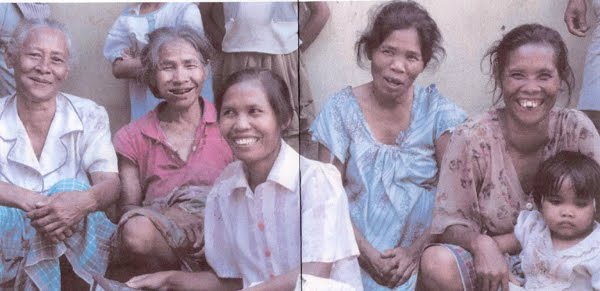
One of the opening photographs of Legacy is a two-page spread depicting a smiling group of weavers in the bay of Muara in the southwest corner of Lake Toba. One of my main goals on the 22nd of June was to find those women.

The spirits of Toba guided our search. Our chauffeur, Pak Jerry, decided spontaneously (after my search had been fruitless) to ask a young man walking down the road if he recognized any of the women in the photograph. The young man was inscrutable at first, pointing out that two of the women were deceased. It took him awhile to divulge that one of them was his mother and that she was working in the ladang (on the land). Later the young man repeatedly noted how lucky our meeting had been as he was generally working in the garden himself at the time that we met him.

The garden was far away and he agreed to climb into our vehicle to guide us to his mother. Her peels of laughter when we found her reminded me of that merry day, 24 years ago with my friend Erna Lohuis, when the photograph was taken.

We crouched on the side of the road and I explained the book and the Back to the Villages Project and presented her with a copy. Ompu Josua received it proudly. When the school next door requested a book for their library, we insisted that Ompu Josua be present for the group photograph to acknowledge the ancient weaving heritage that her skills represent. As Mas Nashir put it, she is a cultural hero. For me, this was an important and symbolic moment as I notice repeatedly how much culture is being lost in the struggle to make ends meet and to march to the drum of external cultural influences. The struggle – there is no better word for it – to survive and get ahead in the current social and economic climate entails the excruciating irony of disregarding and coring out that which is ancient, valuable and beautiful in the people’s own culture. We do not live in a time when school children are proud to say that their mother is a weaver and weaving is not a goal to which a school child aspires. It even felt somewhat subversive to make a Batak weaver a centerpiece in a photograph of a school, but it was time! I had given the book in the name of Wendela ter Horst, a dear
socially progressive friend in Oosterbeek who makes no bones about battling “the system” when she feels that injustices need to be corrected.

The young man who guided us to his mother, then took us to his neighbour, another of the women depicted: Mutiara, br. Pandiangan. She was covered in mud and working in the fields. She and her husband climbed into our vehicle and we joined them in their house for a cup of coffee. She showed us some of her old textiles and the harungguan that she was making. 


Pamela's weaver, Mutiara br. Paniangan, Ny. Siregar, making a harungguan

Near the end of our visit, the weaver’s husband asked if I couldn’t assist in some way to revive the Batak weaving arts. I told him that this was one of my long-term goals and that I would do my best to contact them again in the future. The weaver is a very talented and bright woman. She knows how to make indigo dye from the local salaon plant and longs for the opportunity to weave textiles of integrity rather than just to earn a pitiful few cents on the market.

I was pleased to have made this presentation of
Legacy courtesy of Pamela Cross. Pamela has been so terribly supportive of both Legacy and this project that she deserved a recipient in that wonderful opening photograph in the book. Furthermore, Muara has ancient ties with the Silindung Valley with which Pamela also has strong ties. And finally, the hint of a future for Batak weaving, through this talented weaver promises to give her gift longevity. I hope that she may one day meet the recipient of her generous gift.

Another of the women in the photograph lived close by, but was unavailable just then, so we gave her the book through her daughter-in-law, courtesy the Soroptimists of Arhem. 


Before leaving Muara, I wanted to give one more book to a group of active weavers. I found them by calling Torang Sitorus (see blog: Didn’t Pay? It was costing money!) who had expressed the hope that indigo-dyeing could be revived in that part of Toba. It also turned out to be a village that I had contacted in the past: Huta Simatalo II. Two women were weaving the very long surisuri textile and the whole village came out for the presentation – courtesy Museum Volkenkunde in Leiden.


I could not have hoped or imagined that more interest could have been expressed in the book.  Such a moment, sitting on a mat with the entire village, talking about the results of my 30 years of work…I must not dwell on this as it is too overwhelming.


See Back to the Villages - the map!

Monday, June 21, 2010

"When I am gone..."

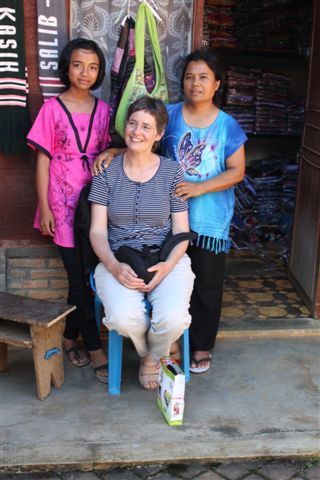
Ompu Borsak’s son lived in a large, quiet house (if quiet exists at all in Pangururan). We were given a seat in the entrance of the house, especially designated for receiving guests, and I told him my story about Legacy, but especially about his mother, how she had taught me that Batak women tied their hair in a knot on the side of the head and not at the back, and about the kinds of earrings women used to wear. She lived facing the remarkable sopo or rice barn that somehow had escaped the raging fires that the Dutch kindled during Van Daalen's expeditions in 1906. She told me about the raja class and I recognized the truth in her words from my readings about Batak culture. “Your mother is very halus(a refined lady) I told her son and this touched him. He beamed. He was pleased to receive the book in the name of his mother and his sister and would take it to them. I explained that the book was intended to give the Batak an insight into their weaving tradition and that I hoped that they would show it to as many people as possible. I gave the book in the name of the Soroptimists in Arnhem.


The next stop was Simbolon in the Kacamatan Palipi on Samosir Island. I had been told that weaving there had ceased but I wanted to check whether there were still some weavers working with indigo dye.  We pulled up beside the white scar on the side of the road, where hot water bubbles out of the depths of the island and the smell of sulphur fills the air. One of the renters of the baths turned out to be a woman of highly advanced years. When I asked her if there were any weavers around, she answered in the affirmative and asked me what I wanted. She was prepared to make anything I wanted but she warned me that it would be expensive. She said that she had stopped cultivating salaon, the plant that yields the indigo dye, and that she hadn’t used her weaving equipment for a long time. This was the region that had specialized in making the three blue textiles central to Batak ritual and daily life: the sibolang, surisuri and bolean.

I suddenly remembered Boru Hite -- in Mogang, I believe, a place a little further down the road -- from whom in 1986, I had purchased a beautiful sibolang of the same quality as those made a century earlier. She sat beside a bag of indigo-dyed yarn. “This is the last of my yarn,” she had said. “When this is used up, I will stop weaving.” Now I was meeting another who had stopped weaving. The reason was the same: it didn’t make economic sense. She now invested her efforts in selling oil, gardening and renting the hot water baths. I write on a patio in a Muara Hotel, looking out over Lake Toba. I love the tranquillity, watching the paddlers guide their dug-out canoes across the surface of the water. It is idyllic and beautiful and why can’t it continue for ever, but the reality is that even the paddlers have to eat.

Several kilometers further, in Simbolon, Kec. Palipi, I stopped again to ask if there were weavers and was pointed in the direction of a village on the lake, and later to a house where another woman of highly advanced years was living: Ompu Nerda br. Marbun. In response to my question, she pulled out her loom, a bundle of sticks bound together and laced with dust and spider's webs. “This is my loom,” she said, “I don’t use it anymore.” Her textiles included an indigo-dyed bolean with brightly-coloured and gold supplementary-weft patterning. “This is for my family when I am gone,” she said.

I chose to present her with a copy of Legacy to honour her work. She was the first to see the irony in the gift. “I am 90 years old,” she said. And then to her daughter-in-law, “This will soon be yours.” There was nobody in her village who could weave and nobody who was carrying on the tradition. Her daughter-in-law pointed out that weaving was far too difficult and didn’t pay anyway. 


I gave the book away in the name of Ria Tobing in The Netherlands, someone who has supported the publication and marketing of Legacy in many ways and did translations for me for the Back to the Villages project.


See Back to the Villages - the map!
The longest day...

The plan was to head out from Pusuk Buhit to find Ompu Borsak’s son in Pangururan and gradually make our way south to Nainggolan at the southern tip of Samosir Island (across from Balige) and then to return to Pangururan and the land bridge to the mainland and head south to arrive in Muara, a bay west of Balige.

We accomplished that. However, the route was different than expected. From Nainggolan we drove back to Tomok (taking the long route over Pangururan because the road on the shorter trek is apparently bad) and from Tomok, taking the ferry back to Parapat and heading to Muara on the trans-Sumatra highway – again because the road from Pangururan to Muara is apparently bad. In both cases, we took the longer but apparently faster way. I am deeply sorry to not have been able to have seen all the landscapes. I promised myself to take a boat in the future. How much more pleasant the journey would have been in a boat!  Just as in the old days when the great dug-out canoes transported the Batak and their market wares criss cross over the lake. (Large  market boats still sail, but they are too slow for my current purposes.)

However, the spirits of Toba were once again guiding our day. In Balige, we had to make an unexpected stop at my old haunt, the nurse’s residence, which was my pied-a-terre in 1979-80. My photographer had developed such a severe toothache that he needed medical attention. Luckily we were in Balige when he announced that he needed care and the town played the same role as it had played for me in the past, offering care and guidance. My thoughts went back to Nuria Gultom, Ibu Hutabarat, in my day the heads of the residence and the nurses’s training; to Dr. Westerhausen, the kind Germany doctor then in residence. (As the fates have willed it, she phoned me unexpectedly just before my departure to Indonesia because she had purchased a copy of Legacy. The book keeps bringing me in touch with my past.)  My mind also went back to my attack of dysentery, and other medical issues that occasionally brought me back by boat from Harian Boho to Balige. My debt to the hospital in Balige is huge – and continues to grow! In no time, Mas Nashir had visited the hospital’s dentist and had a handful of medicine. We had dinner in Balige and pushed on in the dark to make our destination.

From the turn-off to Muara, the road has been immensely improved and although it was dark, the journey was not too harrowing. Our hotel is new and comfortable. I am hopeful that Mas Nashir will be recovered enough to be able to perform today with his regular spirit and energy.

(Ah! A text message from Mas Nashir. He is up and about, fresh from a good night’s sleep, taking photographs of the sunrise downstairs! Once again, our hotel is on the edge of the great lake.)

Yesterday, our day was long and successful, but I only disposed of 4 books and I would have liked to have had occasion to give more away. More about those gifts anon.

Today, we hope to find the women in the opening photograph in Legacy, the ones with the happy faces. Yesterday, we visited the market in Nainggolan and I saw several textiles there from Muara, so I know there is still active weaving here. Hopefully, we will be able to fill our goals here, if the spirits of Toba are willing.


Pages 10, 11 - fig. Acknowledgements 2 Weavers in Muara. 1986.